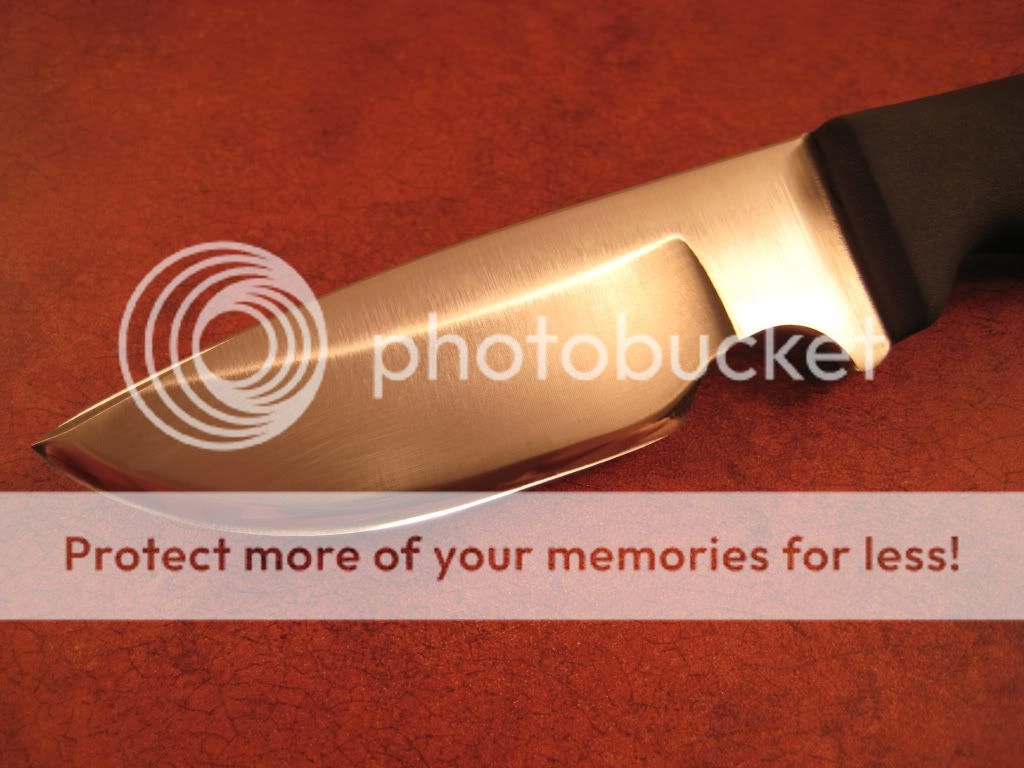
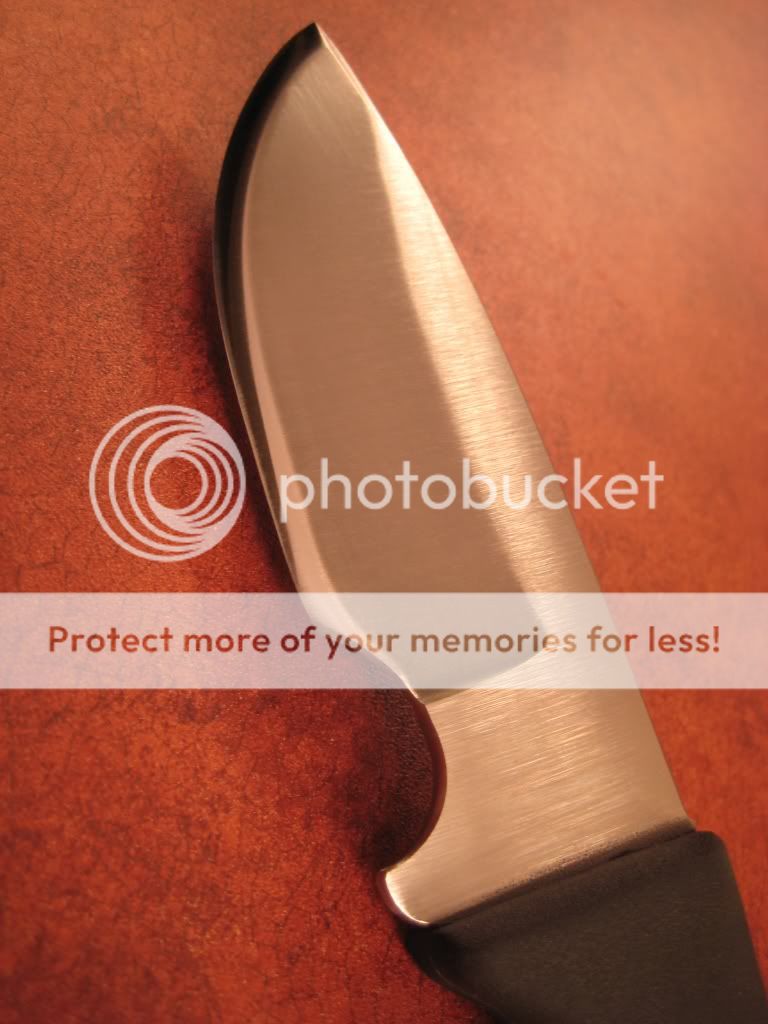
How do you guys sharpen your BAD's

Yes, Don't do it... Unless your planing to make to it convex, which it isn't now.

You will knock off the bevels that way(sandpaper on pad)


Use stones, Sharpmaker(its great, but can dull tip a bit), edgepro or something designed for a standard edge.
Then after sharp strop on leather, or steel knife to polish up the edge.


edit- try a leather strop(with compond if you have it) first before you remove any steel. Sometimes that edge may just need polishing, not sharpening. Cardborad on a box edge will also work, but won't polish the edge as good as leather.
Yeah, don't do the mousepad trick on a non-convex edge. Use the Spyderco Sharpmaker or diamond stones. (DMT is great)
 
On knives that come with a decent edge, like the BAD, I use only a strop loaded with green compound. Takes some time but using leather, first with compound snd then without polishes and leaves a hair whittling edge.
I have found that the best way to test an edge is with cigarette paper. If my knife can push cut cigarette rolling paper with no snags then I'm a happy infiholic
 
Yes, Don't do it... Unless your planing to make to it convex, which it isn't now.

You will knock off the bevels that way(sandpaper on pad)

Now I'm really confused. I though the BAD had a convex edge. Is it just a regular flat grind? If so what angle is it.
 
Now I'm really confused. I though the BAD had a convex edge. Is it just a regular flat grind? If so what angle is it.

The BAD's have a standard edge, not convex, and yes they are a flat ground blade.
I havn't check'ed mine, but would think it was around 30 degree's(Havn't used mine or looked at in a while..maybe a bit more...prob 17 to 18 per side, I do remember it looking thinner than most). If I do use it and dull it, I'll go with 40 degree(20 a side).


edit- here's the link Jerry first put up
http://www.bladeforums.com/forums/showthread.php?t=553153
 
Last edited:
The BAD's have a standard edge, not convex, and yes they are a flat ground blade.
I havn't check'ed mine, but would think it was around 30 degree's..15 for each side.

News to me, I took it for granted that it was convex like most other Busse's. I apologize for the misinformation I gave yesterday ;). You can still touch up your knives on sandpaper....though I'd recommend the stall or workout floor rubber for a backer. It's basically like a very large stone...that's mirror fine grit wise. I sharpen all my knives that way....unless I get lazy and use ceramics for a quick touch up. I like the AG russel ones more than the spyderco. The round sticks do all blade shapes.
 
Fudge, guys. Who's BAD has needed sharpening so far. With the uber-sharp edge and hard heat-treat, I'm surprised anyone's needed it yet.

This isn't a knife to take down a Georgia Live Oak.

Dennis - congrats if you received a Busse that you consider sharp. In all fairness, sharp is a relative term. I don't own a Bad, but I have probably owned about 70-80 Busse and kin knives over the years and have only recieved about 10-15 that would make moderately decent slice cuts in regular paper. Most have a lot of drag or tear quite a bit.

NONE would fit my definition of sharp..... let alone "Uber-sharp". Also, heat-treat or not, Busse blades will need sharpening if "Used". INFI is incredible steel - NO DOUBT. But, it isn't that "Magical". It still gets dull and needs sharpening. For that matter, while INFI has very good edge holding properties, there are steels that will hold an edge even longer than INFI. They just aren't as tough as INFI.

But, I am sorry, Busse factory edges (on average) aren't very good IMO. As a rule, it seems any Busse I have needs significant edge reprofiliing and sharpening. But, that is my opinion. And I concede that Busse factory edges have been random.
Some are horrible and some are... not as horrible.

I like my knives VERY sharp and to cut well. Kinda-Sorta sharp doesn't cut it for me.

Also, what does "taking down a Georgia Live Oak" have to do with a knives sharpness or needing to be sharpened?

It sounds like you are saying: "Since you aren't taking down a Georgia Live Oak, you knife doesn't need to be "that" sharp".... ???? :confused:

I would argue that any and every knife should be sharp whether taking down a tree or cutting thread. I PARTICULARLY like my smaller knives to be "HAIR-SKINNING" sharp / push cut through thin paper sharp.

To me, the Bad should be sharpened to be "Optimized" as a "Slicer" - slick smooth cutting. :thumbup:


---


Stage,

You are getting a LOT of different information. Sorry... I am sure it can be frustrating along with confusing. But, in all fairness, there is no "One" way to sharpen a knife.

I think a lot of people use a way they are most comfortable with. Or if they get the hang of doing something a certain way and get good results, they tend to like continuing with that method.


Ken - could you define "standard edge"?

Yes, the Bad's have a FLAT "Primary" grind. But, most Busse and kin knives I have ever seen appear to be sharpened on a (very coarse grit) belt sander of some degree and always appear to have some degree of convexing to me. Keep in mind, the amount of convexing in the blade can be determined by a few different ways and can vary a lot from very convexed to almost flat. The thinner the edge profile, the harder it can be to notice a convex edge. I don't have a Bad. But, every Busse and kin knife I have owned (many) has had some type of apparently hand applied convex "edge". (***Not to be confused with full convex grind.)

In any event (Stage), a more relevant question should be: "What type of edge profile do you want?"

Whether a blade edge has a flat grind or convex, either can be changed.

I would say if you intend to use a Sharpening "Jig" for all of your sharpening, then get and/or keep the edge flat.

If you plan on using stones, you will probably have random edge profiles.

If you plan to use a belt sander and/or strop, a convex edge is what you are usually working with.

If you plan on using this knife much, I would recommend to considering the edge profile and other aspects of the blade that affect cutting performance as much as the very tip of the knifes edge.

Edge sharpness is one issue. But, a proper edge profile is a HUGE part of how well a knife will cut in most cases.

If you are just shaving hairs off your arm, only the very tip of the edge matters - less than 1/100" of the edge. But, most cutting involves more of the blade cutting/slicing through the material being cut. Edge profile becomes much more important with certain materials.

The pictures of the Bad's appear to have a very thin cutting edge (by Busse standards). Most Busse edges are very thick and very obtuse. Thick obtuse edges can be made to shave hairs, but still not good at slice cutting or most cutting for that matter.

If you want a flat edge, use a good jig like Sharpmaker, EdgePro or EzeSharp. All of the jigs can put a shaving edge on a blade. It is just a matter of "Time" and having worthwhile stones! Matching the angle is important. Using a marker on the edge to see what is abraded off is a good trick to help determine angles. I find that placement of the knife in the jig and different angles is a PIA. Every time you want to sharpen a knife, you have to figure out the angle, jig set-up and even then the jig will be inconsistent depending on where you clamp the blade.

If you want convex, I personally believe a belt sander method to be easily the best. It is WAY faster than any other method (*** Once you get the hang of it!) And WAY easier once you get over the initial learning curve. Having the right belts is also VERY relevant - just like having the right stones. But, worthy and proper belts are WAY cheaper than worthy stones.

I have tried stones and some of the finest "Jigs" on the market.

However, I am SOLD on convex edges and sharpening with a belt sander.

A flat edge tends to leave a "shoulder" - transition between edge and primary grind. If you cut "through" any material that goes over the shoulder, the shoulder creates friction and drag.
A "full" convex grind doesn't have any shoulder at all. But, even a good convex edge blended into a flat primary grind is VERY good and sufficient. It comes down to how well the two grinds are blended together.

Coatings cause drag in many cases...... - at least in most cases "IF" a knife is used to actually cut through stuff. ;) - Cutting through most any food or meat would be a good example. Popping hairs off your arm is not.

I agree with mfaster7 that testing on paper is more relevant to me than whether an edge can shave. Shaving hairs isn't that hard and not an indication of a blade being able to cut the way I want a knife to cut.

----------

Like any other sharpening method, there is a learning curve and a little investment up front. But, you can buy a $40 Harbor Freight or Delta 1"x30" belt sander and spend a few bucks on some belts and still pay WAY less than the cost of "quality" stones or reputible sharpening Jigs. So, I would argue the investment for a Belt Sander is low by comparison.
For example, many decent water stones can cost $75 - $125 each!!! and you tend to need quite a few different grits to cover a range of sharpening needs.

*** You could upgrade to a much nicer Delta 1"x42" belt sander (much nicer than Delta's or Harber Freights 1"x36") or a Kalamazoo belt sander for less than paying for a decent variety of grits in water stones.

*** But, even a 1"x36" cheap sander will do a LOT!

I prefer a good strop to the cost of water stones. And personally, I like the results and feel of using a good strop with compound over stones. You can have a "Good" belt sander, good belts, a good strop and compounds for less than many decent jigs with proper stones or decent variety of water stones.

I would argue the learning curve is about the same. **** BUT, sharpening or doing ANYTHING with a belt sander is WAY faster than doing it by hand - regardless of what method by hand (stones, jigs, strop, etc.)
**** So, especially at first, caution should be used to make sure you don't damage your blades. If not careful, you can seriously and quickly re-shape your blade or damage the heat treatment.
So, if using a belt sander, practice on some cheap blades first. And try to keep blade edges cool to the touch. Keep a Water-Dunk nearby. A dunk in luke-warm water will cool the blade very quickly. Whereas, without water, the blade will hold heat for many seconds to a minute plus.
My rule of thumb, again, is keep my blades cool enough to hold against my skin comfortably.

Since I personally like convex edges and using a belt sander, I will provide info for what I consider the best method. (*Not saying other methods are wrong or can't provide good edges. ;) ) But, once you get the hang of using a belt sander, not only will you likely never go back, but you will probably also start modifying and improving a lot of your knives in other ways as well. :thumbup:

Check the following links for some good info:

http://www.knifeforums.com/forums/showtopic.php?tid/776367/


* Same Post by Jerry Hossom, but on a different forum and with different feedback:
http://www.jerzeedevil.com/forums/showthread.php?t=18391


This one is long-winded, but with lots of info and more good links:
http://www.scrapyardknives.com/ubbthreads/showflat.php?Cat=0&Board=Knives&Number=183198&page=4&fpart=1


My favorite video - simple tutorial by J. Nielson:

http://www.youtube.com/watch?v=TLjFjT4vYsM


Some longer, but "Excellent" belt sharpening videos by Brian here:

http://backyardbushman.com/?page_id=68


You can get a "Mirror" edge on any knife with any different method. I just comes down to having proper abrasive grits. The most time efficient way (regardless of method/technique) is going to be to use stages of finer and finer grits. If you do it by hand, using staged grits is even more important because each consecutive grit has to remove the scratches from the previous grit. If you skip too far ahead in grits, a grit that is too fine will have a VERY hard time removing the deeper scratches.

By hand, this can take hours.
With a belt sander - minutes.

The following knife was sharpened entirely with a belt sander (cleaned up, satin finished, profiled, etc. all with belt sander) and it was done entirely with two belts - 80 & 120 grit (** Cheater tip - the back mesh side of 120 grit with compound was used as 3rd "grit" option, but still 2 belts. ;)). Anyway the results are good/decent - WAY better than factory. That blade will easily push cut through newspaper or magazine pages. Shaving is smooth. :thumbup:
With proper belts and grits, it can be done way more efficiently and even more mirror finish.:

SwampRat-HowlingRat-Improvedbladea.jpg


SwampRat-HowlingRat-Improvedbladeb.jpg


SwampRat-HowlingRat-Improvedbladec.jpg


--------------------

Stropping is a great way to put a final touch on a knife or maintain and already sharp edge. I can easily and quickly get a knife to make hairs pop right off with just a belt-sander and proper grits, belts, compounds. But, a good strop system is great to have.

Here is a good tutorial on how to strop from Reid Hyken (Sharpshooter) - CONVEX SHARPENING THE BRKCA WAY:

http://www.barkriverknives.com/convex.htm

.

 
News to me, I took it for granted that it was convex like most other Busse's. I apologize for the misinformation I gave yesterday ;). You can still touch up your knives on sandpaper....though I'd recommend the stall or workout floor rubber for a backer. It's basically like a very large stone...that's mirror fine grit wise. I sharpen all my knives that way....unless I get lazy and use ceramics for a quick touch up. I like the AG russel ones more than the spyderco. The round sticks do all blade shapes.

No worries man. Having too many knives to be able to keep track of what they are is a good thing:D It was good to meet you yesterday and sharp or not, this thing is my new favorite by far.
 
And post of the year goes to... (opens envelope)... DWRW.

I really appreciate all the info. The reason why I wanted to know what type of edge the BAD has is to keep things simple. I do prefer a convex edge, but in the interests of simplicity I was just going to go with whatever the BAD has and not deal with any reprofiling.

Looking at the knife, as you said, the edge does look to have a degree of convexing to it. As such I'm probably going to stick with sand paper and a strop. I do like the sharpmaker and stones for my daily carry knives because they are simple and quick. However since this is my first Busse and isn't going to be an EDC I'd like to get it "wicked" sharp and don't mind sacrificing a little speed for an extra sharp edge.
 
DWRW, I havn't seen much convexing on Busse's in nearly two years untill some recent ones this year.

And I'm talking about the edge.

I've only been a meatcutter for most all my life, so I may not know what I'm talking about.

Your convex edge does look awesome:thumbup:, I'm not near that good at convexing, just havn't done much of it.
And great post by the way, those links will help many!

Edit- just looked at alot of my newer ones(other than comps), most doesn't look to be sharpened on belt. Take a CG BATAC for instance, take a close look at that edge. I would think a machine cut edge, its just to perfect.
 
Last edited:
Ken, I am not trying to step on your toes or question your knowledge. Maybe yours are flat (?????).

But, from what I can tell, most of the many Busse knives I have (and have had in the past) clearly appear to be "slightly" convexed and appear to have been sharpened on belt sanders. It doesn't appear they put too much time or effort into sharpening or even fine grits (probably 80 grit or so on most and maybe 120 on Competion edges ?????), but I would bet belt sanders anyway.

It is possible that some could be "possibly" flat ground while others are convex. "Some" belt sander have or can be fitted with a platten to achieve flat grinds. But, for the edges, this seems unlikely to me (????).

Since most Busse edges tend to be very optuse, the sharpened edge is only about 1/16" - 1/8" at most anyway (except for the Competition edges).

With light pressure on a belt, an edge can have a VERY subtle convex and even appear close to flat - especially if the edge is only 1/16" high or so.

Or again, maybe some are flat (?????).

Again, I don't have a Bad. But, from what I can tell, every Busse and kin blade I have has at least a subtle convex.

If NOT reprofiling, there usually isn't too much edge to worry about changing the slight curvature.

But, conversely, that is the key to most sharpening - consistantly hitting that bevel just right.

If doing by hand, it takes a lot of skill to be consistant. A lot of people have a hard time on flat stones.

A jig is VERY consistant - except for each time you put a new blade in the jig or if you clamp the jig in a different place.

Also, stropping after using a jig can negate some of the profiling set by a jig. The two processes are not entirely complementary - It can be a vicious circle. The stropping after using a jig isn't in itself a problem. The problem is more about if you round over the edge too much when stropping and then the next time you put it in the jig, you have to reflatten a lot again.
If stropping after using a jig, I would only VERY litely strop with VERY fine compound - to help avoid changing the angle set by the jig.

Or even better (if using a jig), I would probably only litely strop on cardboard or similar type rough paper. If you are not getting the edges so close to perfectly sharp that you can't finish with a lite cardboard strop, you might need to reconsider you stones. (?????) or similar.

Belt sanding and leather strops with compound are reasonably complimentary.

---------

Sandpaper with proper grits to 400, 600, 800, 1000, 1500, (and maybe 2000, 2500 ????) can work very well. But, technique is still key. Don't push too hard. Some mouse-pads can convex too much if you push to hard and you can effectively just keep dulling the tip/edge with each pass. Consistent light passes and patience are key. Usually, just the weight of the knife.

I feel I have more control with my belt sander .....

But, to each their own.


.
 
Last edited:
Here is a consolidation of a bunch of fairly worthy links for various sharpening and stripping info (some from above):


• Belt Sharpening videos: http://backyardbushman.com/?page_id=68

• J. Nielson’s Sharpening Video: http://www.youtube.com/watch?v=TLjFjT4vYsM

• Sharpening with a Belt Sander per Jerry Hossom
http://www.knifeforums.com/forums/showtopic.php?tid/776367/
http://www.jerzeedevil.com/forums/showthread.php?t=18391

• Scrap Yard – “Sharpening Thread”:
http://www.scrapyardknives.com/ubbthreads/showflat.php?Cat=0&Board=Knives&Number=183198&page=4&fpart=1

• Convex Sharpening (Stropping) the BRKCA Way By Reid Hyken (aka: Sharpshooter): http://www.barkriverknives.com/convex.htm

• Hand American – Strop kits: http://www.japaneseknifesharpening.com/catalog.html?&Vl=8&Tp=2

• Lee Valley Belts: http://www.leevalley.com/wood/page.aspx?c=2&p=48040&cat=1

• “Stripping My Howler - Pics of process” - http://www.swampratknifeworks.com/cgi-bin/ultimatebb.cgi?ubb=get_topic;f=10;t=005087#000000

• “Tutorial: Stripping & Polishing Pics” - http://www.scrapyardknives.com/ubbthreads/showflat.php?Cat=0&Number=79719&page=0&fpart=1&vc=1

• Swamp Rat @ Bladeforums – “What is Best way to strip coating” - http://www.bladeforums.com/forums/showthread.php?t=509324

• Swamp Rat @ Bladeforums – “How does a stripped Swamp Rat knife do?” - http://www.bladeforums.com/forums/showthread.php?t=497995

• General grinder tips: http://www.engnath.com/public/grinder.htm

• Compounds from DLT: http://www.dlttradingcompany.com/index.php?cPath=24_335_378&osCsid=a61a2b419280790e9a747c577fca84c1


.
 
A little late commenting on this, but my BAD is not convex. Both it and the Cultellus came with very nicely finished edges, but not convex edges. As mentioned elsewhere in this thread, some Busse knives have come with rougher edges, but not these two models (at least in my experience).

Though I prefer to keep a knife with a good convex edge convex, you can remove a convex edge with the Sharpmaker (or whatever) and change it to a conventional bevel with (IMHO) very little, if any, effect on the performance of most knives. Since the BAD is not convex, this is a moot point.

The older Busse's I have owned had an asymmetrical bevel, flat on one side and convex on the other and the instructions I saw were to sharpen on the flat side with ceramic rods and then strop the other.

All of the Busse knifes I have owned sharpened up really nice on ceramic stones. There are lots of other ways to do it, but this is what I think best in terms of ease and results.
 
A little late commenting on this, but my BAD is not convex. Both it and the Cultellus came with very nicely finished edges, but not convex edges. As mentioned elsewhere in this thread, some Busse knives have come with rougher edges, but not these two models (at least in my experience).

Though I prefer to keep a knife with a good convex edge convex, you can remove a convex edge with the Sharpmaker (or whatever) and change it to a conventional bevel with (IMHO) very little, if any, effect on the performance of most knives. Since the BAD is not convex, this is a moot point.

The older Busse's I have owned had an asymmetrical bevel, flat on one side and convex on the other and the instructions I saw were to sharpen on the flat side with ceramic rods and then strop the other.

All of the Busse knifes I have owned sharpened up really nice on ceramic stones. There are lots of other ways to do it, but this is what I think best in terms of ease and results.

Neither are several others I just checked made in last 2 years(except the comps). Take the CG BATAC for instance, they made a ton and all I have had and seen had a perfect edge. Could they have done that many that perfect with no convex on a belt sander??? I dought it???
 
Last edited:
No worries man. Having too many knives to be able to keep track of what they are is a good thing:D It was good to meet you yesterday and sharp or not, this thing is my new favorite by far.

Definitley a good thing......fortunately I still have few enough to be able to stuff them into a single backpack (HI khuks not included :p) most are in zippered pouches to keep them from clanking together user or otherwise. Most of my knives are users.....:D it's too hard to withstand the urge.

It was good to meet you as well, sorry I didn't have much time to talk :o I'm usually a motormouth. If you have a hard time sharpening it, Busse will put a better edge on it for you for free and if the wait is too long, Bill Siegle is very quick and make his knives STUPID sharp. The two sharpest knives I have are a siegle and a knife Ban Modded.

Busse knives have a nice toothy edge that's very aggressive, with some 1200 grit you could strop it up to popping sharp without having to reprofile. I'd suggest having a pro reprofile it for you if you plan on doing it with paper as you'll more than likely scuff up the finish pretty good :D I speak from experience :p It sucks when you find that one out the hard way. It's a killer blade though and should serve your purposes very nicely. Not to mention the piece of mind of knowing you've got the best.

There's knives out there that I like more than Busses when it comes to the smaller knives, design wise at least...with much better edges: But I don't have the faith in the materials that I do with Busse's. That said, I'm crazy about my Leaner and my custom shop BAIII.....there's just something about a classic Loveless style drop point hunter or a Fallkniven F1 that speaks to me.
 
No BAD, but I have similar sized knives and lately I've been using sandpaper on top of strop method. Most my blades are flat ground, so I prefer the stiffness of the strop to a mouse pad. Since I've been using this method, my sharpmaker sees less use.
 
Thats actually why I was asking the question. I just picked one up today and its not quite hairpopping. It catches and binds rather than cleanly slicing through paper.

mine did the same. It would not shave, or slice paper very cleanly. I just stropped it on my leather strop for a while, and now it shaves and push cuts paper. If the bad is convexed, then I must be blind. looks like a normal grind to me.
 
mine did the same. It would not shave, or slice paper very cleanly. I just stropped it on my leather strop for a while, and now it shaves and push cuts paper. If the bad is convexed, then I must be blind. looks like a normal grind to me.

Nearly all the Busse's I've had....which is a considerable number :p (key word HAD :( ) were'nt hair popping, though if you strop them with a strop or on some 1200 grit paper they'll be good. Busse grinds the edge nicely for the most part (though sometimes they're not entirely even) and you just need to bring it up to par. They've gotten much better lately from what I've seen...with the whole hog shaving sharp test.

Though my offer to Jerry is still open to be hog shaved (my back at least) by each knife that leaves the shop. I feel it to be my calling as I've got fresh hair at the beginning of each day due to my Italian and Spanish portion of my heritage :p that's the true measure of a Busse. Steel wool is less resilient than my backhair. Ask Guyon. He keeps the pictures.
 
Even though my BAD and my Cultelli came plenty sharp I still laid back the grind on a 120 DMT sharpener. Once I got the right shape and a wire edge I smoothed out the edge on a 250 carborundum stone then to the 400 side of the stone then the 600 sandpaper on a mousepad (don't use much pressure) and a leather strop with green polishing compound on a flat, hard surface. Wicked sharp!
 
Back
Top