
How do you keep flux from etching your steel?

Joined
Jun 27, 2006
Messages
2,331
After I soldered the bolsters on these I noticed that while applying flux, some of it popped on the finished blade and quickly etched pit marks into it. You can see the spots on the blade near the bolsters
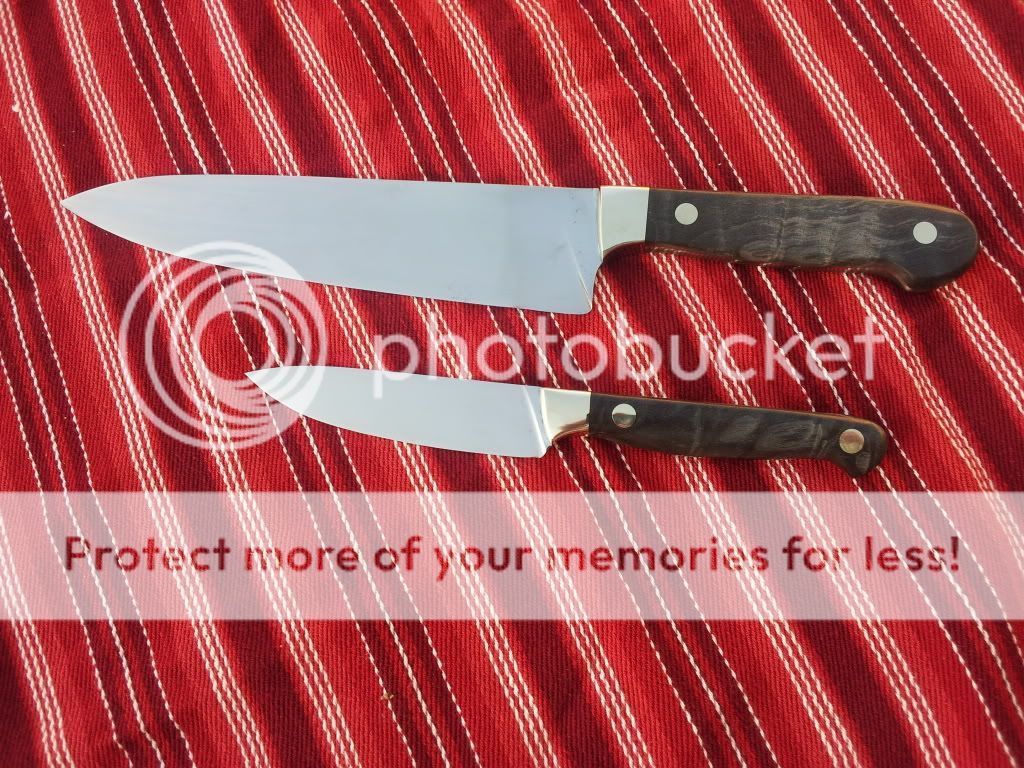
20120301_081959.jpg


I heated the peace, then applied flux, then soldered. The solder took well and I am pleased except for messing up my 600 grit finish. Where did I go wrong and what can I do to avoid this next time?

Thanks,
Jason
 
Also if the parts fit well it doesn't take much flux,I use a q-tip and just get the parts wet,and as Bill said,Apply then heat.
Stan
 
when I apply the flux before heating three flux always burns and turns black. is that normal?
 
Flux before heating and I don't let flux get anywhere I don't want solder to go.
 
It might turn a little black but not much. I usually put some thin strips of solder on the joint so it melts right when the temp gets right. Helps to know when you have enough heat applied so not to overheat the joint. Then I take a sharpened copper wire (12 or 14 gauge) and run it down the joint to help spread the solder and make sure it has spread all along the joint.
 
The entire problem can be eliminated by not overheating the joint and the flux. You only need to heat everything to 450°F to make it work. Too high a heat and too much flux are the culprit in most bad solder joints.
Done right, there should be little excess to remove and no etching of the blade.

Try using a heat gun instead of a torch. It does not require a 3000°F flame to heat the joint to 450°F.
 
The entire problem can be eliminated by not overheating the joint and the flux. You only need to heat everything to 450°F to make it work. Too high a heat and too much flux are the culprit in most bad solder joints.
Done right, there should be little excess to remove and no etching of the blade.

Try using a heat gun instead of a torch. It does not require a 3000°F flame to heat the joint to 450°F.


Heat gun is the way to go.

It takes a while to get the joint up to temp but I have soldered large guards on large knives with no problem.

Take care

Charles
 
I did use a heat gun but I used it on the high setting. Should I keep it on the low setting and just take more time heating it?
 
I use the high setting also.

Once it is hot enough for the solder to flow you might want to use the low setting to maintain the heat while working the solder.

Take care

Charles
 
The heat gun is good.
What type of flux atre you using?
Most normal fluxes won't pit the steel unless left on for a long time or heated very hot.
 
I'm using the Stabrite liquid flux and applied it with a Q-tip. When I put it on the first knife, it popped in all directions and landed on the other blade I had nearby that was waiting to be soldered. It wasn't until I was finished with it that I noticed the small marks on the other knife. Maybe I just left the flux on the blade too long. I did neutralize each one after I let it cool (maybe 3 minutes).

If I recall I saw a video by Tony Bose on soldering for slipjoints and he put oil on the blade where he didn't want the flux to go. Is this a good option?

I tried the soft lead pencil trick and it didn't work for me. I tried fingernail polish but that didn't work either. I had to scrape a lot of solder off afterwards so I obviously used too much.

I tried to cut the solder in small strips and put on the edge of the bolster from the top but the curve on the blade side of the bolsters would not allow the solder to stay on. It kept falling off.

I think next time I will turn the blade sideways with edge up and solder so the excess flows down towards the spine, or I could just use JB Weld. I do that on guards but hadn't thought about doing it to bolsters.
Jason
 
I use liquid flux and apply it with a fine artists brush only where I want
it. If your flux is turning black, you're getting it too hot too fast. I put the
blade in the vise blade up. Everything must be clean, clean, clean. Apply
flux and heat. I work the solder into the gap on the tang side of the guard
and it will wick up into the joint. If the solder beads instead of flowing,
dip a needle in flux and draw it along the ricasso-guard joint. This should
cause the solder to flow evenly around the joint.

Hope this helps.

Bill
 
I use liquid flux and apply it with a fine artists brush only where I want
it. If your flux is turning black, you're getting it too hot too fast. I put the
blade in the vise blade up. Everything must be clean, clean, clean. Apply
flux and heat. I work the solder into the gap on the tang side of the guard
and it will wick up into the joint. If the solder beads instead of flowing,
dip a needle in flux and draw it along the ricasso-guard joint. This should
cause the solder to flow evenly around the joint.

Hope this helps.

Bill


+1, I use a wood handle ice pick instead of the needle.
 
Back
Top