I get the tip nice and pointy when i cut out by blank, but throughout the grinding process it always gets slightly rounded off at the tip. I try to dunk the blade in cold water each time after a few passes on the belt to keep it cool. but I am starting to think that is my technique that is suffering. Any pointers would be greatly appreciated. I am still working on my first knife. Thank you.

-
The BladeForums.com 2024 Traditional Knife is available! Price is $250 ea (shipped within CONUS).
Order here: https://www.bladeforums.com/help/2024-traditional/
You are using an out of date browser. It may not display this or other websites correctly.
You should upgrade or use an alternative browser.
You should upgrade or use an alternative browser.
How do you keep the tip of the blade from not rounding off when grinding your bevel?
- Thread starter shurik6
- Start date

- Joined
- Oct 3, 2002
- Messages
- 12,297
You're dragging the tip across the belt, just stop doing that! 

- Joined
- Nov 11, 2012
- Messages
- 220
I had the same issue when I first started. As my hands have gotten a bit more steady, it's become less of an issue.
One thing I did on a few of my early knives to mitigate this was left a little bit of meat on the spine behind the tip. I'd go about grinding my bevels as usual, then when I got to finishing stages, I'd grind the spine down to final profile. Not an ideal way of doing things, and I'm sure someone can tell me why it's a bad idea, but it helped me get nice, sharp tips when I was starting off.
One thing I did on a few of my early knives to mitigate this was left a little bit of meat on the spine behind the tip. I'd go about grinding my bevels as usual, then when I got to finishing stages, I'd grind the spine down to final profile. Not an ideal way of doing things, and I'm sure someone can tell me why it's a bad idea, but it helped me get nice, sharp tips when I was starting off.
- Joined
- Oct 3, 2002
- Messages
- 12,297
Ya have to sneak up on the tip.
Practice, Practice, Practice...
Practice, Practice, Practice...
- Joined
- Jun 11, 2010
- Messages
- 489
You might also be moving the blade toward your body at the end of a pass. That'd make you grind it more, thus leading to your rounded points. Otherwise, what Don said. It just takes practice.

Okay, from what I gather - 1. Don't pull the blade towards myself as I get to the tip. 2. I can leave the meat on the back of the tip and finish it after grinding most of the bevel. So then, do I grind the tip with a file or on a belt? What do you guys do? I searched online for a good example of people doing it, but it seems like that is one minor detail that is left out of a lot of how-to videos.

- Joined
- Oct 15, 2010
- Messages
- 338
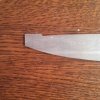
In addition to what others have said you can also leave some metal at the tip and then grind it off before heat treatment. This will give you an idea what you are doing wrong and allow you to fix your technique before your tip gets "modified". I do plenty of grinding after heat treatment, so it does not replace proper technique. I got this idea from someone here. I apologize for not remembering who. I wanna say Johnny Mac or James Terrio?
Attachments

Stacy E. Apelt - Bladesmith
ilmarinen - MODERATOR
Moderator
Knifemaker / Craftsman / Service Provider
- Joined
- Aug 20, 2004
- Messages
- 38,513
On finely pointed fillet blades, I do the same as above. I leave extra metal at the tip until the bevels are shaped. Then I shape the point. On very thin blades, I usually leave the extra metal until after HT.

Fred.Rowe
Knifemaker / Craftsman / Service Provider
- Joined
- May 2, 2004
- Messages
- 6,848
Leave the tip till last. Put the distal taper in the blade "before" you grind the bevels, if you do, most of the grinding will take place at the plunge lines. Develop this area moving toward the tip, but leave the actual tip till last. Grinding distal taper in either direction from the ricasso is best done early; it makes all the grinding that takes place afterward much more effective.
- Joined
- Jul 1, 2013
- Messages
- 32,479
On finely pointed fillet blades, I do the same as above. I leave extra metal at the tip until the bevels are shaped. Then I shape the point. On very thin blades, I usually leave the extra metal until after HT.
I do what Stacy said to avoid rounding the tip. Also I only profile the blade before Heat Treatment.
I do all of the bevel,Distal tapering etc after HT. I get a crisper more exact grind and that also helps with any problems with the tip.
Keep at it and focus even more as you approach the tip with light passes.

- Joined
- Apr 16, 2008
- Messages
- 814
Slow your grinder speed use a sharpie to ink your blade go slooooow

- Joined
- Jan 9, 2011
- Messages
- 16,486
Rounding while grinding the initial bevel? you could be lifting the butt as you get near the tip. I spend extra time on the tip as it is tough to get any leverage there.
Rounding the tip while sharpening? sharpen just up to the tip, sneak up on it as mentioned... don't make your pass go past the tip, just up to it
Rounding the tip while sharpening? sharpen just up to the tip, sneak up on it as mentioned... don't make your pass go past the tip, just up to it

- Joined
- Jul 27, 2003
- Messages
- 5,699
Guy walks into the doctor and raises his arm over his head and says, "Hey, Doc, it hurts when I do this."
Doctor says, "Then don't do that."
Doctor says, "Then don't do that."
You're dragging the tip across the belt, just stop doing that!
- Joined
- Jul 27, 2003
- Messages
- 5,699
Seriously, though, when I was beginning I had pretty much the same difficulty.
I was having trouble grinding my blades just the way I wanted them to be.
I found a guy in Blade Magazine giving knife lessons and went for a visit.
In minutes of grinding the first blade, I saw what I was doing wrong.
I was cured.
So, not only did I learn something and fix my problem, but I made a new acquaintance in knife making as well.
Find someone near you - or not near! - and get some help.
Get real world help. Not "computer" help.
I ad literally buckets and buckets of failed blades. That cost money!
Lots of us sort of "paid our dues" doing it the hard way, and I think lots and lots of failures and practice, practice, practice, sort of helps to solidify our progress.
Keep at it.
Back off when you get to the end.
Don't do anything before you have to.
Somebody had a good idea about marking your blade with a marker. See where the blade is hitting the belt and adjust accordingly.
Practice.
Practice.
Practice.
I was having trouble grinding my blades just the way I wanted them to be.
I found a guy in Blade Magazine giving knife lessons and went for a visit.
In minutes of grinding the first blade, I saw what I was doing wrong.
I was cured.
So, not only did I learn something and fix my problem, but I made a new acquaintance in knife making as well.
Find someone near you - or not near! - and get some help.
Get real world help. Not "computer" help.
I ad literally buckets and buckets of failed blades. That cost money!
Lots of us sort of "paid our dues" doing it the hard way, and I think lots and lots of failures and practice, practice, practice, sort of helps to solidify our progress.
Keep at it.
Back off when you get to the end.
Don't do anything before you have to.
Somebody had a good idea about marking your blade with a marker. See where the blade is hitting the belt and adjust accordingly.
Practice.
Practice.
Practice.

- Joined
- Dec 27, 2010
- Messages
- 6,852
Yup, Bufford's explanation is about what I was thinking. There's less surface area towards the tip, which means that the same amount of pressure will remove more metal at the tip than at other portions of the blade, due to the difference in kinetic friction and the fact that there's just less metal in a given space, but you're still going to remove the same amount of metal with a given amount of pressure. Decreasing pressure around the tip seems to help me avoid that issue.

- Joined
- Mar 10, 2013
- Messages
- 1,074
Toward the tip it is less wide .That makes it harder to prevent "rocking"the blade back and forth rather than keeping it on plane with the bevel .I use a file to do the tip and keep everything planing properl