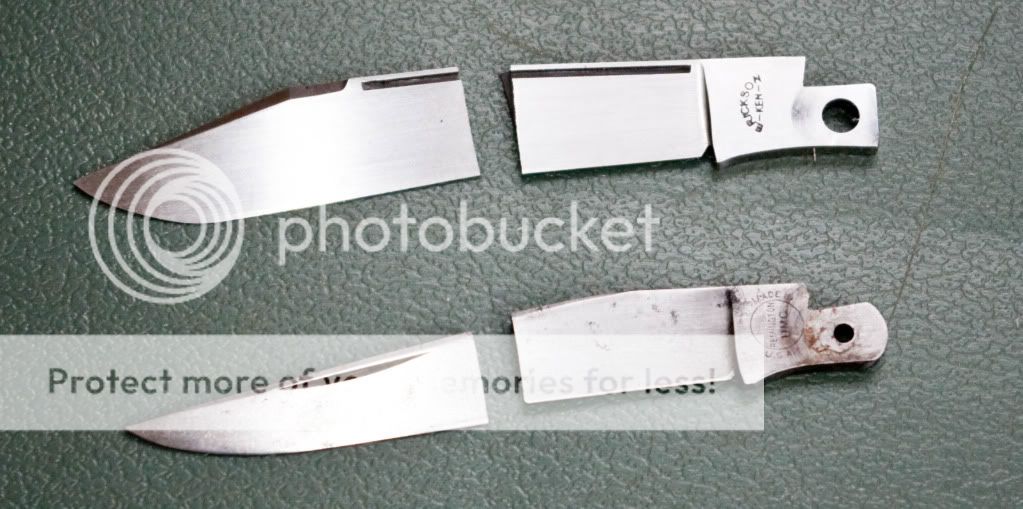
How do you move the blade off the liner? Or do you?

Joined
Nov 20, 2000
Messages
2,262
I am slated to buy a custom full size trapper locally. I have examined it with a keen eye and I see that the tip of the clip point blade lays against the liner.
It is a beauty and I know I am going to purchase it anyway.
What methods have you used to move a blade? Hammer? Tongs? Heat? Return to maker?

Or, do you just live with it? :rolleyes:

Thanks
 
Well, if you can see it's not centered then you see that is how it's being sold. It would probably require a new start on the knife to correct that problem. It can be caused by being ground off center, (if it's a multi blade knife, this can be part of the way it must be made) the pivot hole ground on an angle, the liner holes for the pivot not aligned and a few other things. Frank
 
That old grump Ed (modoc) posted a good thread on this a while back. Very informative. It was posted in the maintenance forum. If you do a search under that forum it should show up. Could you call the maker before you buy it to see if he could fix it? Either way, until Ed chimes in himself to help that's all I can offer.

Hope its helpful.

Kevin
 
C Ben, that repair would be called "crinking" the blade. Most production cutleries anneal the tangs, along with an eighth inch or so of the blade above the shoulder. This softens the steel a bit at the shoulder and this is the area you want to strike to avoid snapping the blade. I use one of those mallets with the amber heads to avoid marring the blade, and keep the knife half open. If you open it all the way you run a greater risk of loosening the blade. The problem with a custom is that there's no telling whether the maker annealed the tangs or not, you may be running full hardness all the way through, which means a) you have to hit that blade darned hard in order to get it to bend, and b) you run a much greater risk of snapping the blade. I'd leave that risk to the maker and ask him to crink the blade, he could have it done in about ten seconds.

Eric
 
Last edited:
Language, please. Maiden Aunt Elizabeth is reading over your shoulder.
 
Some of these modern steels will snap (break!). I would crink carbon steel, but leave it to the maker to crink ats-34, bg-42, even d-2. I watched a nice looking bg-42 blade shatter into 3 pieces with a light tap, on Queen's repair bench! They gave me a new knife, fortunately!!
 
Sometimes Charlie, ya just gotta take a deep breath. The knife in my example was Case's SS.

But I take your point.
 
Case's SS will crink pretty readily. They have a pretty decent quality control when they heat treat them (in house). If it is 420HC, I don't think it is known to be brittle.
BG-42, I've been told by an expert, risks snapping every time.
I learned my lesson the hard way (sigh) to leave expensive knives to experts, and bang away on the cheap ones.:rolleyes:
 
I'm definitly not suggesting this - after all if I break a blade I make a new one. I will say this
works pretty well while not the whole answer. Ats-34 Rc61-62 after the draw and the obvious 3
point setup, some use arbor presses. The overbent blade in the vise, and the blade after. Have
only ever broke 1 blade doing this and I knew I was way over. I've broke test blades on purpose
both ground and unground and it will surprise you just what they will take. Somewhat of an overbend
is necessary so when they come back they stay where they belong.
Ken.
102_0857-1.jpg

102_0859.jpg
 
Last edited:
Thanks kc. I'm going to make one of those (using a small, spare, vice I have) and give it a try. Looks promising.
 
If I remember right Ken Charlie bludgeoned that one with a hammer- sorry Charlie I just
had to say that. I imagine a tig welder in this instance would separate the men from the
boys. LMAO!
Ken.
 
Back
Top