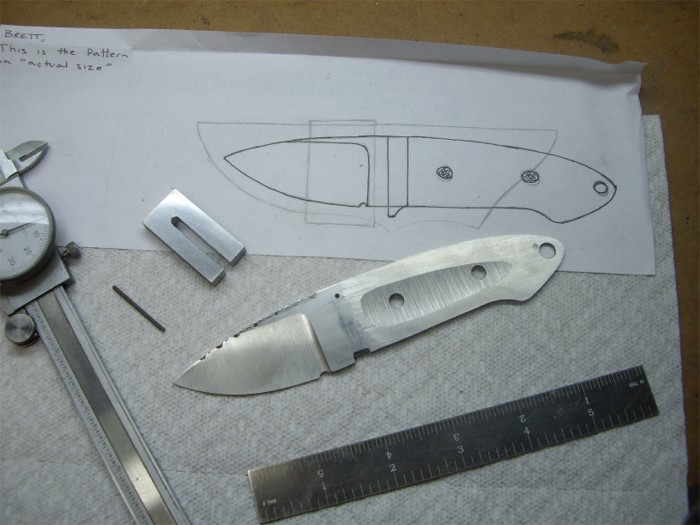
How do you sand your ricasso and tang on full tang blanks?

Joined
Sep 16, 2002
Messages
1,577
On my first knife or two, I sanded the tang/ricasso flats by putting sandpaper on a flat surface and moving the knife in alternating directions with each grit.

This seemed like too much work and like I was needlessly sanding areas that would never be seen, so on the next couple I only sanded the ricasso and partially into the tang (slightly beyond where the handle scale would cover) using a sanding block with the blade in a vise. This went much faster and easier, but I know that this will result in the tang not being perfectly flat.

So how do you do it? Do you sand just the visible areas and not sweat the minor resulting difference in material thickness, or do you sand the whole tang so that it's perfectly flat? I can't say that I could see much difference in the final product, but I've only made a few knives so far and there were other issues with them that made it a less-than scientific comparison.

Thanks!
 
I'm just a newbie but, I do what you do and only sand the ricasso and partially into the tang. I don't waste time sanding something that will not be seen.
 
I sand the ricasso and tang altogether up to the finishing grit to ensure that everything stays flat from ricasso to butt. As far as scratches I do not worry about em in the tang. When it comes time to glue up I use the dremel with the cut off wheel and scuff up inside the gluing area. I then go back with said finishing grit to make sure everythig is stil flat (scratchless too in the ricasso) and there are no raised burrs from the dremel. Seems like a lot of work but I would rather do everything to ensure total flatness than only finish the ricasso and then have a huge difference in tang thickness towards the butt cause you did not remove material uniformly.
I made that mistake with a blade and for the life of me could not get it flat. The smallest gap after glue up really irks me. Don't get me started about when stuff moves when it is not supposed to from humidity or temp change. Don't ask.

My method is using a granite surface plate moving the blade on the paper, and finish the bevels with the blade clamped down moving the paper on the blade.
 
you'll notice on a lot of the tutorial/WIP threads that a lot of makers hollow grind the center of tangs in the rough grinding stage (after drilling pin holes) - being careful to stay away from the edges of the tang.

This makes it much easier to taper and finish the tang, since you are only dealing with the edges.
 
Last edited:
If you do it like Mark said you will have a lot less sanding to do because you are only sanding the thin edge around the outside.
Cheers Ron.
 
I drill a lot of holes through the tang, to both lighten the weight, and allow the epoxy to make bridges between the scales, then flatten on a 6x48 table sander to 100 grit. The tang and ricasso are treated as one in this. The table sander will make the tang and ricasso dead flat if held on the sander lengthwise. I then go back and true up my plunge line, if the blade has one.
 
you'll notice on a lot of the tutorial/WIP threads that a lot if makers hollow grind the center of tangs in the rough grinding stage (after drilling pin holes) - being careful to stay away from the edges of the tang.

This makes it much easier to taper and finish the tang, since you are only dealing with the edges.

If you do it like Mark said you will have a lot less sanding to do because you are only sanding the thin edge around the outside.
Cheers Ron.

Yes, I have seen this method in the past but I had forgotten about it. I don't have a real grinder with small wheel, so I would have to try and do it with my Dremel.
 
You can use a large wheel; I use a 8" wheel and it works great. Just don't grind into the edge of the tang and you're OK.
 
You can use a large wheel; I use a 8" wheel and it works great. Just don't grind into the edge of the tang and you're OK.

Hmm, thanks for that tip. I assumed a small wheel would be required. I'll see if I can make the drive wheel on my Craftsman work for this (I've not measured it, but it's probably 4-5" in diameter.)

Edit to add: The drive wheel on my Craftsman measures about 4 3/4" or so, and I held the tang of a bird and trout I'm working on up to it. I don't think I can see well enough or hold it steady enough to not get into the edges of the tang, but maybe I'll give it a try on a piece of scrap.
 
Last edited:
Angel grinder would work fine, and you could see where you are grinding. I found on the wheel it was a little dicey to see where I was going, course if you go over to the edge it would need some "fixing"
Ron.
 
Angel grinder would work fine, and you could see where you are grinding. I found on the wheel it was a little dicey to see where I was going, course if you go over to the edge it would need some "fixing"
Ron.

Ron,

I think the angle grinder would be easier to see with than my grinder's drive wheel, I'll give it a try.
 
Ron,

I think the angle grinder would be easier to see with than my grinder's drive wheel, I'll give it a try.


I've done it on my craftsman's drive wheel. I had to cut off some of the factory guard towards the bottom to reveal more wheel but then it worked like a charm. Just be careful that you don't get the blade stuck in between the wheel and the guard. If you take off some of the bottom of that guard it will also help in not having sparks come all the way back around the belt and hit you in the face. Once I did this, I actually grind the hollow into the tang all the way down the tang all the way to the end. You'll end up having two hollows on each side and it allows you to see where you need to taper to. Of course, this is only if you want to taper the tang otherwise don't take the hollow grinds past the end. Just hollow out the middle between the pin holes.
 
I've done it on my craftsman's drive wheel. I had to cut off some of the factory guard towards the bottom to reveal more wheel but then it worked like a charm. Just be careful that you don't get the blade stuck in between the wheel and the guard. If you take off some of the bottom of that guard it will also help in not having sparks come all the way back around the belt and hit you in the face. Once I did this, I actually grind the hollow into the tang all the way down the tang all the way to the end. You'll end up having two hollows on each side and it allows you to see where you need to taper to. Of course, this is only if you want to taper the tang otherwise don't take the hollow grinds past the end. Just hollow out the middle between the pin holes.

Thanks for the advice, Garrett. Do you happen to have any pics handy of either the cut-down grinder guard or a tang you've hollow ground all the way to the end (for tapered tang?) If so, I'd love to see them as pics are always helpful for me, but if not please don't go to any trouble to get them.
 
Thanks for the advice, Garrett. Do you happen to have any pics handy of either the cut-down grinder guard or a tang you've hollow ground all the way to the end (for tapered tang?) If so, I'd love to see them as pics are always helpful for me, but if not please don't go to any trouble to get them.

PJ, I hope to get some "quality" time in my shop tonight and I'll take some pics of what I am talking about. It just so happens that I need to do a tang taper as well so I'll try to get some pics of that as well. Sometimes it is hard to explain what I mean so hopefully the pics will make it make sense.

Garrett
 
I also use an 8" wheel to grind the hollow. Here's what's left of the hollow after the tang has been tapered - there was a lot more to it before tapering. By the way, I grind the hollow even if I'm not tapering the tang - that much less flat to finish. Of course, I don't take it off the end of the tang in that case.


custom.jpg
 
Yeah, just like Mr Schaller said. I didn't get a chance to grind the hollows on this blade but here are some pics showing the main idea.

this is where the hollow will go...you'd grind a hollow between the two lines all the way to the end
DSC01104.jpg


this is kind of what the end looks like when the hollows are cut out
DSC01105.jpg


Then, when you grind the tapers in, the two round areas in the butt of the handle area will fade out....like Mr Schaller's pic
 
Here is the Craftsman mod I was talking about. The top cutout makes tang tapering easier too. After I got both tapers just about right, I hold the knife by the blade(up) and put the tang area against the platen to even them out. Before I removed the top cutout, you couldn't get the blade flush this way. If you look close you can see the ceramic liner on the platen too.

DSC01100.jpg

DSC01101.jpg

DSC01103.jpg


Those things come with a lot of stuff that I trashed. Not a bad little starter machine though. I still use it for hogging off steel occasionally.
 
Back
Top