
-
The BladeForums.com 2024 Traditional Knife is available! Price is $250 ea (shipped within CONUS).
Order here: https://www.bladeforums.com/help/2024-traditional/
You are using an out of date browser. It may not display this or other websites correctly.
You should upgrade or use an alternative browser.
You should upgrade or use an alternative browser.
How do you store your celluloid knives?
- Thread starter bdev
- Start date


- Joined
- Jul 30, 2006
- Messages
- 45,618
O right I have never heard about them before . as anybody got any pics please ?

Please forgive my ignorance . but what is a celluloid knife ?
A knife with covers (or scales depending on your own terminology) made of celluloid.
Essentially, celluloid is a blend of nitrocellulose (cellulose reacted with nitric acid) and camphor. The camphor is added added as a plasticizer (makes the plastic less brittle). The combination forms a clear plastic to which coloring agents can be added. Celluloid was one of the first plastics, having been developed in the 1850's. It has a great many trade names and synonyms. Among them are Xylonite, French Ivory, Ivorine, pyremite & pyralin. It was made into any number of items, including knife handles.
Over time the nitrocellulose decomposes, releasing the original nitric acid. Nitric acid is extremely corrosive and attacks the other parts of the knife. In addition to that hazard, celluloid is extremely flammable.


5K Qs
Gold Member
- Joined
- Jul 20, 2014
- Messages
- 16,520
A knife with covers (or scales depending on your own terminology) made of celluloid.
Essentially, celluloid is a blend of nitrocellulose (cellulose reacted with nitric acid) and camphor. The camphor is added added as a plasticizer (makes the plastic less brittle). The combination forms a clear plastic to which coloring agents can be added. Celluloid was one of the first plastics, having been developed in the 1850's. It has a great many trade names and synonyms. Among them are Xylonite, French Ivory, Ivorine, pyremite & pyralin. It was made into any number of items, including knife handles.
Over time the nitrocellulose decomposes, releasing the original nitric acid. Nitric acid is extremely corrosive and attacks the other parts of the knife. In addition to that hazard, celluloid is extremely flammable.
Thanks, Frank!! :thumbup::thumbup:
That's the best, most informative and concise description of the composition and challenges of celluloid knife covers I've ever run across!
- GT

JPD1998
Gold Member
- Joined
- Oct 18, 2004
- Messages
- 3,577
I recently posted this picture in another thread. These are Bulldog brand knives made in Germany around 2004. I took this picture shortly after getting them ( about 9 years ago).
They've both been stored in a Sherpa lined case , separated by compartments. The one on the right still looks the same, the copper head on the left began to out-gas almost immediately. The outgassing has pitted the shield and the upper bolster.
So now I keep it in a drawer, but the shield is still turns green, I just keep polishing it out.
Ironically the scales still look the same.
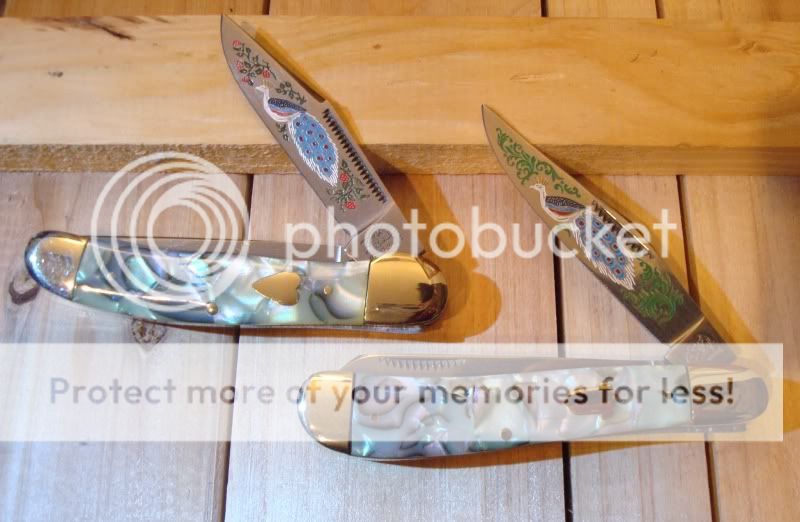
They've both been stored in a Sherpa lined case , separated by compartments. The one on the right still looks the same, the copper head on the left began to out-gas almost immediately. The outgassing has pitted the shield and the upper bolster.
So now I keep it in a drawer, but the shield is still turns green, I just keep polishing it out.
Ironically the scales still look the same.

kaotikross
BANNED
- Joined
- Nov 20, 2013
- Messages
- 1,453
VERY informative! I've come across many old knives that have these exact symptoms, I always thought somebody was just hard on the knife. I never made the connection between the decaying knife and celluloid. thank you
- Joined
- Mar 6, 2014
- Messages
- 19
So, does the more modern celluloid off gas just as the older material??? Is there anyway to prevent it?
 Seems very stable at this point.
- Joined
- Sep 10, 2014
- Messages
- 1,375
The gas they give off is corrosive to metal, both on the out gassing knives themselves as well as neighboring knives. So not only do the handles break down but they take the metal with them.
Thank you for this explanation!
Cate
- Joined
- Sep 10, 2014
- Messages
- 1,375
A knife with covers (or scales depending on your own terminology) made of celluloid.
Essentially, celluloid is a blend of nitrocellulose (cellulose reacted with nitric acid) and camphor. The camphor is added added as a plasticizer (makes the plastic less brittle). The combination forms a clear plastic to which coloring agents can be added. Celluloid was one of the first plastics, having been developed in the 1850's. It has a great many trade names and synonyms. Among them are Xylonite, French Ivory, Ivorine, pyremite & pyralin. It was made into any number of items, including knife handles.
Over time the nitrocellulose decomposes, releasing the original nitric acid. Nitric acid is extremely corrosive and attacks the other parts of the knife. In addition to that hazard, celluloid is extremely flammable.
Thank you.
Cate
Not all "celluloid" is the same. There must have been different chemical compounds used, different base materials, different eras, and different companies making the stuff.
Frech ivory, for example, is a type of celluloid (from my understanding), yet it rarely exhibits the worst signs of offgassing and deterioration.
Many newer brands used celluloid that corroded quite rapidly, while some long-ago vintage brands are generally reliable.
The unpredictability is the most annoying aspect of celluloid...
I keep mine in drawer toolboxes. That gets them plenty of fresh air, yet they aren't exposed to direct light. Sealing them up, seems to me, would be the worst possible storage.
Frech ivory, for example, is a type of celluloid (from my understanding), yet it rarely exhibits the worst signs of offgassing and deterioration.
Many newer brands used celluloid that corroded quite rapidly, while some long-ago vintage brands are generally reliable.
The unpredictability is the most annoying aspect of celluloid...
I keep mine in drawer toolboxes. That gets them plenty of fresh air, yet they aren't exposed to direct light. Sealing them up, seems to me, would be the worst possible storage.