how do your blades stack up?

Joined
Jan 21, 2009
Messages
62
I was looking at some fixed blades in the other sections of this forum and I see a lot of A vs B knife comparisons. most of these fixed blades cost $250+ basically they put them through a torture test.

My question is, How would your blades hold up against other knives like Busse, Fehrman, Strider??????????

If a newb used good steel and sent blades out for HT how do you think a newbs knives would do against these????

here is one of the test I was talking about:
http://www.bladeforums.com/forums/showthread.php?t=648410
 
Last edited:
If a newb used good steel and sent blades out for HT how do you think a newbs knives would do against these????

In theory, anyone "can" make a knife the equal of those, using quality materials and HT as you specify, yes. Fit and finish, blade geometry, ergonomics and other fun details separate the pros from the beginners.
 
There is another guy on utube that tests knives to failure, he bends, beats, slams until they are not usable. While these tests are interesting and provide some good information the toughest, these knives may not meet your needs. If you were looking to go into combat in Iraq one of the three knives may be your choice or you may compare another to these. If you were going to slice tomatoes, enter a cutting competition or carry on your hip all day at work, I would select something different.

My point being testing is important to understand how different blades, handles and materials perform but may not be appropriate for selecting a knife or making a comparison. I test my knives, I bend until they break, I hammer the handles off, and I cut everything I have from rope to 2x4s to understand how the choices I made in the materials and methods effect how I am trying to meet my customer needs. I do look at other tests but I do not fully judge my knives based on the testing of others.

I wanted to make a quick comment on a newby making a knife that would stand up, most likely not. These guys are professionals and it would not give them proper credit to say someone could jump in a make a blade that is compariable, however, ( as will all my statments I give then take), a newby could make a blade that they would have tremendous pride in and keep their whole life, a blade that would have its story told over and over and would be handled and admired buy their friend every time they saw it.
 
Last edited:
In theory, anyone "can" make a knife the equal of those, using quality materials and HT as you specify, yes. Fit and finish, blade geometry, ergonomics and other fun details separate the pros from the beginners.

+1 I would also say that attention to detail in terms or fit, finish, and manufacture is one thing that also sets custom knives apart from production.

Its also all about intended task for the knife...would a busse beat a fillet knife in a fish cutting competion? Would a fillet knife beat a busse in a log chopping competion? HT and materials can only get you so far...a perfectly heat treated bar of mythical INFI is crap without a good blade and edge geometry.

That being said, I would indeed be interested to see how a custom maker who specializes in tactical/survival knives would match up to those high-value production models.
 
I would indeed be interested to see how a custom maker who specializes in tactical/survival knives would match up to those high-value production models.

thats what I was trying to get at.

just looking around here I see that custom knife makers have the knives I listed beat 10 fold in looks and attention to detail. I just wanted to know how they would stack up in terms of durability.

as patrick said "a newby could make a blade that they would have tremendous pride in and keep their whole life" I'm a newbie and I think the only knife worth having is a knife that can "hold its own". I want to make knives for my avid hunting/fishing/cooking friends to use frequently. I would love to hear complements like: best knife I've ever had, holds an edge better than any knife I've ever had, this is the sharpest knike ever, its my favorite knife, shoot.. I'd just like to see it on them when they go hunting. Most of them use plain old buck knifes so I was just kinda wondering if I can top a buck knife as a newb. I wouldnt give out a gift that was less than what they allready have.
 
Most of them use plain old buck knives so I was just kinda wondering if I can top a buck knife as a newb. I wouldnt give out a gift that was less than what they allready have.

If your goal is to make a knife similar to a Buck, only better, by all means go for it. There's plenty to be learned about design and quality in the classic Buck hunting knives.

Lots of us got started in this hobby because we weren't quite satisfied with production stuff. Once you learn to grind well, you can select higher-grade steels, make your own tweaks to the design, use nicer handle materials, etc.

Whether you can "top a Buck as newb" or not depends on you and you alone. Your skill set, experience with tools, patience and talent are what will make it yours; the materials, tools and techniques are available to all of us.

It's also all about intended task for the knife...would a busse beat a fillet knife in a fish cutting competion?

Well said. It's like comparing a sniper rifle to a handgun... yeah they're both firearms, but with different uses.
 
Most of them use plain old buck knifes so I was just kinda wondering if I can top a buck knife as a newb. I wouldnt give out a gift that was less than what they allready have.


Well if you want to get off to a good start, research the steel that buck knives use and either choose that same steel or a better steel and do everything yourself except the heat treating. Send that knife out for HT from someone like Paul Bos and so long as you take your time on the knife, you should end up with something that will at very least have good steel, and HT thats as good as what buck does. The rest is up to you!

Honestly, though, shooting to begin making knives that outperform quality production knives might be a lofty goal. Its certainly attainable, but it might be best to start with the basics and go from there. Theres a lot to what makes a knife work for its intended task, and it can be too much to try to do all at once without any experience.
 
Buck generally uses 420HC these days, but I don't know if it's available in small quantities. 440C is available though, and it's a better steel.

Honestly, though, shooting to begin making knives that outperform quality production knives might be a lofty goal. Its certainly attainable, but it might be best to start with the basics and go from there. Theres a lot to what makes a knife work for its intended task, and it can be too much to try to do all at once without any experience.

Good points. Maybe start with a full-tang neck knife. That way you can concentrate on the blade grind without worrying yet about building a handle, fitting a guard or bolsters, etc.
 
i believe that in time my blades will stack up with any production blade..... why am able to make such a bold statement? because of the incredible guys here on the forum that have a wealth of knowledge and are willing to share that knowledge. and also because these guys are in it for the craft..... the money for most is a secondary pursuit. with a support group like this there is NO reason not to succeed.

Jake
 
As a beginner, I believe it is possible to compete with the better production blades, but it takes a lot of patience and research.

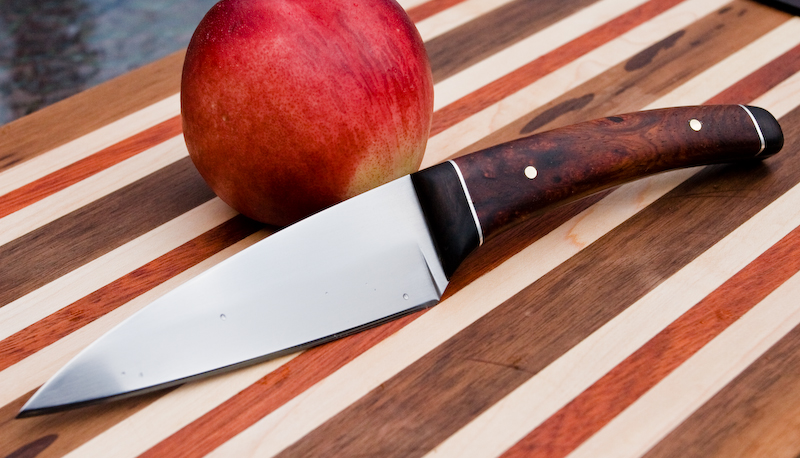
I chose to make kitchen knives to start out with. My first idea was to make something small like a paring knife. I researched steel types, heat treating, design and so on. I ended up with this:CPM 154, heat treated to HRC 59 by TKS with a cocobolo and blackwood handle.

2825998780_a737794fee_o.jpg


How does it work? Decently. The partial grind makes the blade a bit thick for true paring. It handles pretty well for most tasks, but doesn't stand out from the nicer production knives. It does look nice, though.

I took what I learned and applied it to the next paring knife. I knew I wanted a thinner grind and a distal taper for detailed work. I changed the blade shape and handle design considerably. The steel is the same, but this time it was heat treated to 60-61 by Paul Bos. This was my first time using synthetic handle material; "blue glow" burlap micarta by Todd Combs.

3555168046_aeb7504f89_o.jpg


This one outperforms the previous design in almost everything (the wharncliffe blade is still better for dicing herbs). The blade cuts with much less resistance, and is more precise at the tip. The handle is easier to control and more comfortable. I'd put this knife against production blades any day.

Phillip
 
Back
Top