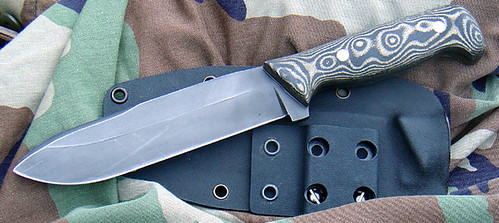
how does 3v do in the abs js test

Bottom line... 5160 will not out perform 3V, all heat treats and HRC equal. As far a toughness, 1018 will beat 3V hands down. As for Strength/Toughness ratio... you have to custom HT each steel to tweak its properties. 3V at 60HRC will outcut 5160 at the same hardness/geometry but 5160 will be tougher at lower hardness.


I would say for a beater blade, yes, 5160 would be my choice. 3V is a super steel design for edge retention, and impact toughness at higher HRC. 5160 is desigedn to ride under a pickup truck, suck up shock and give you a smooth ride. You are compairing a Formula One racer with a Baja Buggy .... it is not fair for either one.

for 5160 i really do not consider this beating up the blade. i take good care of my blades and was wondering if 3v would do better at these applications in a big knife?
 
Chad... I am the last guy to call knife abuse a bad thing... lol. I am hard on my knives and frankly don't worry so much as to what other folks think about it.... I know what I need and am comfortable with it.

That said.... Chopping, Batoning and Prying is "Beating" by conventional standards. You need a beater blade not a cutting tool.
 
Chad... I am the last guy to call knife abuse a bad thing... lol. I am hard on my knives and frankly don't worry so much as to what other folks think about it.... I know what I need and am comfortable with it.

That said.... Chopping, Batoning and Prying is "Beating" by conventional standards. You need a beater blade not a cutting tool.


sounds good its cheaper anyways :D
 
Me too. Here's the problem, not too many people work with both those alloys. I offer a friendly challenge... someone send me a chunk of new, real 5160 (not some old leaf-spring junkyard thingamabob you think might/could/should be 5160!) and I'll supply a piece of CPM-3V in the same thickness, and grind a blade from each as close to the same dimensions as I possibly can.

I'll have them HT'ed to same hardness (I suggest 58Rc) and testing will commence from there. Then we'll have a better idea.

I have no axe to grind, I'm honestly interested in the results.

i may be able to supply the steel. direct from aldos in 1/4 inch.if your serious, what dimensions were you thinking
 
but the reason i bring up this question is because i want to make a camping knife made for chopping, batoning and prying. i was wondering if a diferentially quenched 5160 blade would do better then 3v at this application.
No.
i may be able to supply the steel. direct from aldos in 1/4 inch.if your serious, what dimensions were you thinking
2" x 15" is about standard for a camp knife. 1.5" x 13" would be minimum in my opinion... any shorter and you just don't have the leverage you need to really chop well.
 
Well said Butch..... the content, that is... no comment on the grandmer and speelng. You know I love ya, buddy!

well least i got the right half right (i troll grammer boards for fun tho )
my last camp knife was 3v and had a 10 inch blade witha spine thickness of 1/4 inch at the hande fully flat ground and distal tapered to the tip with light convexing it was a hell of a blade.

the O1 to 3v compare is not any better then the 5160 is as 3v was made to be tool and die steel that was all most as tough as S7 but had better ware then D2 also the specs that you read are for tempers in the 1kF range and more then jsut me dont do the high temp temper but still get great blades (its all about how you treat the RA )

i think if tested at yield strength both 5160 and cpm3v would be really close if they had the same mono HT tho if you torched the spine of the 5160 you could bend it with less fear of braking

before we say 3v looses the bend test cause of alloy i can tell you i have had cpm154 at 90 degrees bend before (at 62-63RC no less ) so its more on blade geromerty then it is on hardness
 
i may be able to supply the steel. direct from aldos in 1/4 inch.if your serious, what dimensions were you thinking

Email replied to :)

before we say 3v looses the bend test cause of alloy i can tell you i have had cpm154 at 90 degrees bend before (at 62-63RC no less ) so its more on blade geometry then it is on hardness

That's a really good point. Even through-hardened steel can bend pretty well if it's thin enough. Anyway for my purposes I'm just interested in comparing edge-holding and chipping.
 
3V will make a monster camp knife. I'm wondering why that wasn't the original question, rather than the thing about it passing the ABS performance test.... ???

I really like 3V. But that doesn't mean I would always choose it over 5160, or any steel for that matter.

That's a double sided equation.

Yes, 3V is very tough and has super edge retention... but that abrasion resistance doesn't magically go away when you have to sharpen the knife. If a customer doesn't have large diamond stones, then them sharpening a 3V blade is going to be a bear.
 
how much of the performance of the 3v is due to the CPM process? I imagine the super fine grain size has allot to do with its fantastic toughness. And wouldn't most of the PM benefits be erased during forging?
 
how much of the performance of the 3v is due to the CPM process? I imagine the super fine grain size has allot to do with its fantastic toughness. And wouldn't most of the PM benefits be erased during forging?
You always run a risk of screwing up the steel when you forge. Unless you need to manipulate a bar to fit a certain profile, PM steels are already set up for success and I would think it foolish to mess with that. Not that it can't be done.

I have to admit, I wasn't fully aware that 3V's toughness compared to S7 and L6... the charts you see on the web are all over the place, depending on which supplier is presenting them.
 
Here's charpy numbers from the datasheets...
S7 at 57Rc is 125 ft-lbs energy
3v at 58Rc is 85 ft-lbs (note this is significantly harder than 57Rc)
3V at 60Rc is still 70 ft-lbs
L6 at 57Rc is approx 92 ft-lbs inferred from knowing hard numbers for others and using Latrobe's relative table....


Wear resistance in standardized test show that S7 and L6 are both about 1/10 that of 3V..
 
Here's charpy numbers from the datasheets...
S7 at 57Rc is 125 ft-lbs energy
3v at 58Rc is 85 ft-lbs (note this is significantly harder than 57Rc)
3V at 60Rc is still 70 ft-lbs
L6 at 57Rc is approx 92 ft-lbs inferred from knowing hard numbers for others and using Latrobe's relative table....

Wear resistance in standardized test show that S7 and L6 are both about 1/10 that of 3V..

So what are the charpy numbers for S7 and L6 at 58Rc and 60Rc? There are no true comparissons made here.:confused:
 
Rick, those are the numbers that they give us. I guess that the implication is that S7 is primarily designed to be used at 57 or maybe less. I'm not sure how hard a rock drill bit has to be. Crucible says that 60 is the "sweet spot" for the best combination of impact and wear resistance with 3V. From what I have seen with posts about L6, if you jack it up to higher hardness to get better edge retention, its impact resistance probably is the same or slightly lower than 3V at similar hardness. I get the impression that for our purposes, L6 really comes into its own when used as a component for damascus when you can combine it with another steel like O1 that has better inherent wear resistance and fine edge stability. I have seen Kevin Cashen playing with some rather fancy "comp cutters" made from O1/L6 damascus and they were pretty impressive.
So what are the charpy numbers for S7 and L6 at 58Rc and 60Rc? There are no true comparissons made here.:confused:
 
From what I have read and learned, the purpose of 3V's type of "toughness" is the ability to resist chipping/rolling on much "thinner" edges and primary bevels, even at much higher hardness levels.

I honestly don't know if 5160, L6 or S7 have the same kind of characteristics or not. On a side note, I have been fairly surprised how rust-resistant 3V is at 59 HRC, even with a bead-blasted finish.

As far as lateral strength goes, I have not met the human who has enough strength to bend any knife over 3/16" thick to breakage, without some sort of mechanical assistance, I have used 3V to pry open many a stump, and it does not take that much force if done intelligently.

However 5160 is no slouch of a knife steel. In terms of cost vs. performance it beats 3V by miles(or kilometers). Personally, 3V is probably my favorite steel. I think it has the best of all worlds; excellent toughness, great edge holding, fairly good rust resistance.


P.S. Rick
I tried the spark test with 3V at 59 HRC with a few different types of stone including quartz and had no sparks.
 
Last edited:
So what are the charpy numbers for S7 and L6 at 58Rc and 60Rc? There are no true comparissons made here.:confused:

No matter the steel they all get lower impact resistance as they get harder. I don't have more data for L6 at the moment... Unfortunately we have to rely on what they give us unless someone has the time and equipment to do charpy testing for us... Generally extrapolation is possible and necessary, along with that infer what is said by their leaving out some data..

But S7 at 59Rc is charpy impact of 85 ft-lbs The difference between S7 at 59 and at 57 is temper at 300 vs 400F
and finally 3V at 62Rc is still a very respectable 40 ft-lbs.

In other words 3V is absolutely in the same toughness range as L6 and S7 but with some much more significant (several times more) edge holding/wear characteristics (all things being equal).

Of course by messing about with edge geometry and heat treat you can make one or the others better or worse... And depending on your intended approach to knifemaking, (material removal or forging) one may be a better fit than the others.
 
From what I have read and learned, the purpose of 3V's type of "toughness" is the ability to resist chipping/rolling on much "thinner" edges and primary bevels, even at much higher hardness levels.

I honestly don't know if 5160, L6 or S7 have the same kind of characteristics or not. On a side note, I have been fairly surprised how rust-resistant 3V is at 59 HRC, even with a bead-blasted finish.

As far as lateral strength goes, I have not met the human who has enough strength to bend any knife over 3/16" thick to breakage, without some sort of mechanical assistance, I have used 3V to pry open many a stump, and it does not take that much force if done intelligently.

However 5160 is no slouch of a knife steel. In terms of cost vs. performance it beats 3V by miles(or kilometers). Personally, 3V is probably my favorite steel. I think it has the best of all worlds; excellent toughness, great edge holding, fairly good rust resistance.


P.S. Rick
I tried the spark test with 3V at 59 HRC with a few different types of stone including quartz and had no sparks.

Dang, Dave.... I'm reading your post and the whole time I'm getting excited about testing the sparkability with F&S and then I read your last statement that through me into a depression. It is only one small attribute but it has great importance to me.

I'm thinking that a plain carbon steel butt cap/plate might solve my problem.

Does 3V etch? Can someone try to cold blue a piece for me?
 
Rick, 3V does supposedly etch like other carbon steels but is supposed to be a bit more resistant. I hear guys like Jerry Hossum saying that he started back in the day with a 50/50 FeCl solution and tops it off with etchant and water when it gets low and others saying they do an overnight soak in white vinegar or a mix of FeCl and vinegar with no water dilution.
Dang, Dave.... I'm reading your post and the whole time I'm getting excited about testing the sparkability with F&S and then I read your last statement that through me into a depression. It is only one small attribute but it has great importance to me.

I'm thinking that a plain carbon steel butt cap/plate might solve my problem.

Does 3V etch? Can someone try to cold blue a piece for me?
 
3v can be etched i did it one a few field knives
204083774_618bdf3c72.jpg

thats one form many years ago
 
Back
Top