How fine of a edge during bevel?

Joined
Nov 22, 2015
Messages
14
So I'm as new to this as it gets. I am still working on my first test knife using mild steel using a filing jig as described by Gough Custom. I am wondering how close do you guys take your bevel to the center line? Mu favorite knife (Gerber 06) has a bevel which extends down but then stops and the edge begins. My test knife has a bevel that goes right down to the knife edge and it just doesn't look right to me. I'll attach pictures so hipefully you can see what I mean. What is standard?

2uy3xty.jpg


ei9zzt.jpg
 
Newbie here also but on the Gerber is a secondary bevel.
Some knifes are fine flat ground to the edge and others a secondary bevel is needed.
I can't give you all the reasons, but if you search/Google for secondary bevel you will find out.

Manny
 
I found the term V vs compound used. I'm assuming the compound is stronger but doesn't slice as smoothly. Any idea how a secondary/compound is effectively achieved?
 
So after you make the V then you go back with a sharpening system and grind the edge back to get the secondary bevel?
 
Taking the "primary" bevels to zero is done for several reasons. On a kitchen blade, where slicing is the goal, a zero primary bevel makes sense because the actual cutting bevel can be quite small which makes for very little resistance. On the other end of the scale, a blade built for chopping needs a beefier geometry; the steel behind the edge needs to be thicker in order to handle the more severe impact. Scandi grinds, where the primary bevel is the edge bevel as well. With a Scandi grind the knife is thicker overall but can still be taken to zero. With proper heat treat and the correct steel selection most knives can be ground quite thin. So in the end its about the job being done, the choice of steel and proper heat treat. Edges can be treated to make them, hard, tough, chippy, soft, ductile, all of these come into play when considering which grind to use.

Fred
 
I'm not sure what you mean by the term V but I'm thinking that is a flat grind to tip.
I thin to about half the thickness of a dime before heat treat.
I hand finish the blade than add my secondary bevel at the very last part.
 
Thin the primary bevel to zero after heat treat. You can get down to .030 or .035 before heat treat but not much thinner without risking distortion. Hand sanding and bevel development is necessary no matter the equipment you have. I believe the reference to "V" is used meaning a "flat" primary bevel instead of a convex or hollow grind.

Fred
 
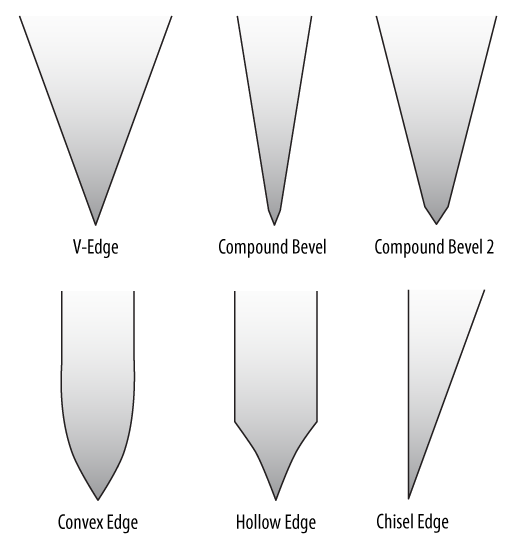
Sorry for the use of "v" it was coming from this picture.
knife-edge-styles3.png


So if I want a hollow or something other than zero then I would go down to about .03 HT and then do the secondary bevel? Or I must go to .03 HT, zero, and then put the secondary bevel on? Hopefully that question makes sense.
 
Most knives are left with some thickness before sharpening. It depends on the steel, use of the knife, hardness, and skill of the user, how much that thickness is. Maybe .020 for a chopper, .010 for a hunter, .005 for a kitchen slicer if you are goi g to do a flat grind with a secondary bevel.

So for me, with a 10xx steel in a hunter, it would be forge, thermal cycle, grind to ~.030, heat treat, grind to .010", hand sand, handle, make sheath, sharpen.
 
Back
Top