How is this finish achieved?

Joined
Dec 1, 2016
Messages
474
5561a61c9e54ad968f4122bcfbf544c1.jpg


Hello! Just using this knife as a example. I've been wondering how the finish above the bevel is created? Is it an acid treatment or something to do with the ht or...

Daniel.


Sent from my iPhone using Tapatalk

 
Firstly, you posted a pic from knivesshipfree.com. Why not tell us the make/model of the knife?

It is a Fiddleback Forge knife. If you spend a bit of time searching here and/or google, I'm sure you'll find the answer to your question. It is discussed and explained in great detail.
 
Firstly, you posted a pic from knivesshipfree.com. Why not tell us the make/model of the knife?

It is a Fiddleback Forge knife. If you spend a bit of time searching here and/or google, I'm sure you'll find the answer to your question. It is discussed and explained in great detail.

Ok thank you I've been looking around and didn't find anything so I'll look harder! It is a fiddleback forge bushfinger.

Daniel.


Sent from my iPhone using Tapatalk
 
I am also interested in this kind of finish. Specifically that which can be found on blades from Fiddleback Forge. Andy calls it spalted steel. Unfortunately he isn't sharing the process. http://www.bladeforums.com/forums/showthread.php/1321254-Spalted-Steel-is-Fiddleback-Forge-Exclusive

The closest i have found is a technique using cold blue and bleach and other variations. I haven't tried it yet so i don't know if the results are similar.

I am still very new to all this though. Hopefully someone with more experience can shed some light on this.
 
From what I can tell he is splattering some sort of coating on it to make a pattern and then etching it. Nothing very special about it I can tell, the material not covered by the protective coating is getting etched. Looks look he is taking something along the lines of bubble wrap dabbing it on the blade with something like fingernail polish, letting it dry and then etching. The high spots have a slightly darker color than the bevels, remove the coating from the previous etch, etch again for a few seconds and sand lightly with a hard backer over the high spots and get a slightly lighter color than the low spots, but darker than the blade bevels.

That's what it looks like he's doing IMHO..
 
From what I can tell he is splattering some sort of coating on it to make a pattern and then etching it. Nothing very special about it I can tell, the material not covered by the protective coating is getting etched. Looks look he is taking something along the lines of bubble wrap dabbing it on the blade with something like fingernail polish, letting it dry and then etching. The high spots have a slightly darker color than the bevels, remove the coating from the previous etch, etch again for a few seconds and sand lightly with a hard backer over the high spots and get a slightly lighter color than the low spots, but darker than the blade bevels.

That's what it looks like he's doing IMHO..

Thanks everyone! I'll have to experiment with some stuff sometime and see what I can come up with!

Daniel.


Sent from my iPhone using Tapatalk
 
I am also interested in this kind of finish . . . Unfortunately he isn't sharing the process.

If you click the link posted directly above your post, and scroll down, you will encounter the following:

"When we do we texture it with a small tap hammer that we etched a special texture onto the face. We do this cold, it doesn't take much of a tap to put the texture on the flats. This allows us to use the mill finished flats without having to surface grind it off. (My surface grinder is kinda a joke.) Then once we are past heat treat, the finishing of the textured flats takes a few seconds on the scotchbrite wheel, and we get the contrast. "
 
If you click the link posted directly above your post, and scroll down, you will encounter the following:

"When we do we texture it with a small tap hammer that we etched a special texture onto the face. We do this cold, it doesn't take much of a tap to put the texture on the flats. This allows us to use the mill finished flats without having to surface grind it off. (My surface grinder is kinda a joke.) Then once we are past heat treat, the finishing of the textured flats takes a few seconds on the scotchbrite wheel, and we get the contrast. "

Sorry but I'm going to have to call this one out. There is no way that is made with a hammer with a pattern etched in it. It's too random and I've looked at a lot of the blades since this post and there aren't any exact similar patterns or spots that pop out I can find with similarities. If this was done by a hammer with a pattern etched in it you'd be able to find some sort of replication in the finish somewhere. I could very well be wrong, but I don't see it. Looks more like an etch to me. Just my opinion.
 
The paragraph that P. Brewster quoted is missing the first 2 sentences. This is the full quote:

"I'm not big on SS. We do use CPM 154 on a fraction of our knives though. When we do we texture it with a small tap hammer that we etched a special texture onto the face. We do this cold, it doesn't take much of a tap to put the texture on the flats. This allows us to use the mill finished flats without having to surface grind it off. (My surface grinder is kinda a joke.) Then once we are past heat treat, the finishing of the textured flats takes a few seconds on the scotchbrite wheel, and we get the contrast."

This is how he finishes CPM 154 which looks nothing like the majority of his knives which are A-2.
 
The paragraph that P. Brewster quoted is missing the first 2 sentences. This is the full quote:

"I'm not big on SS. We do use CPM 154 on a fraction of our knives though. When we do we texture it with a small tap hammer that we etched a special texture onto the face. We do this cold, it doesn't take much of a tap to put the texture on the flats. This allows us to use the mill finished flats without having to surface grind it off. (My surface grinder is kinda a joke.) Then once we are past heat treat, the finishing of the textured flats takes a few seconds on the scotchbrite wheel, and we get the contrast."

This is how he finishes CPM 154 which looks nothing like the majority of his knives which are A-2.

Yes I have to agree with you. I did a search for "154" in the Fiddleback forum, and found this pic http://media.fotki.com/1_p,rrkssqtr...xwtdrgbktk/8/1214808/13557310/IMG_2834-vi.jpg

I think we can agree that this pic shows a hammer-tapped texture. I agree that it looks different than OP's knife.
 
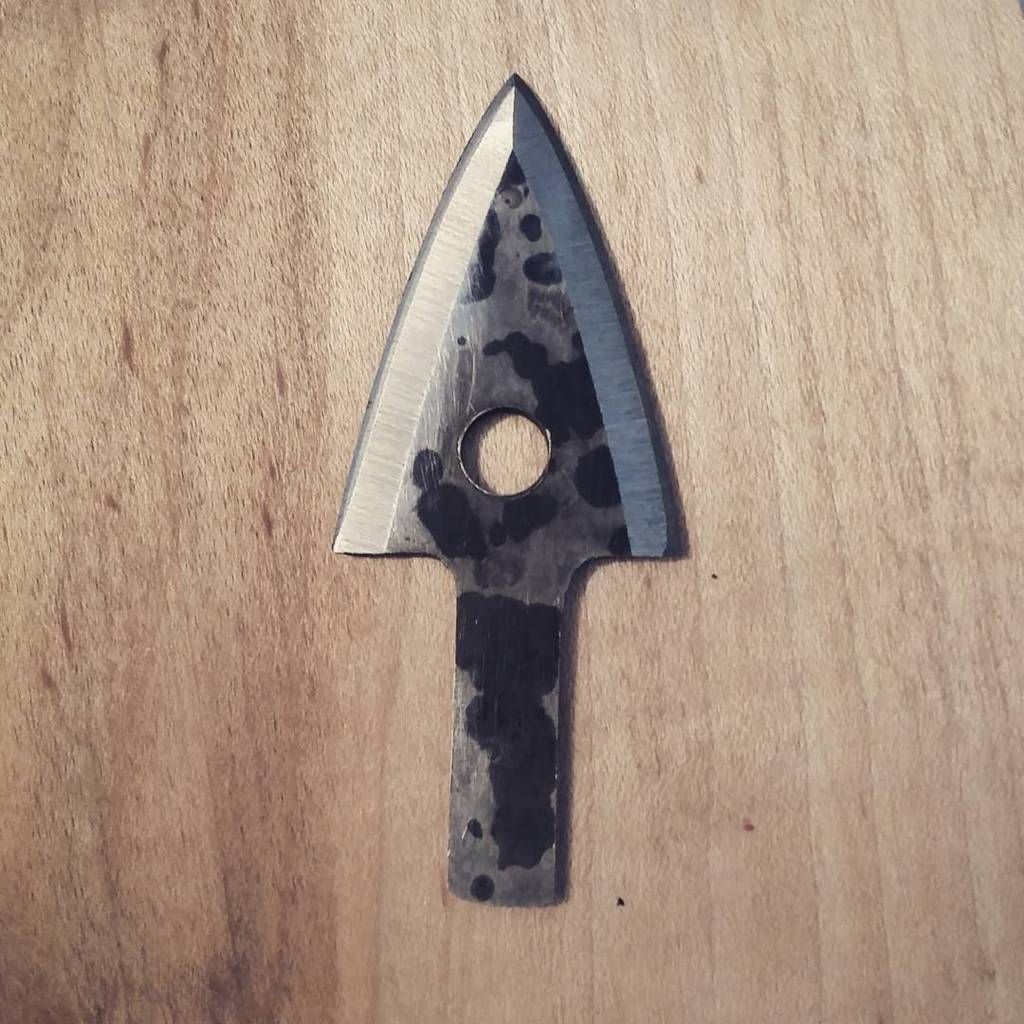
You can also achieve that look by leaving the heat treat scale on the flats. That is how I finished this 15N20 arrowhead below.
 
It's a well know fact that Andy's "Spalted Steel" blades are etched with unicorn tears and sasquatch blood :)
 
You can also achieve that look by leaving the heat treat scale on the flats. That is how I finished this 15N20 arrowhead below.


I was wondering if I might get a finish like that leaving the scale on! You answered that question! Thanks!

Daniel.


Sent from my iPhone using Tapatalk
 
This is proprietary and Andy fiercely guards it. To those who say it isn't special - do you know how many knives Andy sells, and how many people have asked about this very method over the years? Not very special at all.

Anyway. You can get a nice textured finish on your flats with a texture hammer. Get yourself a cheap hammer and use a cut off wheel in an angle grinder to score random crossing lines into the hammer face. When you strike your blade flat, it will leave square and triangular indentions into the surface. You can do this cold, but make sure the steel is dead soft. Normalizing heats, quenching and tempering will darken and heat color your flats nicely. If you'd like, you could scotchbrite, hand sand, grind etc. your flat surface and the dark scale will remain in the low spots you hammered. Very cool contrast. Hope this helps.
 
This is proprietary and Andy fiercely guards it. To those who say it isn't special - do you know how many knives Andy sells, and how many people have asked about this very method over the years? Not very special at all.

There is ABSOLUTELY NOTHING proprietary about etching a knife. He may have the term "spalted steel" trade marked or what ever it is it's "called", but by far I'm certain he does not have the process of etching a knife trade marked as "proprietary". He may guard how he gets the exact pattern he has and how he etches it in regards to what chemicals he uses but the process of etching I am certain he does not "own".. Personally I think it's great he sells a good number of blades, and if people find them attractive and desire them all the more good for him. I mean to bad mouth him in no way what so ever. He himself said it was a short cut to finishing knives "the easy way". It's no more than a gimmick and a gimmick that helps him sell knives. Kudos to him.

So in answering the question to the OP who asked how to get a texture like he asked about, there are literally hundreds if not thousands of people who etch knives. Nothing special about it, its an etching process. The etch looks splattered, so if you want an etch like that I'd suppose you'd have to find a way to splatter something to protect the high spots during the etch. I'm sure a few trials and errors and it wouldn't take much for someone to mimic it exactly. Well exactly enough considering that it is a completely random pattern.
 
Thanks for all the help guys! I don't particularly care for the finish my self (Nothing against fiddleback forge.) but had gotten a request for that type of finish from a family member. So now I'll experiment with some acid etching! Thanks again!

Daniel.


Sent from my iPhone using Tapatalk
 
The etching is not proprietary, how he achieves his exact pattern and texture is. He never said he invented etching or is the only guy making etched knives. Proprietary meaning he figured his own method to achieve his particular look and does not disclose it. With experimentaion someone else could achieve the same, or similar or even nicer.

Sent from my LGMS428 using Tapatalk
 
Back
Top