
-
The BladeForums.com 2024 Traditional Knife is available! Price is $250 ea (shipped within CONUS).
Order here: https://www.bladeforums.com/help/2024-traditional/
You are using an out of date browser. It may not display this or other websites correctly.
You should upgrade or use an alternative browser.
You should upgrade or use an alternative browser.
How Long is Too Long For a Bushcraft?
- Thread starter redsquid2
- Start date

- Joined
- Aug 19, 2007
- Messages
- 39,339
Good to know. I have made knives out of 440C, 154CM, CPM154, A2, files, industrial hacksaws, and recently O1. I think O1 is the easiest steel I have worked with so far, in terms of cutting it, filing it, etc. I also like the way it sands. I get a finish that I like with less work.
O1 and 1095 are my favorites for a knife of this type. Easy to sharpen and they take a fantastic edge. Of course this is with a proper heat treat.

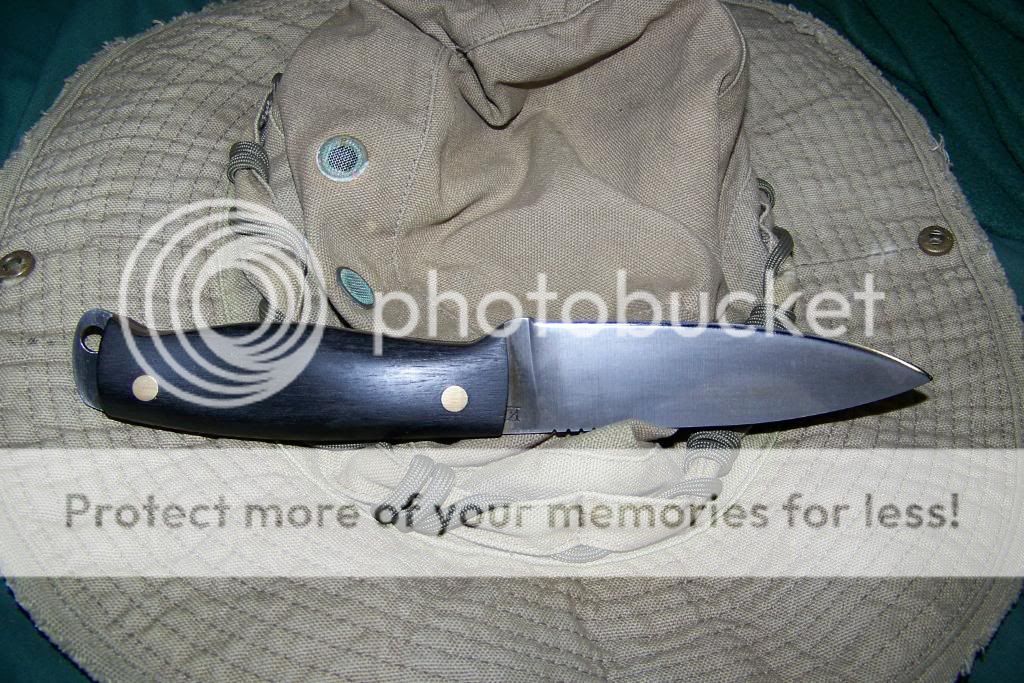
My favorite is 4 1/2 inches but I wouldn't hesitate to get one an inch or so larger if it's designed well.
This is my favorite.

wildmanh
Part time Leather Bender/Sheath maker
- Joined
- Jul 9, 2000
- Messages
- 7,764
I find no benefit for a length longer than 4.5"
I love the bark river aurora but its blade is longer than I think is necessary...
My Bark River Aurora has a 4.5" blade, tip to scales. I've used it to carve wood utinsel handles for practice, cut card board boxes, carpet, whittle roasting sticks, even used it in the kitchen. For me, for a General Purpose knife, It's about perfect. A knife with the same handle, but a shorter and thinner blade would also work great for me.
To me, a Bushcrafty type knife, is one that is mainly used for wood carving. Wood carving to make camp crafts, friction fire kits, traps and the like. In other words, some drilling, knotching and carving. . . . I tend to favor General Purpose knives, something that's good in the kitchen, can whittle, knotch stitcks, slice and dice, clean game if need be.
I tend to pair my GP knife with a saw and chopping tool. The chopping tool could be a 12" to 16" bladed Machete, a 15" to 20" [length over all] Khukri, or a 3/4 axe. The saw can be the 4.5" Saw on my SOG Revolver Hunter, an 8-9" folding saw or my 15" Stanley Sharptooth saw.
Recently, I used my Fiddleback KPH for some carving. It did fine. Even though I tend to favor using it in the kitchen, It's nice to know that it will handle carving tasks.
There are lots of ideas floating around out there. Make what you want, test it out and see if those features work for you. If it doesn't work out, modify the knife or make something else.
 Good luck and keep us posted.
Hammer67
Gold Member
- Joined
- Nov 9, 2012
- Messages
- 11,824
Forget the word bushcraft, just ask what you expect the user to do with the knife, especially the point....
Exactly.
For some, the term may mean a knife that is pretty much solely intended for wood carving and related tasks. For some, a "bushcraft" knife must be a knife long enough and stout enough for serious batoning, while for others, this isn't their intended purpose for the knife, and is the realm of other tools. For me personally, it also means a knife that can well perform skinning and other game processing duties, which can lend itself to some different characteristics than a tool intended primarily for wood tasks.
In my admittedly biased opinion, and given the various needs above, something along the lines of the BR Bushcrafter really hits the nail on the head:
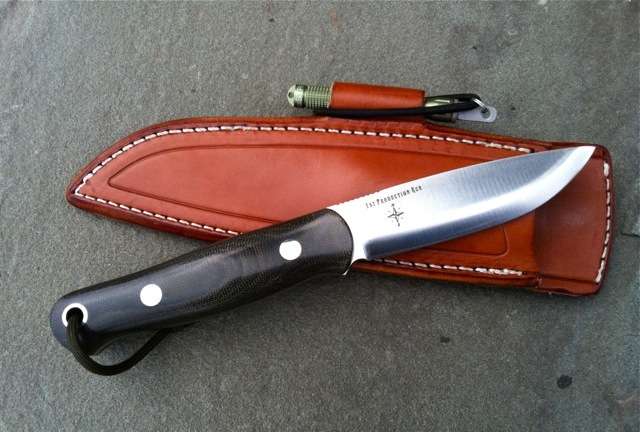
- 3.8" blade
- 8.6" overall
- a handle that is comfortable in lots of different grip styles
- Scandivex grind, full tang
- .145" thick
- CPM3V steel
But the real brilliance is in the blade design - the modified drop-point puts the point of the blade just barely above the centerline of the handle, making it quite good for drilling, etc. But it also has enough belly to it for game tasks (unlike some other "bushcraft" designs). And the grind allows for a stout spine with a narrow edge that, being convexed, still allows for great edge retention.
Others may totally disagree, and with good reasons. But this particular design is extremely versatile for my needs.

- Joined
- Aug 31, 2011
- Messages
- 3,136
Doodling around with pencil and paper, I came up with this:
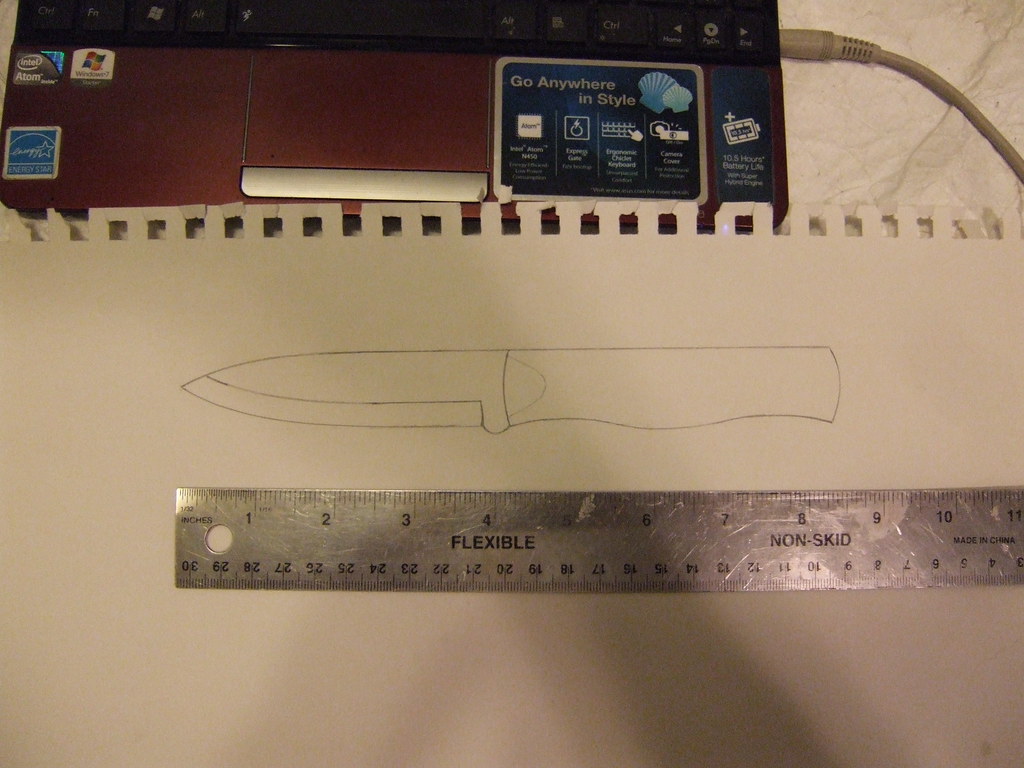
This one has a tip - to -scales measurement of 4 1/8", cutting edge of 3 7/8".
I saw a bushcraft demo on youtube where the guy says he likes to have a divot there at the front of the scales, to place his thumb.
This one has a tip - to -scales measurement of 4 1/8", cutting edge of 3 7/8".
I saw a bushcraft demo on youtube where the guy says he likes to have a divot there at the front of the scales, to place his thumb.
Hammer67
Gold Member
- Joined
- Nov 9, 2012
- Messages
- 11,824
I like. :thumbup:
Kind of like this?
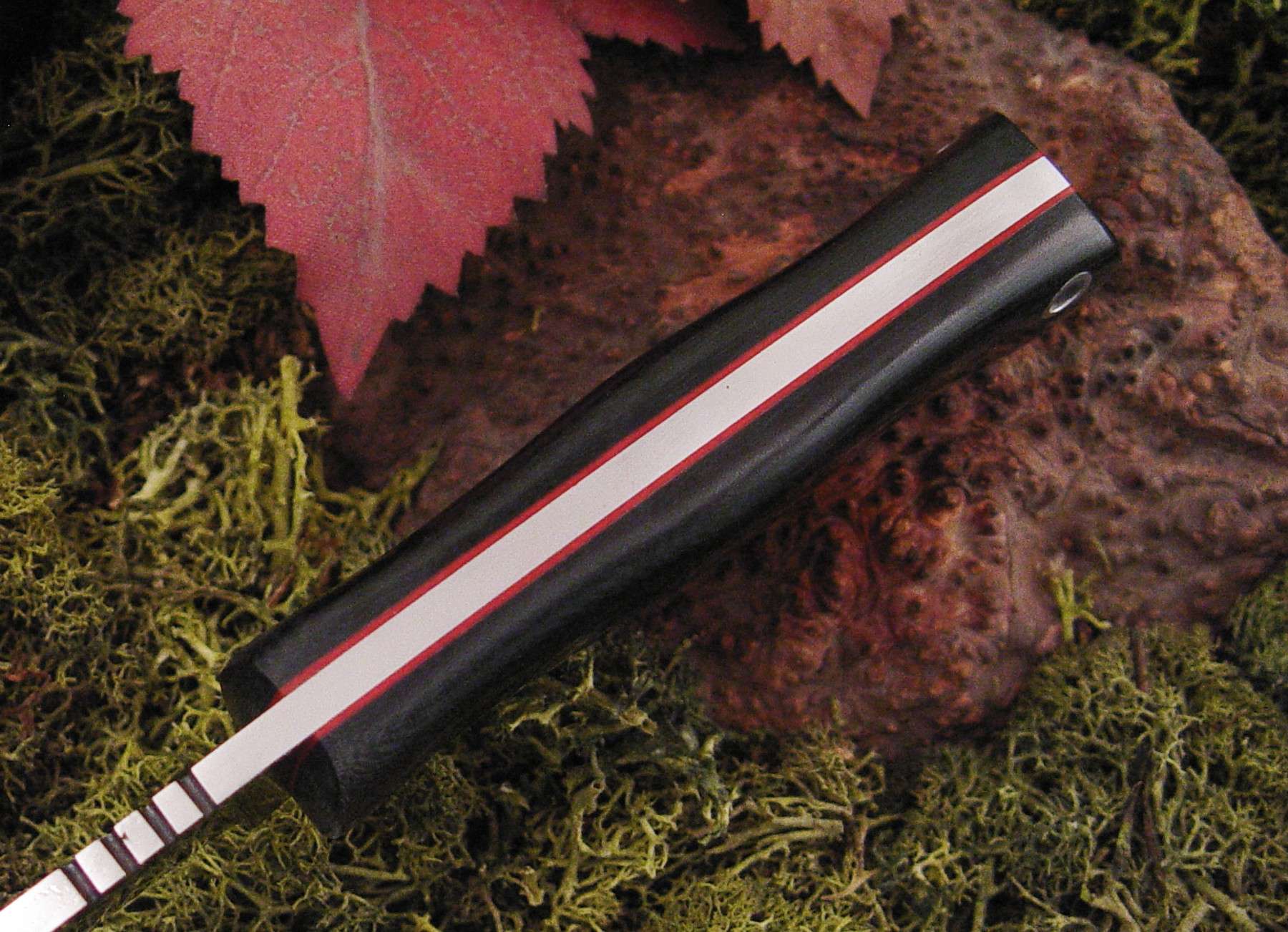
With the palm swell and the constriction near the front of the scales, I find the above to be a really comfortable handle, for a variety of grip styles. Obviously though, that will come down to a lot of personal preference, hand size, etc.
I saw a bushcraft demo on youtube where the guy says he likes to have a divot there at the front of the scales, to place his thumb.
Kind of like this?
With the palm swell and the constriction near the front of the scales, I find the above to be a really comfortable handle, for a variety of grip styles. Obviously though, that will come down to a lot of personal preference, hand size, etc.
For my taste, a scandi-ground, carbon steel blade between 3 and 4" is perfect. I have found that most anything made from stock thicker than 1/8" to be too thick for basic wilderness tasks (cutting wood, fibers, food, etc). My favorite knife (has been for ages) is the Kellam Wolverine. Its light, sturdy, COMFORTABLE (best handle on anything I've used), nimble, and cuts like a dream (though not as good as a Mora). I obviously prefer scandi knives, but I have a couple convex-ground knives that work pretty well. Here is what I look for in a woods knife (I also hate the term 'bushcraft'), in order of importance:
1) cutting ability (This is it's function, no? Again, I prefer a scandi for what I do, but some don't. Do what you feel)
2) comfort (this is really on par with cutting ability for me; if it hurts to use, I use something else. I have ditched a number of fine handmade knives just for being uncomfortable to use)
3) weight (a reasonably light, well balanced knife feels more like an instrument rather than a club...others would disagree. I find something less than 6-7 oz to be ideal. The Kellam is 3.5oz)
4) durability (I feel like this isn't hard to manage, even with the above criteria in mind. I beat the everlivin CRAP out of my first Mora #1, and it made it through just fine)
5) fit and finish (I like pretty shiny things as much as the next monkey, but the thing is going to get dirty and scratched up anyway. That said, a handmade knife should look like someone took care in its construction).
Hope that helps
1) cutting ability (This is it's function, no? Again, I prefer a scandi for what I do, but some don't. Do what you feel)
2) comfort (this is really on par with cutting ability for me; if it hurts to use, I use something else. I have ditched a number of fine handmade knives just for being uncomfortable to use)
3) weight (a reasonably light, well balanced knife feels more like an instrument rather than a club...others would disagree. I find something less than 6-7 oz to be ideal. The Kellam is 3.5oz)
4) durability (I feel like this isn't hard to manage, even with the above criteria in mind. I beat the everlivin CRAP out of my first Mora #1, and it made it through just fine)
5) fit and finish (I like pretty shiny things as much as the next monkey, but the thing is going to get dirty and scratched up anyway. That said, a handmade knife should look like someone took care in its construction).
Hope that helps
For my taste, a scandi-ground, carbon steel blade between 3 and 4" is perfect. I have found that most anything made from stock thicker than 1/8" to be too thick for basic wilderness tasks (cutting wood, fibers, food, etc). My favorite knife (has been for ages) is the Kellam Wolverine. Its light, sturdy, COMFORTABLE (best handle on anything I've used), nimble, and cuts like a dream (though not as good as a Mora). I obviously prefer scandi knives, but I have a couple convex-ground knives that work pretty well. Here is what I look for in a woods knife (I also hate the term 'bushcraft'), in order of importance:
1) cutting ability (This is it's function, no? Again, I prefer a scandi for what I do, but some don't. Do what you feel)
2) comfort (this is really on par with cutting ability for me; if it hurts to use, I use something else. I have ditched a number of fine handmade knives just for being uncomfortable to use)
3) weight (a reasonably light, well balanced knife feels more like an instrument rather than a club...others would disagree. I find something less than 6-7 oz to be ideal. The Kellam is 3.5oz)
4) durability (I feel like this isn't hard to manage, even with the above criteria in mind. I beat the everlivin CRAP out of my first Mora #1, and it made it through just fine)
5) fit and finish (I like pretty shiny things as much as the next monkey, but the thing is going to get dirty and scratched up anyway. That said, a handmade knife should look like someone took care in its construction).
Hope that helps
1) cutting ability (This is it's function, no? Again, I prefer a scandi for what I do, but some don't. Do what you feel)
2) comfort (this is really on par with cutting ability for me; if it hurts to use, I use something else. I have ditched a number of fine handmade knives just for being uncomfortable to use)
3) weight (a reasonably light, well balanced knife feels more like an instrument rather than a club...others would disagree. I find something less than 6-7 oz to be ideal. The Kellam is 3.5oz)
4) durability (I feel like this isn't hard to manage, even with the above criteria in mind. I beat the everlivin CRAP out of my first Mora #1, and it made it through just fine)
5) fit and finish (I like pretty shiny things as much as the next monkey, but the thing is going to get dirty and scratched up anyway. That said, a handmade knife should look like someone took care in its construction).
Hope that helps