How long should an edge last in construction?

weo

Joined
Sep 21, 2014
Messages
3,111
Hello all. I've been using one of my little damascus (1095/15N20) blades with a twist pattern in my remodel of my house, to cut a variety of things, but mostly fiberglass insulation (I got lucky and this seems to be a great shape and size for this task) and sheetrock laying on my OSB subfloor.
I'm curious as to y'alls opinion on how often I should have to re-hone the edge. I realize it all depends on how often I use the knife, but suffice it to say that I'm working pretty much full time and have insulated and sheetrocked my whole 1200 sf house using this little blade.
Thanks
 
i am going to guess the glass is pretty tough on the edge, that may be dulling it more than most common uses.
 
I think this is where the "type" of edge you put on your knife can make a world of difference. Refer to that crazy thread around here somewhere where lots of various steels are tested.
I used an xhp blade yesterday to remove carpeting, it just kept on cutting! except where i tried to pry a small nail, it made small chip, lol
found it: https://www.bladeforums.com/threads...ed-on-edge-retention-cutting-5-8-rope.793481/
 
Fiberglass and gypsum are both really rough on a blade edge. In those uses, you may have to touch the edge up weekly of more often to keep it sharp. A few seconds on a fine stone or DMT plate will keep the edge good. IT is when you let it get really dull and the edge worn back that it takes 15 minutes to re-do the edge.

I know people ( mostly chefs and firefighters) who give their blades a quick pass or two on a fine or extra fine stone every day. A final strop on a charged leather strap puts a razors edge on them. The whole process takes less than a minute.
 
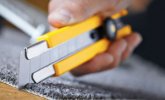
Fiberglass, sheetrock, carpet, shingle, tar paper/tyvek are hard on a knife. Let alone running into staples, nails and screws along the way. That is why they make utility knives with snap tips and replacement blades. I always have my knife on me when doing construction but only use it when it is inconvenient to use the retractable utility. I am one of those guys who strops/hones their knives more for pure joy than necessity, so I can't really comment on how long I think a knife should hold it's edge on the worksite. Disposable blades do the grunt work and when I need exact fine cutting, I use my personal knife.

I have three Extra Heavy Duty OLFAs in various tool pouches around the house... they are amazing tools. I could make a knife that can hold an edge longer... but in the long run, the disposable blade wins out because I am not afraid of ruining it... even cutting on concrete, knowing a fresh tip is a snap away.
OlfaH1b.jpg
 
Thanks for the replies. I figured the fiberglass would be hard on it, wasn't too sure about how bad the gypsum would be.
So I guess if I'm having to run it across a stone for a few passes after a full day's use to re-hone the edge, then I shouldn't be too hard on my heat treat. For this blade anyway...
 
The uses you mentioned are some of the hardest n blades ... I would touch it up at least at the end of the day if not a few times through the day depending on how the edge is performing.
 
Thanks for the replies. I figured the fiberglass would be hard on it, wasn't too sure about how bad the gypsum would be.
So I guess if I'm having to run it across a stone for a few passes after a full day's use to re-hone the edge, then I shouldn't be too hard on my heat treat. For this blade anyway...
You can try more coarse ege ?
 
Again, thanks for the replies.
I think this is where the "type" of edge you put on your knife can make a world of difference. Refer to that crazy thread around here somewhere where lots of various steels are tested.
I used an xhp blade yesterday to remove carpeting, it just kept on cutting! except where i tried to pry a small nail, it made small chip, lol
found it: https://www.bladeforums.com/threads...ed-on-edge-retention-cutting-5-8-rope.793481/
One thing I know I need to learn more is the different types and uses of edge angles/shapes. I just hope I can remember to do this.
 
Some things that increase wear resistance are: use a steel with greater carbide volume, use a steel with harder carbides, heat treat to a higher hardness, sharpen to a very low/acute angle, sharpen using coarser media, grind the blade to have a thinner cross section.

1095/15n20 is not a very wear resistant mix.

Hoss
 
I never fully replace an actual construction razor knife with a fixed blade, and to do so IMO is kinda silly. Not that I dont think they are useful and even practical on the job. I've been in construction my whole life, I use a construction razor knife in straight or hooked blade, a pocket folding knife, and a fixed blade on jobs, but not each as a universal tool.

My construction razor is my primary blade on job because the blades work and are designed to be disposable. Shingles, insulation, wood, caulk, etc. A new blade can be used for splinters even over my pocket knife.
My pocket folder is often used for strings, paper, maybe tarps, sharpening pencil, and other random utility and one hand emergencies.
Fixed blade often was an ESEE 3 in 1095 which is FFG. I used it for plastic, rope and bands, felt, heavier use and very light prying.

As to sharpening my fixed blade in 1095, it would obviously depend on how often I used it and on what, often a pass or two on a stone would get me right back to sharp, but I didn't let it get really dull. Every three days usually and it was more ths2n serviceable in between. Just like any time, it needs it when it wont cut efficiently and dont wait until you need it to sharpen it.
 
I never fully replace an actual construction razor knife with a fixed blade, and to do so IMO is kinda silly.

I agree, I mainly did it to test my edge/heat treat. It was my first attempt at a twist pattern I did a number of years ago (the bottom one in the picture) that has a couple of cold shuts on both the spine and edge where I didn't quite get the ridges from the twist smooth enough during forging and that was just sitting on my desk for the past few years.

The reason I said it was a great shape for cutting insulation is that it is long enough to slice through both the batt and paper backing, when sometimes a utility knife blade is a little short with the thicker batts that sometimes don't get compressed enough for the utility knife to cut entirely through.
UZ8R1A7.jpg
 
Back
Top