How long to dry Stabilized wood

Joined
Jan 24, 2007
Messages
1,626
Hi, How long does it take for the wood to dry after it's been Stabilized.??
Looking a scale size pieces 1/2" X 2" X 5"

I just made a vacuum set up and have no idea on the drying time.
I hope this is the right place to post this question.

Thank You
Richard
 
Tried a bit of pine and it went right through, then Jarrah not sure on this one yet, still drying used Minmax a very thin polyurethane.
Need advice on how long to leave it in as well, I left it in for about three hours until it stopped bubbling then let of the vacuum, put under vacuum for two more hours @ 18 inches of mercury or -8.8 psi no more bubbles for that time in.

Richard
 
Last edited:
How do you make a vaccuum set up? I'd like to learn how to do this. Thanks.

I have not had time to put up the pictures in Photobucket yet, still playing.
what you need is a air tight container and some way of creating a vacuum in the container pump or venturi set up connected to your compressor.

put the wood in the container cover with the liquide put it under vacuum other details are still being worked out.

I made a venturi .

Richard
 
I have no stabilizing equipment to try but for a relatively dry piece I've managed to dry them completely in silicagel in a day, I've tested on some pieces, some of the samples were cut a couple months ago, so it maybe a short cut for some woods before stabilizing, though I couldn't confirmed that. Maybe it is suitable for you. Silica gel is a very cheap material (15- 20 $ for 3 pounds) and it sucks the humidity very fast...
 
Emre is getting to the more important question:
How Long Do You Dry the Wood BEFORE Stabilizing.

The wood needs to be below 10% moisture content, better if below 7%.
Any wood needs to have as little water as possible to allow the stabilizing agent to properly penetrate and cure ( most resins will not cure right if water is involved). If you want to test this theory, add a little water to polyurethane and paint it on a piece of wood. It will stay sticky forever, most likely.

If the process is true stabilization, the resin will be cured in the stabilization process. If you are just impregnating the wood with something, it may never dry (You can cut into wood stabilized with Nelsonite and smell the chemical after years on the shelf.).

The answer to your question can only be answered by you, since no one has the same set of parameters as your setup (Ingredients, wood ,pressures, etc.). I would do the wood in batches of five or six test blocks ( 1X2X4") , and try different procedures until you come up with a good process. It may take twenty or more tries to get all the variables tweaked.

Here is a laundry list of areas to consider:
Wood species
Wood moisture content pre-stabilization
Stabilizing agent
Removal of excess agent prior to catalyzing
Amount of vacuum/pressure used
Curing catalyst or process (Heat, chemical, moisture,air, etc.)
Post-stabilization removal of excess cured and uncured agent

I recommend a full understanding and research into how polymerization occurs ,and the agents used to properly stabilize wood.

All this, and a lot of other things, may well add up to the realization that having it done in a processing plant (like WSSI) is often the simplest and best route.

I'm not trying to put you off from trying this.Have fun, and see what you can come up with. Make thorough records of every batch, with every detail listed.
Good luck.

Stacy

 
Hi Stacy, Thank you for your input you mentioned a few things I had not even thought about.
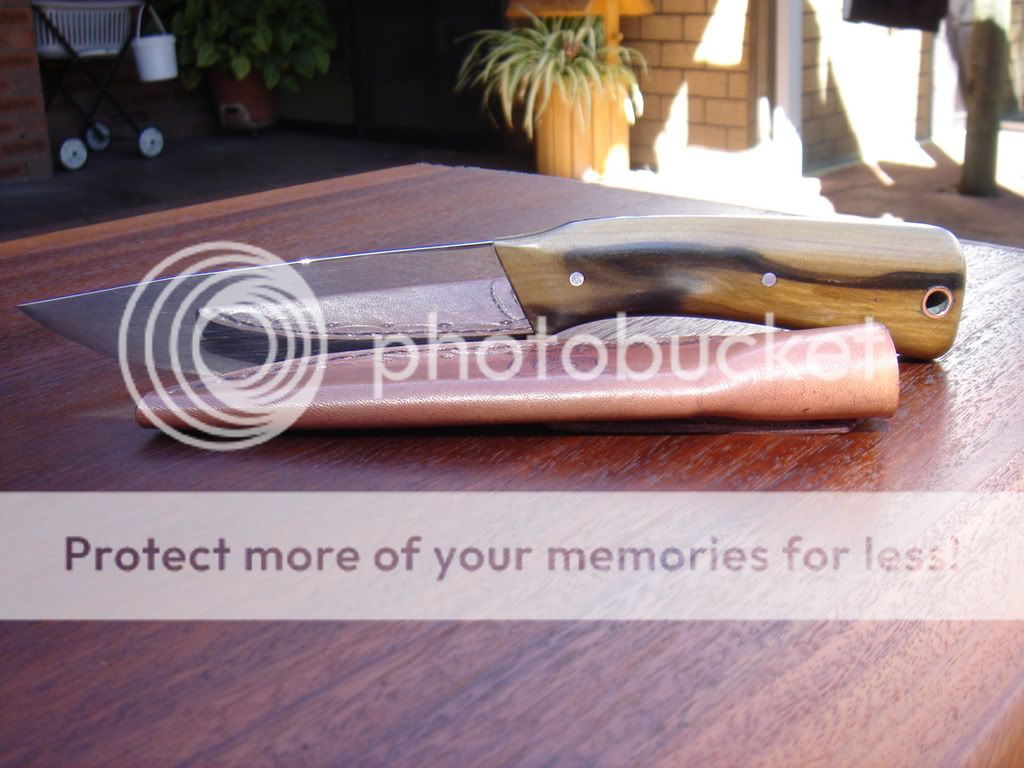
I bought quite a bit of Tasmanian Blackheart Sassafras about 4 years ago and it has been sitting in the back room for that long.
It has a great grain but the lighter colour is quite soft and I want to begin using it on my knives.
I think that should be dry by now, I will cut into the wood I used in a few days to see how dry and what level of penatration I obtained in a few days.
Once I know it's working then I will post pictures, sending wood to the USA to get treated would add a lot to the cost.

Richard
Blackheart4.jpg
 
Back
Top