How to achieve this grind?

Joined
Mar 16, 2013
Messages
92
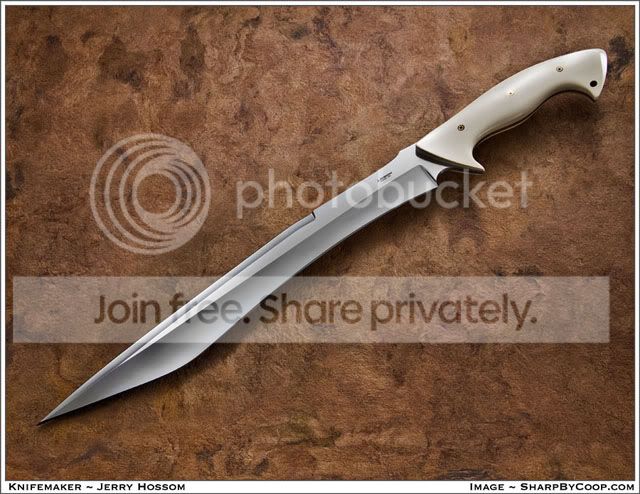
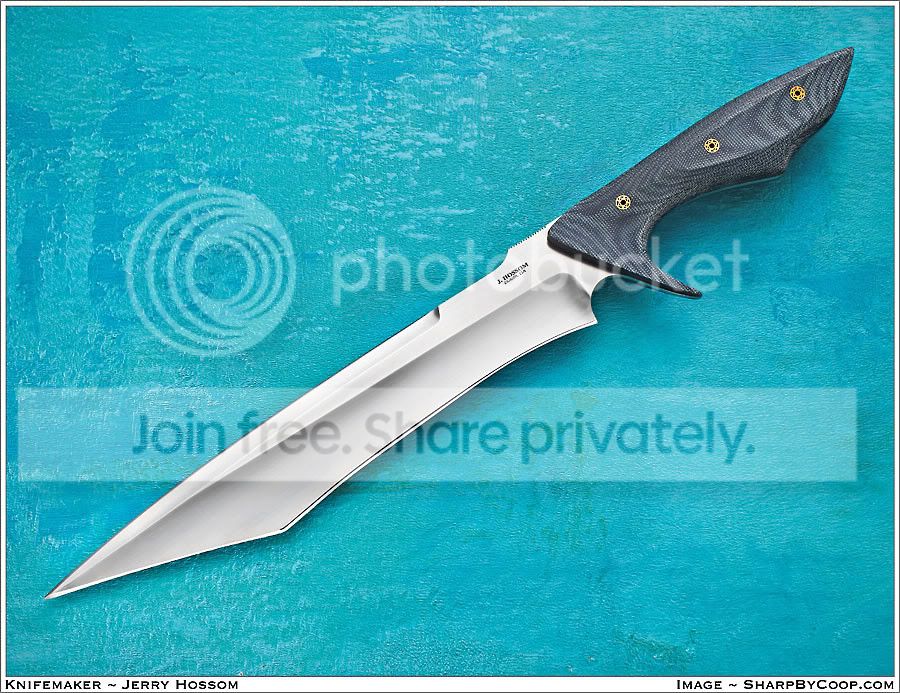
Hello all, I was making a friction folder for a friend recently and I was reminded of Jerry Hossom's american kopis and decided that a grind like that would be a great feature to include. When i went to grind it though, I realised I had no idea how to achieve it whatsoever.
Hossom_Kopis02-ww.jpg

What does he do to achieve a straight grind line on a curved edge like that? Does he hollow grind first to create the line, then grind everything below the hollow grind flat?
Is it a flat grind with a variable angle? Is it the product of some kind of relationship between distal taper and the radius of his grinding wheel?
I've tried looking on the net but with no luck. Does this sort of thing have a name?
If you've got a hunch or two, please share!
 
I'm not sure how he done this but it looks great.

I free hand grind to achieve a grind like this, I usually start and the plunge high on the wheel and as I move down the blade I bring it further down the contact wheel so there is more blade contacting the wheel, giving it a taper like the grind on this knife. I do however grind a little diff than most people. Belt running up and cutting edge down.
 
I don't do hollow grinds, or even make that many knives lately:o, too busy with house renos right now and my shop space is full of stuff from the renos. My guess on how he is pulling it off is that he just pushes the grind up in the wider section of the blade so the grind line stays more less straight.
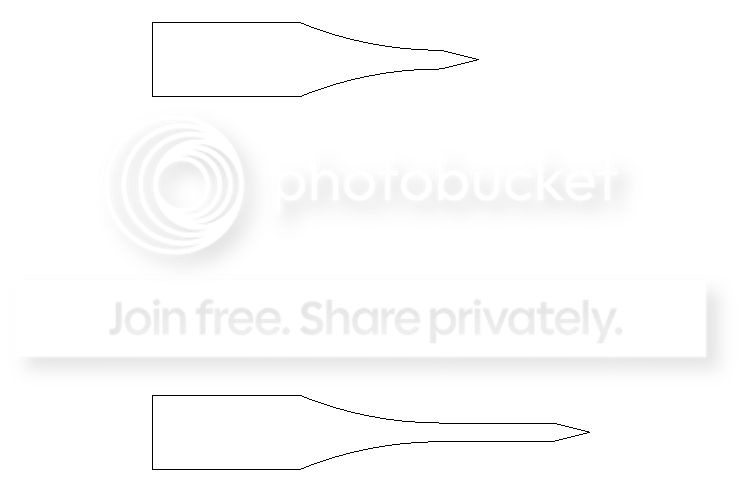
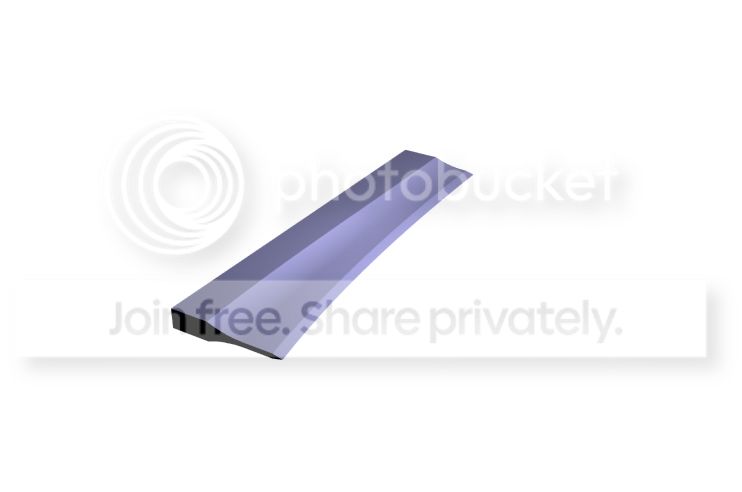
It may be an optical illusion, but the blade grind looks almost flat in the wide section and only starts to curve out to full thickness about 2/3 the way up. I am sure if what I am trying to say is coming out right but I will draw up what I am talking about and edit this post with pictures in a few minutes.

pictures added:

cross_section_zps43a732db.jpg


cross_section_2_zps99da598d.jpg


If this is what he is doing, he has very skilled hands, because I think it would take a fine touch to pull it off:eek: Keep in mind these pictures are just aids to help explain what I am trying to say and take no consideration for geometry and performance. In other words, what I drew would most likely break if used:p
 
Last edited:
Oh!
Thanks a lot you guys, I think I've got it figured out now! However, I think I'm going to need a fair bit of practice freehand before I can give it a crack. When I do though, I'll make sure to inbox you guys some photos :)
Thankyou very much.
 
It is called years of experience.
 
It helps to be Jerry Hossom, and seemingly just do it without even trying hard. Practice practice. Thats what the masters have done.
 
I think he may have ground it edge down. It would be easy to follow the straight spine and work down verus the usual working from the edge towards the spine.. Just a guess tho. I do know one thing for sure, grinding a super fine tip like that is a PITA.

Doing a grind like that on a small friction folder adds a whole diminsion of difficulty. Looking forward to seeing how it comes out.
 
Last edited:
Wow that looks tricky!

You can control the grind depth by sweeping or holding the blade at an angle. I'd guess that would be a start but am not really sure.
 
Ha! Unky and David got it right. It's all freehand done edge down, that with a few years of practice and getting it wrong more than a few times though.

And I never blow anyone off. Always glad to help.
 
Last edited:
That sounds like an interesting approach. Do you have the belt traveling down or up Hossom? Always up for trying something new (to me) in the world of makin knives.
 
Ha! Unky and David got it right. It all freehand done edge down, that with a few years of practice and getting it wrong more than a few times though.

And I never blow anyone off. Always glad to help.

Thanks for chiming in, Jerry. Your grinds are always so spot on and clean. I use them as inspiration all the time! :thumbup:
 
Sorry for the lack of replies, I only got an email notification for the most recent post.
Thanks for all the replies and tips everyone, especially you Jerry, gotta say I'm a little starstruck! Your designs are always a source of inspiration for me and I greatly admire your work. See if you can spot the Hossom going on in this khukuri I designed for KHHI :) http://www.thekhukurihouse.com/catalog/product.php?id=323937f65111
It seems that there are as many ways to grind a knife like this as there are to skin a cat. My project has been delayed indefinitely however, as I was overly keen to get the pivot hole drilled and so did it at home with a hand drill instead of at the workshop with my drill press. the drill bit broke on me and sent a crack a good inch straight down my beautiful little O1 blank.
The design for it is still rock solid and when I return to it with renewed enthusiasm I'll be sure to post pics when it's finished.
 
Quint, it's done on a Bader BIII running as it normally runs, with the belt running toward me and down. I got started grinding edge down when I began making knives in 1980 and my brother told me that's the way it should be done. He's been taking credit for my grinds ever since, but the fact is there are serious problems in doing it this way. Obviously you can't see where you're grinding nor the center of the blade while you're grinding, so grinding through the middle of the blade is a constant risk and I used to do that pretty often, not so much lately. I also tend to exacerbate that problem by using fairly small wheels, 4", 5", or 8" for all my primary edge grinds. The secondary edges are done with 2" or 3" wheels. I want to remove as much unnecessary steel as possible to reduce weight and smaller wheels do that. They also cut more efficiently than larger wheels. The above blade was ground with an 8" wheel. I mostly focus on putting the grind line where I want it, then feather the grind down to the edge to get that level (mostly). I really don't recommend grinding this way unless you have extraordinary hand skill OR (like me) a good many years of trashing steel to get a feel for what's happening. There are a good many makers who achieve pretty much this same thing grinding edge up, however, but they're likely smarter than me (most likely) or just don't have a brother giving them advice. :)

Here's another Kopis, this one with a secondary edge. I think the blade length on these was about 20"

AmericanKopisBB.jpg
 
Thanks for sharing your technique, incredible work.

Great looking knives!
 
Before someone says "if that idiot Hossom can do this anyone can," which is true, I probably should elaborate a little on the technique. There are a couple things I've learned in the past 30 years that have made it easier. I don't do all the grinding edge down. I start edge up, laying in a groove that is usually above the edge such that I really take very little off the edge in doing it, at most 30-40%. Once I have that groove well established from the plunge straight out the middle of the front of the blade, I then turn the blade over to edge down and grind up to about where I want the final grind line to be. After that is mostly done, I then begin thinning the edge by grinding down from the center of the grind to the edge. That usually takes quite a few passes, working in sections from plunge to point before the edge is level and about the thickness I want it to be before HT. I often do some tweaking here to get thing even and level, A couple more passes near the grind line and some more smoothing and thinning down to the edge. After HT, it all is gone over again and I adjust the edge to the final thickness I want for the type of blade I'm making. Getting and keeping the edge level is probably the biggest challenge. The fatal error though is when you suddenly see a blue spot appear in the steel on your side of the blade, not the side you're grinding. That means you've ground so close to through that the steel in that area will flex like thin paper. There is no recovery, at least none I've found satisfactory. Of course you can try telling someone that's a new design element you've created, but it's a tough sell at best.

Here's another example, with a secondary edge. Again, I do the narrow secondary edges with a 2 or 3" wheel, always edge up. The reason I use small wheels for that is so I can shape a sharpenable edge in a narrow area. These secondary edges will shave, and you just can't get that with a larger wheel in that narrow space.

Hossom_110611B-web_DxO.jpg
 
Nice looking, but how does the average person sharpen it on flat stones?
 
The average person doesn't need to use flat stone. They can use a 1 x 30" harbor freight belt sander and a few belts, all for under $100, and get a nice, hair popping, polished edge in under 5 minutes on any knife you own. Dead easy,
 
Back
Top