
-
The BladeForums.com 2024 Traditional Knife is available! Price is $250 ea (shipped within CONUS).
Order here: https://www.bladeforums.com/help/2024-traditional/
You are using an out of date browser. It may not display this or other websites correctly.
You should upgrade or use an alternative browser.
You should upgrade or use an alternative browser.
How to avoid scale on engraving?
- Thread starter Alex T.
- Start date
I've spent the day doing both for first time actually
Used thin wash of cement on some blades and high temp paint on others
They both cracked and let the heat on the blades in couple of places bit worked ok where it worked
...............
The ss foil definitely wouldn't crack
Where you HT'ing in a forge or oven? If forge, did you use a muffler tube? I should have mentioned I used an oven with the paint which worked good. It was header paint, but only rated for 500F.
One problem with SS foil with a high carbon steel is getting the foil off fast enough for a good quench, and with foil on it slows the quench too much. Remember with the 1095 mentioned you'll need to remove the blade from forge, remove SS foil, get in oil and cool below 800F in less than 2 seconds or so. I "think" I have that 2 seconds and 1200F fairly close. I've never tried to HT carbon is SS foil, but have read writings by folks who seem to know it doesn't work very well.

Bill DeShivs
Knifemaker / Craftsman / Service Provider
- Joined
- Jun 6, 2000
- Messages
- 12,832
You can try coating the blade with White-Out.
Finish your engraving before you heat treat.
Finish your engraving before you heat treat.

Alex T.
Beginner knifemaker
- Joined
- Mar 10, 2019
- Messages
- 119
I'll try a sample of this too, thanksYou can try coating the blade with White-Out.
Finish your engraving before you heat treat.


- Joined
- May 29, 2004
- Messages
- 25,147
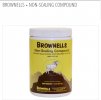
The guys on the engraving forums recommend this: https://www.brownells.com/gunsmith-...ccessories/non-scaling-compound-prod1122.aspx 

~Chip
~Chip
- Joined
- Aug 2, 2010
- Messages
- 1,611
I believe the Brownells stuff is the same as PBC anti-scale compound, which I have and it works very well if properly applied. The only things I'm not the most fond of when using it are that you have to pre-heat the blade to ~500-600 (to get it to stick to the blade) and then you quickly sprinkle the powder on, which can be a bit messy and you have to pour a good bit to make sure every spot of the blade is covered. Of course you do this over a steel pan or backing sheet or something similar in order to not waste the all excess powder. It's not hard to do, but it may seem like an extra step/annoyance to some guys if they do it with every blade, but definitely not for one here and there. You definitely need to boil it off in order to get it all off and also scrub it a bit.
I just use a scrap of aluminum which a sharp edge and scrape off as much excess as possible before boiling, I do the same with clay hardened blades but don't really need to boil those. The aluminum won't leave any create any deep scratches like something like mild steel would.
Anyway, for years now (been slackin') I've been meaning to try some of the liquid anti-scale compound also by Bownells, the ATP-641 stuff that can be applied at room temp by simply brushing it on. https://www.brownells.com/gunsmith-...ating-sku100002607-23076-49084.aspx?rrec=true
Apparently it crumbles upon cooling and will wash off in under hot water, so it might be a good idea to put a screen in your quench tank to filter out any of the coating that falls off in the oil. Also, I'm not sure about the drying time needed before heating it up in the forge. I'm sure some of the guys here have used it and know more about it than myself.
~Paul
My Youtube Channel
... (Just some older videos of some knives I've made in the past)
I just use a scrap of aluminum which a sharp edge and scrape off as much excess as possible before boiling, I do the same with clay hardened blades but don't really need to boil those. The aluminum won't leave any create any deep scratches like something like mild steel would.
Anyway, for years now (been slackin') I've been meaning to try some of the liquid anti-scale compound also by Bownells, the ATP-641 stuff that can be applied at room temp by simply brushing it on. https://www.brownells.com/gunsmith-...ating-sku100002607-23076-49084.aspx?rrec=true
Apparently it crumbles upon cooling and will wash off in under hot water, so it might be a good idea to put a screen in your quench tank to filter out any of the coating that falls off in the oil. Also, I'm not sure about the drying time needed before heating it up in the forge. I'm sure some of the guys here have used it and know more about it than myself.
~Paul
My Youtube Channel
... (Just some older videos of some knives I've made in the past)
- Joined
- Aug 2, 2010
- Messages
- 1,611
Just did a quick forum search and found a semi-recent thread on the anti-scale compound(s) mentioned above. It sounds like the ATP-641 liquid from Brownells might be the way to go
https://www.bladeforums.com/threads/anti-scale-compound.1484814/
~Paul
My Youtube Channel
... (Just some older videos of some knives I've made in the past)
https://www.bladeforums.com/threads/anti-scale-compound.1484814/
~Paul
My Youtube Channel
... (Just some older videos of some knives I've made in the past)
Bill DeShivs
Knifemaker / Craftsman / Service Provider
- Joined
- Jun 6, 2000
- Messages
- 12,832
Regardless of which anti-scale compound you use, bright-cut engraving will be frosty in the cuts.
Alex T.
Beginner knifemaker
- Joined
- Mar 10, 2019
- Messages
- 119
As long as it is cleanable, that is ok with ok.Regardless of which anti-scale compound you use, bright-cut engraving will be frosty in the cuts.