How to cut this board for scales?

Joined
Nov 3, 2010
Messages
65
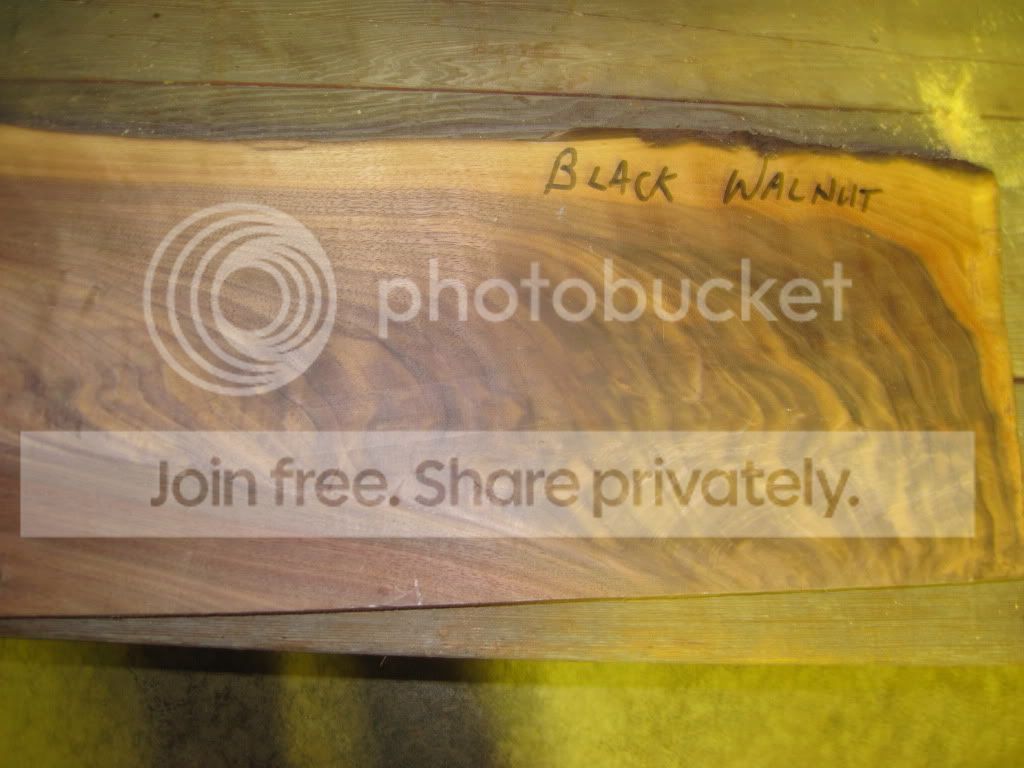
I'm not sure the best way to cut this to get the best character. It's just over 1 1/8" thick and will be used for scales.
Thanks
Burl003.jpg
 
Last edited:
Youre going to need a table saw. Cut it lengthwise, then cut that into whatever length scales you need. Then split those with a thin kerf blade and you should be ready to rock. You may want to base your initial cuts on the grain you want.
 
Cut a rectangular hole in a piece of paper, cardboard, whatever, and lay the paper with the hole on the board to get a better idea of what the grain will look like as scales.
 
Thanks for the input. It's a really pretty piece of wood and once I cut it, I don't get a second chance!
 
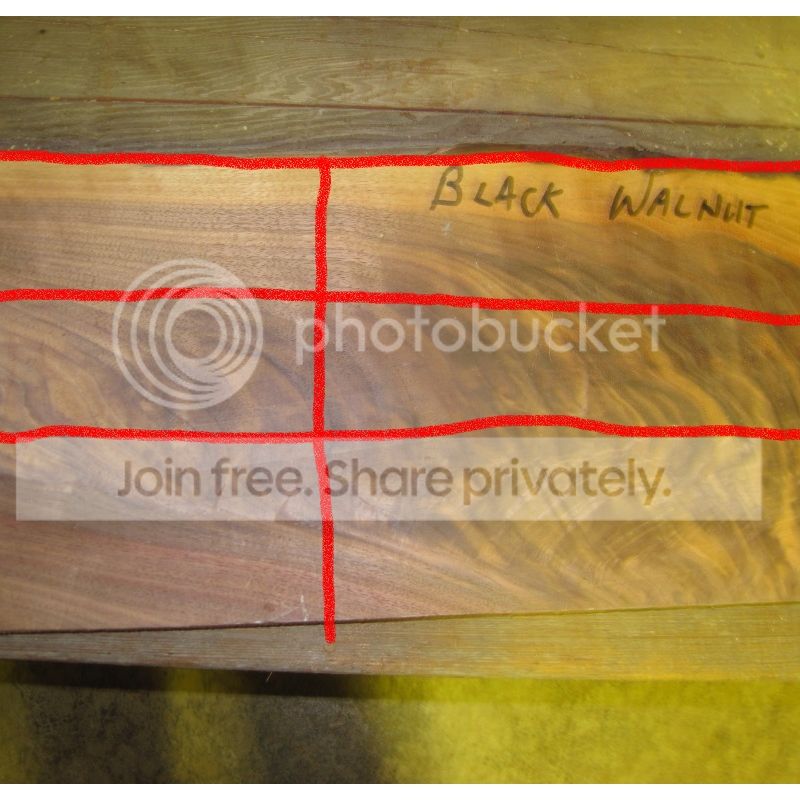
Here is how I would cut based on about a 6 inch wide board.
The lines are supposed to be straight and evenly spaced 2 inches apart.
cut.jpg

The 1st cut would be to get a straight edge along the sapwood.
2nd cut would be so you can get a strip 1/2 sapwood and 1/2 dark.
Next strip will give figured.
Last strip part figured and part straight grain.
Then split for scales.
 
Slightly pointless discussion in that there's no idea of scale.
If the board is wider than 4", I would do 2" vertical slices (in relation to the picture)
That way you get a bit of sapwood in each scale.
 
Thanks Burl Source. Those are the specifics I was really looking for. I didn't know if I should stay parallel with the existing cuts or angle one way or the other to maximize the character of the wood, even if it meant fewer scales.
It's actually 8 - 8 1/2 inches wide. Any reason not to go 1 1/2 " wide?
 
Slightly pointless discussion in that there's no idea of scale.
If the board is wider than 4", I would do 2" vertical slices (in relation to the picture)
That way you get a bit of sapwood in each scale.

Do most consider "a bit of sapwood" a plus or a minus? Again, why 2" as opposed to 1 1/2? Please understand that I'm not being argumentative. Just picking your brains :)
 
It also depends on the knid of knives you make.
You'll get more skinners out of that board then bowies.
 
Do most consider "a bit of sapwood" a plus or a minus? Again, why 2" as opposed to 1 1/2? Please understand that I'm not being argumentative. Just picking your brains :)
Depends who you ask. Some like the 2 tone look.
Like already mentioned 2 inches gives a little wiggle room.
 
Dishrawder,

Don't feel bad about wasting a bunch of that wood.

Most people look at a board like that and simply try to figure out how to get the highest number of blocks or scales out of it. I look at a board like that and think - hey, I like the flow of the grain right there in the middle and that little bit of curl would look really nice when oriented in such and such direction relative to the blade. In other words, I try to find the best handle hiding in that wood. And if it's an inefficient use of the limited amount of boardfeet I have, then so be it. I will spend hours cutting, grinding, filing, sanding, oiling, and polishing that handle, and when I'm done it will serve its new owner for a lifetime of use. Do I really want to use a suboptimal cut of wood just because I didn't want to waste a bit of it? Because in the end its only a few bucks worth of wood....

So here's my suggestion. When you're ready to use the wood, sketch the outline of the knife and handle on a piece of paper, then cut the handle part out of the paper and lay the sheet over the wood. Move it around until you find the most appealing section of grain, oriented in a way that goes well with the overall flow of the knife, and then trace around the edges with a pencil. Give yourself an extra quarter inch around the outside and then cut. You'll be able to do this a few more times on this same board. You won't get the highest number of handles out of it, but you'll get the best ones.

And consider the math. Right now on eBay there's an auction for two really nice boards of crotch walnut, each about 9" x 25" and more than an inch and a half thick. You can "buy it now" for $80, plus maybe $15 for shipping. Each board could then be cut into 12 pieces measuring about 2 3/4" x 6", giving you a total of 24 big thick handle blocks for $95. That's less than $4 a block. Now let me ask you, would you rather have 24 very nice handle blocks for $4 each, or maybe 15 really special handles for $7 each? Are your knives worth the extra three bucks? Mine are. :)
 
Back
Top