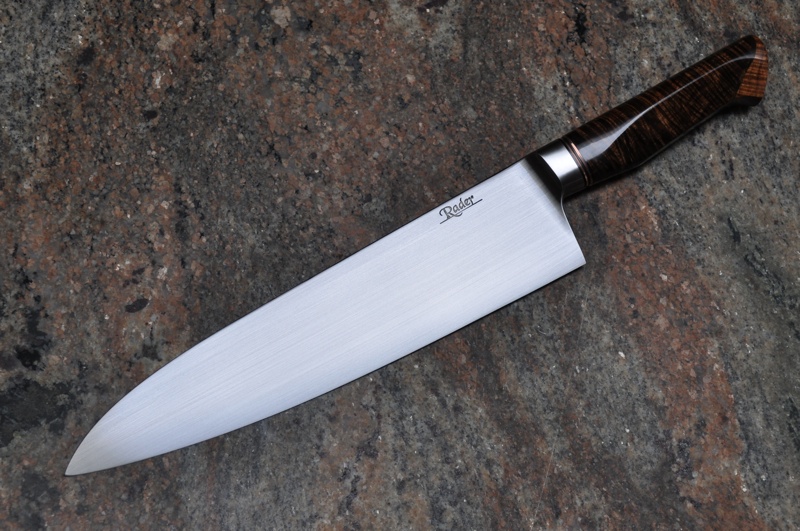
How to get a glassy handle?

Joined
Oct 4, 2011
Messages
1,043
I love handles like this:

M8wsnLq.jpg


What does it take to get to that point? I've been finishing mine up to 2000 grit and then some oil if needed and a light hand buff, but to get it to that slick, shiny finish will I need to get an actual buffer?

What compound is used, also? Thanks!
 
Last edited:
Weird, I'll fix that really quick. It works on my normal browser but not my incognito.

EDIT: Done. Hope it works now.
 
Thin coats of CA glue sanded down between coats - then finished off with a top coat of wax or a danish oil finish.

You could also use a thin coat of clear epoxy - such as West Systems 207 clear hardener. The hardware store stuff that dries amber won't do for a top coat...

TedP
 
Check out some of the finishes that wood workers who make pens use. Try the Penn State Industries web site. THey use some sort of mixture of CA glue, beeswax and oil. They just wipe it on while it's spinning on the lathe and it's done.
 
There are a few easy ways to get a dipped in glass finish.

Conversion Varnish (very hard and chemical resistant)
Polyurethane
Polyester
Acrylic Lacquer

These are expensive finishes for only one knife but if you are in the business of making knives, its worth it.
 
Thanks guys. I'm surprised no mention of a buffer; I would have thought that would have been the way to go.

Now I remember about the CA finishes. For some reason it wasn't registered in my head at all but I clearly know what it is and what it does.
 
Stabilized wood will buff up very nicely. Sand to 2000 and hit the compounds. Basically you are working a plastic after proper stabilization.
For really hard woods, Jobata specifically, I have been able to sand the wood up and buff it raw. Then just a light coat of tru-oil hand rubbed...
Cheers.
 
Thanks guys. I'm surprised no mention of a buffer; I would have thought that would have been the way to go.

Now I remember about the CA finishes. For some reason it wasn't registered in my head at all but I clearly know what it is and what it does.

Conversion Varnish
Polyurethane
Polyester
Acrylic Lacquer

All require a buffer. A simple bench grinder with rag wheels and some compounds will do it for you.
I like coating a wheel with Meguiars Mirror Glaze or one of the many polycarbonite polishes like Novis for a final polish
3M also has some swirl remover that gives a high gloss final polish.
 
As has been said CA in thin coats, maybe 20 or more, sand and then buff with
1400 grit white compound. Slow and with very little pressure. I've done quite a few
burl handles pretty much used all the varnishes and buffed them. I'll take the CA
every time.
Ken.
 
Conversion Varnish
Polyurethane
Polyester
Acrylic Lacquer

All require a buffer. A simple bench grinder with rag wheels and some compounds will do it for you.
I like coating a wheel with Meguiars Mirror Glaze or one of the many polycarbonite polishes like Novis for a final polish
3M also has some swirl remover that gives a high gloss final polish.

Ah, ok. Thanks. I wasn't aware of the process.

Sounds like I do need a buffer then. I'll have to give those a go and the CA too.
 
Don here's a pic of burl oak done at 390rpm's with very little pressure.
Probably 25 coats of CA with a bout a 10 day dry time total. About 15-
-ish years ago there was a recipe in blade magazine. I believe I sanded
@ 400 grit before beginnig the buffing. Ken.
 
I've been using auto clear coat with great results.also seems to work for stsbalizing but a bit messy
 
Back
Top