
How to get seamless fit with bolster to handle

Alex T.

Beginner knifemaker
Joined
Mar 10, 2019
Messages
119
Basically the title, how can I get this seamless fit? Ultra flat surface? Method of fitting the bolster? Special grinding technique? Not put epoxy?

I want to hone my skills and I am seriously getting literally crazy. I spent literally 20 hours last week lapping a handle and bolster utntil they were very flat when tested on my granite plate + dykem. Also tested on new 123 blocks surface is flat, it seemed seamless. Then I pin everything, making sure bolster are flat on the tang, still no gap. Then I grind and it seem the finer I go the clearer the "gap" is visible (even tough you can't feel it with a finger). I am so obsessed by this problem it is getting ungesund (malsain in french?) Any tip? Is the epoxy overheating and expanding in the space?
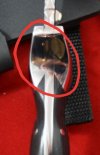
 
Pictures would help.... what bolster material? Handle material?
The gap is on the joining adjacent faces of the bolster and handle?
 
Sorry I meant the tang, so the junction between the tang and bolsters. I use 304 stainless on mostly stainless knives. I was a bit tired yesterday, it is not that much a gap, more like a very very fine black line at the junction. It is visible everywhere where the tang meets the bolsters. I do not have this problem with the scales to bolsters junction. And I do not understand why because when I finish lapping my bolsters and my tang, both can stick together with just a drop of water, something I put nothing and they still stick, then why do I see this very fine line at the junction?20200115_054019.jpg
 
I have no experience with this but I remember reading somewhere here that it can happen if you peen the bolsters and don't counterbore the backside. Pin material accumulates against the tang and pushes the bolster out. Might this be the culprit?
 
So it seems to me that you have a good fit. I’m guessing that what you want is the material to wash away so that there’s no line at all it seamless.
That’s not going to happen.
If you don’t like that joint line then you have to use a colored contrasting liner.

here's a Loveless knife from a world class maker, It's a stainless guard but the concept is the same, the two steel faces joining together show a line.

xYogHoY.jpg
 
Last edited:
Fredy, I found a way around it by clamping my bolsters between 2 pieces of wood after peening and press the hell out of it in my vise, that way the pins enter wood and the bolster is put flat against the tang. A bit hard to explain but it works wonder.

HSC so basically It is impossible ton make them wash away like the pins?
 
HSC so basically It is impossible ton make them wash away like the pins?

I'm not aware of how to....I tried this recently with a softer material thinking the same.
I joined 2 bronze ferrules together thinking the line would wash away (because softer material) but it didn't.

I'm querying my friend Tim Wright, let u know soon
 
I am just taking a pure guess here - but any time you have a junction between two different materials (or even the same materials with the grain running in different directions, when you sand them there will be a difference at the interface in material removal, and that could contribute to visibility of the interface......
 
Alex T. Alex T. he says a line will show....you could reduce the contrast between the two steels by hardening the bolsters to about 40 RC, you would have to change to a 416 ss
 
Thank you all for your input, really appreciated. H HSC /// I tought about switching to 416, the problem is I do not have a HT oven for proper HT and I can buy 304 for cheaper than 416 also. I am curious, how switching to 416 could make it less visible? I do not know a lot about metallurgy, what does 416 have that would help hide the transition line?
 
a variable speed disc grinder and a lapping plate will get you perfectly flat , fast.

If you do not have a disc then a glass platen on your grinder works good to get mostly flat, then take to lapping plate.

If you want to check and see if something is flat. Place it on a piece of glass with a bright light behind it and if you can see light between the piece and glass then it is not flat.

If you want that 304 bolster and tang to look seamless as possible then silver solder it on.
 
Last edited:
Thank you all for your input, really appreciated. H HSC /// I tought about switching to 416, the problem is I do not have a HT oven for proper HT and I can buy 304 for cheaper than 416 also. I am curious, how switching to 416 could make it less visible? I do not know a lot about metallurgy, what does 416 have that would help hide the transition line?

You do not need to switch to 416, 304 looks great and is truly stainless.

416 is much easier to work with, 304 is gummy and a pain to mill.
 
AVigil AVigil I puchased yesterday a 12" disk grinder and tried it today, it definitaly speed the flatening process! I do the rough grind on the belt grinder than switch to the disk. It does not save me from lapping but it does help a lot.

About silver solder, do you bevel the area to be soldered like in welding?
 
AVigil AVigil I puchased yesterday a 12" disk grinder and tried it today, it definitaly speed the flatening process! I do the rough grind on the belt grinder than switch to the disk. It does not save me from lapping but it does help a lot.

About silver solder, do you bevel the area to be soldered like in welding?

I lapped all bolsters, scales etc. when done 95% on a disc the lapping goes by much faster.
 
Thanks for you insight guys :) I experimented a bit today, I bought some cutting fluid. I found that lapping goes WAY faster compared to water, WD40, soapy water or windex. I also found that using a 120 grit disk vs a 80 grit gives a flatter surface on the disk grinder, I will test with finer grit to see if I can improve this more. I will post my progress, if there is any, for other people that might have the same problem.
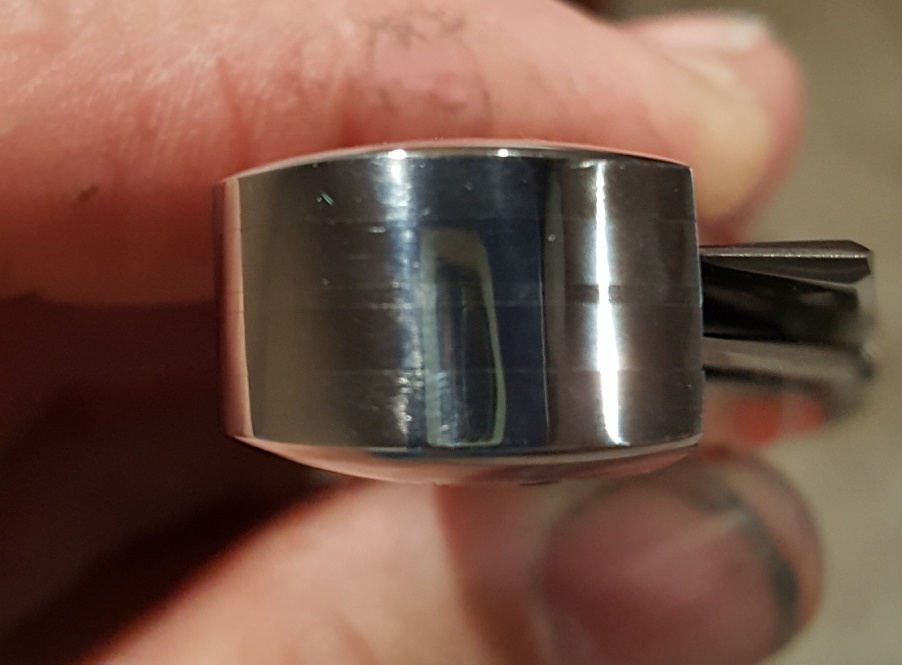
 
Flat and parallel will make the lines virtually disappear. Make your bolsters about 1/8 inch oversize then when you flatten you don't have rounded edges, then grind down to match the tang. you should see color difference but not lines.
This folder is 5 layers.
2v2HE4tHLxAWw5m.jpg
 
So if I "curve" the bolsters the line will show more than if I keep all parallel? Thank you sir!
 
I think what SBuzek means is that it is hard to make bolsters flat all the way to their edge using hand lapping, that there is a tendency for abrasive to form a bow wave (like a boat makes) ahead of the bolster and this removes fractionally more material from the bolster than is removed in the middle area. A bit like stropping rounding a cutting edge over time. Hard to see against a straight edge and hard to see using Dykem.

If the bolster is flattened oversize then when ground back you will be grinding into material that has a higher chance of being really flat.

Think that is what he meant...

Same probably goes for the tang where flattening with really fine grit could polish the edges a little more than the area 2-3mm in from the edge.

Chris
 
Back
Top