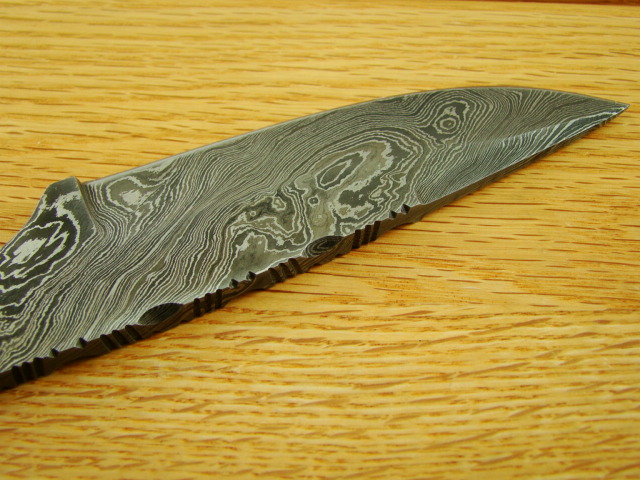
There is more chance of you ruining the knife by trying to "touch up" the etch with FC than the gain of the looks.
Unless you have a removable handle, and can properly re-etch and neutralize the blade ( and then re-assemble the handles), don't try it. It will likely come back to haunt you as rust later on.
Depending on the handle material, you can darken the shiny spots with cold bluing paste and carefully clean up the area.
Here is a short tutorial on doing a file worked damascus spine and installing a handle:
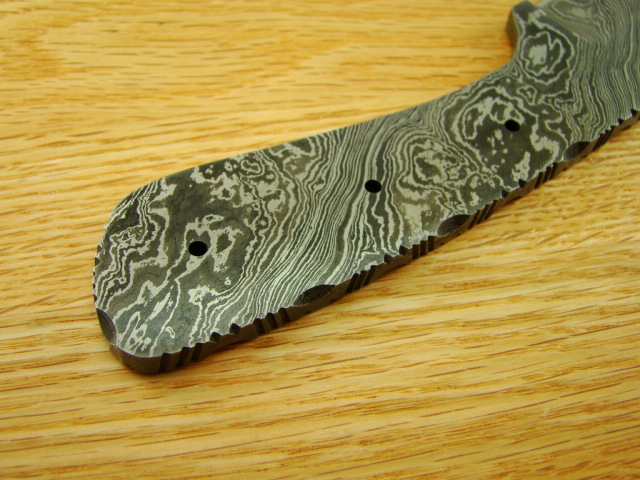
The best method on a blades with a file worked spine ( especially one in damascus) is to drill the scales for Corby bolts and temporarily put them on. Sand to when it gets close and stop as soon as it gets almost to the spine. Remove the scales from the blade, screw them together with the Corby bolts, and finish the sanding along the edges to the final grit. Touch up the etch on the blade if needed, clean the blade well, and permanently install the handle using 1 hour epoxy *. Just tighten the Corby bolts snug, don't torque down hard. Wipe off all squeeze out and remove the residue with acetone as the epoxy dries. Let cure for 24 hours. Wipe off with acetone to remove all traces of epoxy on the blade and spine.
Place a 3/8" wide strip or two of tape all the way around the tang to cover the spine, and wrap the blade in tape. Trim off the excess from the Corby bolts, and sand and shape the sides of the handle to the desired shape. As you do the last sanding grits, untape the tang area, and place a new strip of tape that goes right along the spine.It should cover all the metal of the spine and one scale - exposing the other scale for sanding. Finish the sanding on the uncovered scale as needed. Remove that strip and re-tape the handle to do the other scale.
This method is about the best way to avoid sanding the etch and dark color off a file worked damascus blade.
* Coloring the epoxy to make a color fill in the spine filework is also a good idea. Red works well, as does black.