How to make a knife out of nothing ?

Nice stuff thanks Wolf. It looks very 'authentic' too. Have you ever tried fixing a stone head like those to an arrow?

Yes and I've used them for hunting groundhogs too.

I've been knapping for about 22 years.

For anyone who really wants to get into flintknapping, find D.C. Waldorf's book and videos. They are very well done and you can teach yourself how to do it with lots of practice and good material & tools.
 
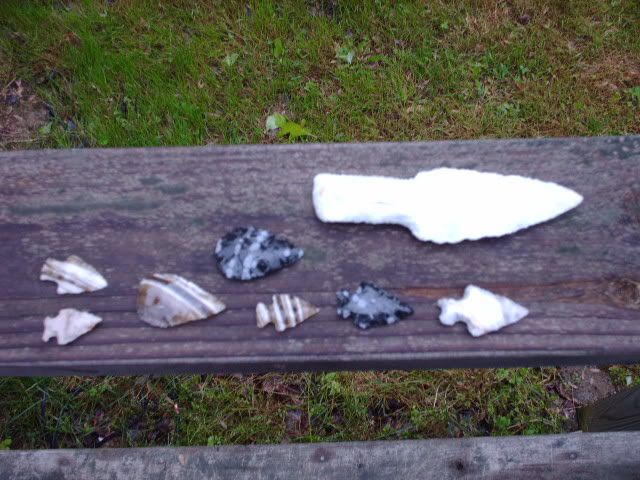
Some of mine:

HPIM0214.jpg

The tan ones are very, very nice. I would love to have some for myself .... Of course, off into the woods I go looking for some very good rocks I can make arrowheads out of. :D
 
Excellent Wolf !! Sorry...now I have a couple more questions.

1. Briefly...how do you fasten the head to the shaft?

2. What is the penetration like with these heads and what poundage bow do you use?

3. Are the heads sharp enough to cut your skin if you ran your finger down the edge? ( I believe that many prehistoric heads were probably never sharp enough to do this, but I am convinced that they worked well enough anyway).

I haven't used a stone head for hunting yet, but I'm nearly ready to. My bows and arrows are entirely home made, but I confess to using synthetic string, steel points, and hot-melt glue for holding feathers and heads.

rabbitarrow2.jpg
 
I am surprised that mussel shells - freshwater or marine has been mentioned yet. You can get a surprising sharp slicer from muscle shells good for skinning!
 
Excellent Wolf !! Sorry...now I have a couple more questions.

1. Briefly...how do you fasten the head to the shaft?

I'm old-school all the way. I cut the notch into the shaft and use a traditional glue made from a mix of pine sap and wood ashes*. After setting the point in, I add more glue and wrap it securely with horsehair; nice and tight.

*This glue should be mixed until it is hard. It will return to a liguid form by heating over a fire. Once it cools, it returns to a hard state again.

2. What is the penetration like with these heads and what poundage bow do you use?

On a groundhog? Usually they're impaled. I use a handmade oak longbow of about #45.

3. Are the heads sharp enough to cut your skin if you ran your finger down the edge? ( I believe that many prehistoric heads were probably never sharp enough to do this, but I am convinced that they worked well enough anyway).

Done properly, a freshly flaked point/blade is wickedly sharp. The artifacts you find out in a field have been out there weathering for centuries or even thousands of years. The original keen edges they once had have long since been lost to time.

Obsidian (volcanic glass) especially! An obsidian edge is the sharpest edge known to man; it is literally only a few molecules thick. If you flake an obsidian blade/point with some serrations, you will have something which will slice flesh with ease.
 
Many thanks Wolf. Very encouraging. Sometime, if you ever get around to it, it would be great to see some photos of your gear and the results of the hunt.

Best wishes from the Southern Hemisphere..... Coote.
 
I'll tell you this... when you start out flintknapping, it's going to seem difficult.

BUT once you learn how to control the angle when you're percussion flaking or pressure flaking, and you learn how to "feel" when your pressure flaking tool is getting dull, and you develop an eye for where to flake next, you'll be surprised how easy it is.


Good material.

Proper tools.

Practice practice practice.


Start out with obsidian or dacite. It's easier to work because it is more brittle. You could even begin experimenting with pieces of thick windowpane glass or the bottoms of old glass beer bottles.

True flints are the next step. They are much harder than glass but flake well.

Then you can move on to various types of chert. This is the hardest because it usually needs to be heat treated by baking it in a fire/hot coals for a period of time in order to melt the silica in it so it can be worked. True flints have a much higher silica content and do not need to be heat treated.


Other materials which can be knapped are agates, opal, some varieties of fossilized wood, and vermiculite.

 
Back
Top