How to Protect a Walnut Handle?

redsquid2

Rockabilly Interim Pardon Viscount
Knifemaker / Craftsman / Service Provider
Joined
Aug 31, 2011
Messages
3,121
I am shaping a [edit: hard maple] handle. I like the light color of it. Is there a way to put a finish on it and keep it light without making it shiny/glossy?

One idea that came to mind was dripping hot paraffin wax on it, and burnishing it. I've never done that, but I saw a woodworker doing it on TV. I would like to get other ideas, though.

Thanks.
 
Last edited:
You should be able to see lots of photos of an oil rubbed walnut gun stick

You can satin,or gloss it up depending on abrasive grit, # of coats & buffing.


Try Tru-Oil

tru-oil.jpg


http://www.usaknifemaker.com/index.php?main_page=product_info&products_id=2583
 
Sorry.

Does Tru-Oil work on maple?
 
Yes it works on maple too.
It brings out the depth in the wood.

maple_top_004.jpg


You can still follow with a buffed wax after the oil if you want to.
 
Yes it works on maple too.
It brings out the depth in the wood.

maple_top_004.jpg


You can still follow with a buffed wax after the oil if you want to.

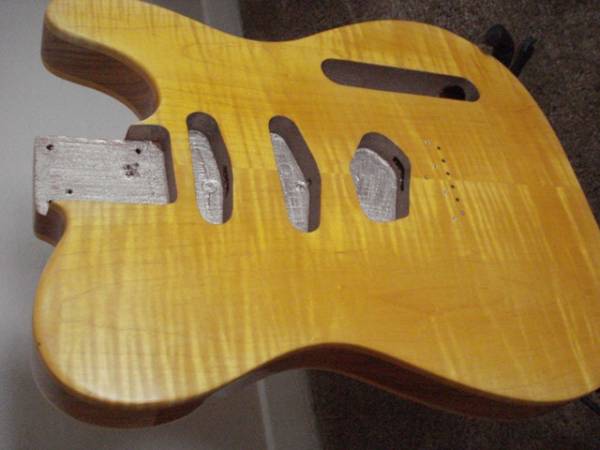
Nice. The color on that guitar would be what I'm looking for, with a rubbed appearance.
 
I use #0000 steel wool to cut the gloss down on my gun stocks after the last coat of tru-oil. Makes for a very nice, non reflective surface. If you want ti try to fill the grain a bit quicker with less coats, apply the tru-oil with sandpaper. Sand across the grain and it will make a slurry with the dust to fill the grain.


-Xander
 
Formby's low gloss tung oil finish works great. It penetrates okay and forms a solid waterproof barrier. It doesn't darken as much over time as the linseed oil based finishes such as Tru-oil.


For better penetration and an even duller hand rubbed look make a mix of pure tung oil, beeswax, and turpentine. Be warned however that pure tung oil takes bloody well forever to dry. Formby's and Tru-oil are polymerized and full of additives and other polymers to help them dry faster.


For any oil based finishes you need to allow each coat to dry before putting on the next and the more coats the better. I usually apply one coat per day for a week or so with the polymerized oils and one light coat every two to three days for the better part of a month with my tung oil mixture.
 
Yeah the old saying of 1 coat a day for a week, one coat a week for a month, one coat a month for a year, and one coat a year for life is true for pure oils and the oil/wax/turpentine mix. The mix is equal parts btw. Now with Tru-Oil you can catalyze it with ArmorAll, I posted it here a while back on how to do it if you want to try to speed things up. I have done 2 dozen coats in a day with this method to great results.


-Xander
 
For an almost colorless finish thear is lacquer, after it cures you can knock the shine down with steal wool or other fine abrasive. The fumes are nasty and very flammable so have lots of veneration.
 
For an almost colorless finish thear is lacquer, after it cures you can knock the shine down with steal wool or other fine abrasive. The fumes are nasty and very flammable so have lots of veneration.


Does it matter if you brush, rub, or spray it?
 
Instead of Tru-Oil, you can also use Pro Custom Oil which keeps closer to the original color. It dries quickly like True Oil. After an oil finish, you can spray with Deft lacquer which dries extremely quickly and is very hard. Spray lightly, it self levels.
Pete
 
Lacquer looks great, is super easy to apply, and won't change the color of the wood but it's not very durable.

If you go with lacquer the best way without using professional spray equipment is to use Deft Clear Wood Finish in the spray can. The satin will look and feel almost like an oil finish. Use multiple thin coats and lightly rub between coats with 000 steel wool for a super smooth finish.
 
Does it matter if you brush, rub, or spray it?


I ether brush, or rub it in. You can use a soft clean lent free cloth, or a pad of absorbent cloth on the inside soft on the out side, it is blaspheme I know but you can also use a foam brush or a pap per towel. Apply a coat about every 2 hours lightly sand between with 220 or finer grit sand paper. Once it is smooth and flat (the low spots will look shiny. Let it fully cure and polish to desired shine. Once the lacquer starts going on you have very little work time so be quick and smooth, if you make a mistake don't try to fix it you will make it worse just give it some love on the next sanding. Also alway work to a wet edge, meaning put it down so that the next pass touches the one before and work around back to the spot you started. on my profile is a knife with black walnut slabs that I used the same technique with, but with a very clear varnish. I polished it to an completely useless point but wanted to see if I could do it. I Am new to knife making but have bin making furniture and humidors for 10 year and the above method is common in that type of work

Hope this helps and dose not hurt
 
Last edited:
Back
Top