How to saw stump ???

Joined
Feb 28, 2006
Messages
3,494
Hi Guys,

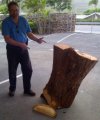
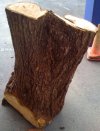
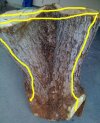
I recently got given a chunk of crotch mango wood. Any suggestions as to what the best orientation would be for sawing it up to move it in the direction of knife handles? That is, where would I find some decent figure (if any) how should I cut it to get at it?

Thanks, Phil

attachment.php
 

Attachments

  • MangoStump.jpg
    MangoStump.jpg
    23.9 KB · Views: 82
  • MangoStump2.jpg
    MangoStump2.jpg
    30.8 KB · Views: 29
  • MangoStump3.jpg
    MangoStump3.jpg
    34 KB · Views: 283
ive been cutting up a few of those crotch type peices and ive found that the nicest bits are the peice that is facing you in the large photo you just posted.so when your facing the v that is the face that you should be looking at on your knife too.hope that makes sence.
cheers, casey
 
Agreed,
With a chainsaw, slice the stump down the center into two "V"s. Then look for the best figure areas at the crotch.Use a portable belt sander if needed to get a good look. Cut it off surrounding the good figure. Wax or paint the cuts and cure for six months to a year. Cut the pieces into manageable big blocks,and slab them 2" thick. Test sand the sides ,trimming away plain figure ,if needed. Wax these and dry for another six months to a year. Cut 2"X2"X6" sections according to the figure.Let those sit for a couple months and use as is or have them stabilized, maybe have some dyed,too. You should get a lot handles from that big boy.

Side note to Phil,
I packed the last of the boxes for you yesterday. You have about twenty large flat rate boxes heading out Wednesday AM. The guy at the post office is going to S**t when I start rolling those in on the hand truck. email sent with details.

Stacy
 
hello., BLADSMTH--are you saying cut it horizontally - or are You saying cut the piece down the center of the "V"--.( vertcally )--thanks marekz
 
I think he means split it vertically so you end up with two "V"s, one from the front, and one from the back of the piece (as shown in the picture).
 
that would be a hard cut for a 14" bandsaw- you would really have to stabilize the piece or you would end up with a zig saw pattern.-marekz
 
Thanks guys!

This was dropped off at our high school last Friday afternoon and landed in one of our all too few parking stalls. I'm taking a little heat to get the bugga moved out of there, thus I'm dragging my chain saw to school today. It has a 20" bar, but I suspect it will still be a bit of work. I might even have a ripping chain some where around here. That would help a bit I guess.

All the best, Phil
 
Stacy gave good advice. If you are facing the piece as shown in the big photo holding your chain saw and cut straight down the center. When you look at the cut surfaces there should be feather figure that will be the most intense at that cut surface. Be sure to seal that surface right away. The feather will have a lot of endgrain, that is why you seal that surface as well as the log ends. I would do a fresh cut at the ends (top & bottom) of the log and seal them as well. The best thing to use is anchorseal. If you can't get that use a latex house paint.

I think I would give it a year or so before cutting further. Mango will get some cool colors if you allow it to spalt. Spalted figured mango has been popular the last couple years with the guitar builders because it can look pretty dramatic.

I would take the log pieces and lay them on a few 2x4s and cover with a tarp back in the weeds out of direct sunlight. Check it every once in a while to make sure it is not becoming spongy. Don't be alarmed if you see mushrooms, mold and fuzzy stuff growing. The dampness and dark allow the bacterias to grow that will cause the spalting.

6 months may be enough time to color up real good. After that I would cut it into slabs. You need to keep a watch checking weekly to make sure it doesn't turn to mush. If the wood starts getting real soft that is the time to stop the spalting. Do that by cutting into slabs, stack and sticker so it gets air flow between the slabs and can dry. When drying, keep out of direct sunlight or it will crack while you watch.

Just my 2 cents. I hope this helps. Mark
 
Thanks Mark!

I emailed a local sawyer friend. He specializes in tropical and exotic woods. He had the same idea Mark had as to cutting it. Although he wonders if it'll really have any crotch figure. Here's what he had to say.
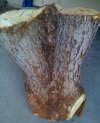
"The view presented in "mango stump 3" on initial perusal promises great possibilities because of the length of the juncture of the two branches. However, on looking at all views, there really isn't much thickness at the actual point of juncture (think of it in cross section more or less resembling an hourglass--the best crotch figure will come at that pinch point). Additionally, it looks more like two branches that grew in conjunction with each other without actually joining tissue than it looks like a crotch that will yield good crotch figure. Looks like the donor had an eye for keeping it whole but my guess is that it's best cut into chunks and 86'd."
 

Attachments

  • MangoStump2-3.jpg
    MangoStump2-3.jpg
    33.1 KB · Views: 27
Last edited:
I asked my sawyer friend how would one go about cutting this if it were good. Here's what he had to say.
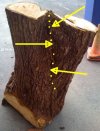
The most intense crotch figure would come in a slab that fully contains the pith (center-point) from each of the two branches as well as their confluence if they come out the other end as one pith. The pith should be equidistant from either face of the slab. Unfortunately, there is always a crack associated with the pith so the wildest crotch is framed in a V of pith. That's why the longer, wider and thicker crotches are the more mileage you get out of them. As you get away from the pith, the crack disappears so the slab can be wider, but the crotch figure also diminishes and is commercially known as "swirl". You would cut the mango log roughly as indicated below.

attachment.php


My suspicion is, however, that the crotch contains lots of bark inclusion and any slab from it would not be very thick because of overall shape does not favor getting thick pieces out of the log.
Here's a few link he shared that illustrate it further.

A quick internet search yielded this site that gives you an idea of what bark inclusions look like in elm: http://lumberjocks.com/Daren/blog/8796

Bubinga crotch: http://www.certainlywood.com/detail.cfm?ID=1856

Bubinga swirl: http://www.certainlywood.com/detail.cfm?ID=2007

Mahogany crotch: http://www.certainlywood.com/detail.cfm?ID=1857

Mahogany swirl: http://www.certainlywood.com/detail.cfm?ID=1639


Attachments

  • MangoStump3b.jpg
    MangoStump3b.jpg
    36.9 KB · Views: 97
Phil,
You never know what you have until you start cutting. Sometimes there will be disappointment, but other times it's like striking gold. I say just cut her up and see what you have.
 
Hi Folks,

Well I started in on hacking, I mean chainsawing, our little (compared to the one below :eek:) stump up. My sawyer friend sent me some more suggestions so I thought I'd share them here.
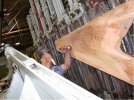
[FONT=&quot]It could be that you will be able to retrieve a less-than-full-length crotch section of some quality and even some thickness from a portion of your log. It's always nice if you can get the complete crotch figure, from one end to the other, but I suspect that yours will have some problems and a good section may be had from somewhere near the middle, meaning that you may get some nice crotch figure, but out of a truncated section.[/FONT]

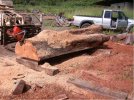
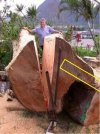
[FONT=&quot]Here's a photo of a mango crotch I sent to Indiana for slicing into veneers. The worker is removing a nail (signs of it appeared before the knife hit it). You can see that in preparing the block (known as a cant) from the tree, I cut roughly along the pith line so as to just get the crotch figure. This cant was 7" thick at the outset and came from a pretty huge tree (see below)[/FONT]
attachment.php


[FONT=&quot]The crotch cant came from the log half at right, more or less as indicated by the yellow box.[/FONT]
attachment.php


[FONT=&quot]Many people on their first such sawing attempt might try to saw the log section lengthwise by standing it on end and laboring into the endgrain in a nonspecific straight vertical line. [Wouldn't you know it? Unfortunately, that's what I did!] However, in the absence of milling equipment, if a log must be chainsawed lengthwise, the process is far less punishing to saw and sawyer (and the results will be better) if you lay the log flat on the ground (or elevated from the ground on a couple waste 4 x 4s) and saw with the grain as much as possible. If the chainsaw bar is longer than the log section, nice results can be had easily, with little chance of kickback. If the bar is shorter than the log is long, care must be taken to avoid kickback and finesse must be mustered to keep the saw on track.[/FONT]

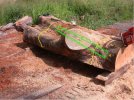
[FONT=&quot]An example: I cut the below log into sections that would give me the highest yield of quartersawn wood once put on my horizontal bandmill.[/FONT]
attachment.php


[FONT=&quot]Crotch cant came out more or less as illustrated by green.[/FONT]
attachment.php


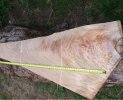
[FONT=&quot]If the planets align, you may wind up with something like this in your piece.[/FONT]
attachment.php

That's it for now. I'll see if I can snap a pic or two tomorrow of the mess I've made.

All the best, Phil
 

Attachments

  • Mango1.jpg
    Mango1.jpg
    87.3 KB · Views: 46
  • Mango2.jpg
    Mango2.jpg
    62.2 KB · Views: 46
  • Mango3.jpg
    Mango3.jpg
    102.3 KB · Views: 46
  • Mango4.jpg
    Mango4.jpg
    103 KB · Views: 49
  • Mango5.jpg
    Mango5.jpg
    87.3 KB · Views: 44
Last edited:
Gotta say, that's an amazing chunk of mango log. Too bad the net of good wood is so low, but I guess that's how it goes. Seems worth it to find that hidden piece inside.

Take care, Craig
 
Back
Top