How would I mill the end of a bolster where it meets the scale?

Joined
May 21, 2007
Messages
1,432
Now that I have my skill level in stone fit so good I have a new problem that has become my fit limiting factor. The problem is on many knives the edges of the bolster are slightly rounded or have gouges where they were polished up to gigged bone. No matter what the cause, they are no longer straight or flat. So, I have been filing them as flat as I can by hand but as hard as I try I seem to often get a slight "bow" in the middle from uneven pressure on the strokes, I believe, and a bit of a gouge down in the liner.

So, I see I need to learn how to use a milling machine but I don't know what type of cutter I would use or what type clamp to allow for holding the knife in the correct position to cut the end of the bolster flat to the liner and perfectly verticle at the end of the bolster.

I do have a Harbor Freight Mini Milling machine I use as a drill press and I can afford to buy the correct cutters and clamps but I have ZERO knowledge of the HOW?

Can anyone help with pictures and good descriptions?

If anyone lives close enough to me to come out to show me how there would be a very nice custom stone scaled knife, probably a Buck 110, you could take home with you for the assist.....
 
If I read correctly you are talking about the edge of the bolster that meets the handle material? I use a 6" disc with adjustable table for that. It really comes in handy for dovetailed bolsters. I paid $99 for mine.
 
I mill the bolsters off of the knife before they are drilled or shaped. I mill them as a pair in a standard machinist's vise with an end mill and then fit them up to the handle, clamp and drill. If you have enough material and the milling is done first then everything else is a cake walk.

Once the bolsters are drilled you can attach them together and shape the front as you like, then put them on the knife to finish shaping. I use screw construction for the most part, but this should work for you on any bolsters.
 
I have been to your website and looked at your work.I assume you mean bolsters of a factory knife that you are re-scaling in stone?If this is the case you would want to make a tooling plate so that both liners could be clamped down side by side so the don't shift, then carefully mill the edges of the bolsters and try not to break the solder bond.You could make the tooling plate so that you could put pins in the holes in the bolsters to keep the edges perfectly in line with each other.If you have a copy of the folding knife book with Lake, Clay, and Centafonte, look at Lake's section for ideas on how to make a tooling plate. Here is a link that may help some .Hope this helps.http://www.sherline.com/3560inst.htm
 
Last edited:
I use a disk myself.
I dovetail most of 'em, but the angle doesn't matter if your tools and technique are right.

If the boster and scale have parallel tops and bottoms it's easy, if they don't a tool helps.

Lay the bolster with the bottom on the grinder table, grind the mating surface.
Put the scale with the top on the table, grind the mating surface.

They will match perfectly, even if they are dovetailed.

If they aren't parallel, like bone, or antler, etc.., I use a modified piece of channel iron and clamp the scale to the inside of the channel so the bottom is still parallel to the table....

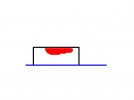
Here's a very crude drawing.
Black is the channel, red is the scale, blue is the table...

Clear as mud?
 

Attachments

  • untitled.jpg
    untitled.jpg
    4.4 KB · Views: 36
if you were using a milling machine with a bar of, say brass this is how i would do it:

1.mill one face of the bar and put this against the fixed jaw of your vice

2. mill the face perpendicular to that face until it is flat, do this with the face previously milled on the fixed jaw of your vice.

3. place the face you milled in step 2 on the bottom of the vice and the face you milled in step one of the fixed jaw of your vice. Mill the face which is now at the top to your final dimension.

4. flip over and mill the side which remains to your final dimension, you now have a block with four pretty much perfectly square sides and two raggedy ends. Depending on the size of the part and the material you could use a flycutter or an endmill.

5. Mill one of the "raggedy" ends of the bar flat using the side of an endmill, flip over and mill the other side.

you now have a perfectly square edged bolster which should mate up to your square edged handle material. This is a very simplified version of the "blocking up" proccess, if you know someone with a milling mahcine they could show you how to do it in ahlf an hour or less.
 
Okay, I guess did not make it clear. I am working with pocket knives that I am replacing the stock scales with stone. I find many of the bolsters just do not have "square " to the liner vertical surfaces and the biggest issue is the edges of the factory bolsters are ofter rolled over somewhat. I will need to carefully read these again but I still don't "get" the picture I need.

Basically I am doing the stone as an "insert" between two existing bolsters on the pocket knife but the factory bolsters do not meet my expectations. I am trying to find a way to "fix" or straighten the existing bolsters without completely disassmbling the knife. I am not getting the perfect fit I want and I am currently using a hand file to somewhat improve the fit but I find I cannot kep a handfile perfectly flat and square.

I want to figure out how to clamp the knife and mill the face of the bolster straigt.
 
Last edited:
The easiest method for you would be to use a "file guide"- a piece of hardened metal that you clamp over the (in your case) bolster. It will not allow you to file past a certain point, and once you have it positioned you just file everything else away.
 
Mr. Hoover if you will go back and read my earlier post on this thread ,I think this is the answer you are looking for.The tooling plate would allow you to clamp the original bolsters and liners on the plate at a 90 degree angle to the cutter and mill the edges of the bolsters. you may remove a little of the liner material in the process, but as long as you do this all the way across the liner it isn't going to matter much.
 
Back
Top