Ht 5160

Joined
Aug 28, 2009
Messages
7,951
I have a small piece of 5160 left over and a friend wants me to make him a marking knife, I don't really feel this is worth sending out for HT as I could just go out and buy one for less then the service and shipping, I could throw together a coffee can forge with the left over bits from my propane forge (still not done but no rush on it with the bad elbows) and try HT it there. Problem is the to reach full hardness I need to hit 1575F and soak, would non magnetic and quench be enough for this application? Or should I hope for the best and go for color, bright cherry red, and quench? Like I said this is a marking knife so it would only be used for scoring wood, but if left unhardened the fine tip will bend.

Thanks for any input

George
 
If the knife will just be a marking tool, a simple HT will probably suffice.

Heat the blade with a torch to non-magnetic, and then a good bit redder. Try to hold it at that color for a couple minutes if possible,playing the torch flame back and forth to maintain as even a heat as possible. Quench in ATF or Canola oil. That should harden the blade fine.
 
... Problem is the to reach full hardness I need to hit 1575F and soak...

When you do have the ability to soak be certain to ignore the source of this information. This is yet another austenitizing temperature that is too high for the alloy, I am not sure that 1575F would be good even if you eliminated the soak entirely. 1525F is more appropriate for this alloying level.

If it will help in the future, I have detailed information here:
http://www.cashenblades.com/info/steel/5160.html
 
Thanks for the confirmation Stacy, but I will just make the coffee can forge for it just because I have everything I need to make it leftover from my propane forge build, along with a benz-o-matic ts4000 torch.

Kevin that is good information to have, I had found the info on a blacksmith page, and it would have sucked to go head ans cook the steel in the future. I have deleted that book mark and replaced it with your page for future reference.

With it being wet and rainy today guess I will start on the coffee can forge today and do the grinding and filing tomorrow, this is a fairly simple knife to make so if all goes well weather wise I should have a finished marking knife next week sometime.

Thanks again,
George
 
Well the coffee can forge is lined and coated, now its time to wait for it to cure then fire it up to set it.

I used Fiberfrax 1" 6lbs 2300F Insulating Blanket and High Temperature Cement rated at 3000F to coat it. It should hold up to the temps this thing should see.

Now if I only had a spare $200 I could by this

Digital Data Logging Pyrometer
Bartlett Instrument’s pyrometer is a convenient, affordable, handheld digital thermometer, with the powerful capabilities of storing temperature readings and monitoring rate of temperature rise and firing time. The portability of a handheld pyrometer makes this an economical tool for monitoring multiple kilns. The data storage feature eliminates the need to be continually present and manually record firing data.

Features include: the ability to store temperatures of 0° F to 2500° F; maximum storage capacity of 864 temperature readings, and a display of the rate-of-temperature-rise and elapsed data collection time.

Requires 9 volt battery, not included.
But I am sure there are cheaper alternatives out there
 
So I got my little coffee can forge put together, but I think I may need 2 torches to get the heat up to anything close to the temps I need.

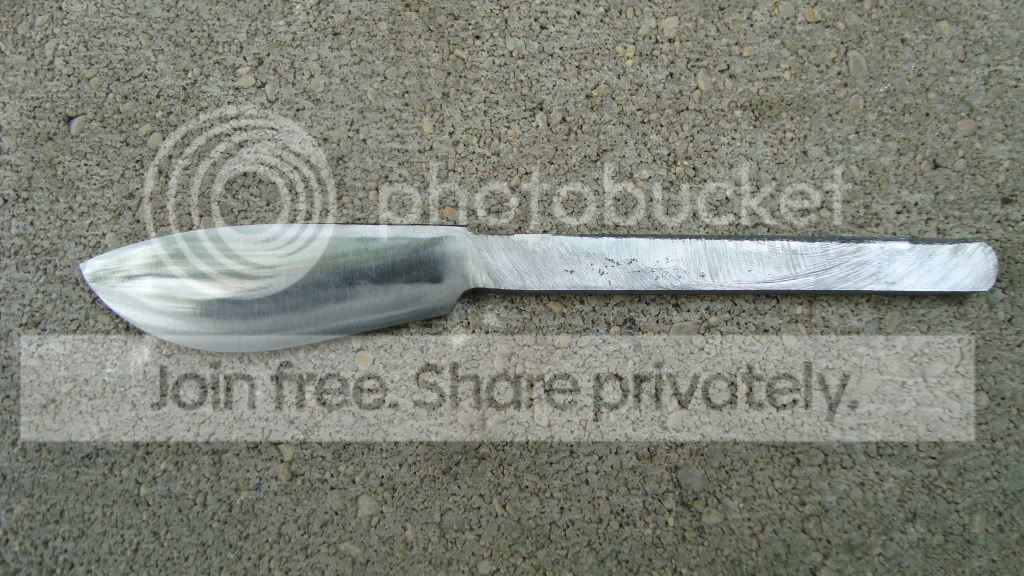
On a side note I have a few scrap pieces of 5160 kicking around so while I was waiting for the coating to set up on the forge I decided to play around with the scrap pieces and my little 30X1 grinder and made this on the first try

DSC01257.jpg


blade length is 2.25" with a full convex grind. I think I will keep it and if I can get some heat out of the little forge I will HT this one as well. It looks shine because it is, I didn't want to waste new belts playing around so I used a worn 80 and 120 to play with.
 
I started out with a little coffee can forge for heat treating. It reached non-mag pretty easy so when I finally got a pyrometer (the cheaper one mentioned above) I was curious about how hot the little guy got. It reached 1850 with the front open (near the back) and with a couple soft fire bricks for the front I was over 2000. I used Mapp gas over propane. Big difference. You'll be ok with one torch. I still heat treat with a propane forge and if your thinking of going this route the setup Farmer Phil mentioned is perfect.
 
Well with that being said, I guess I will wait till after I give a different torch a try the new torch. I don't have the TS4000 yet, I was just using the cheap propane one I have here, but I didn't have my fire brick either, I was just using some regular bricks to block off the front and back. I also want to put a brick inside to shrink up the space.

The out side didn't get overly hot, hotter then I could hold on to, but not so hot that I couldn't touch it. The lining was turning red in places too, so it may be hot enough once I get that stuff in place. I have a couple more pieces of 5160 that are too small to make anything out of so I will use them as test pieces.

I have a full sized forge in the works. I am using a 10X18" piece of pipe and have plans of getting a force air burner from here thats the one I will get the part Phil suggested, now if I can just get a second thermocouple and use the same display I would be laughing.
 
Back
Top