HT Oven arrived last Thursday

Joined
Feb 21, 2007
Messages
270
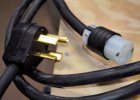
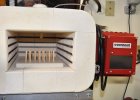
Its been like Christmas around the Tony household these last few weeks with the arrival of the Esteem grinder and now the Evenheat HT oven. I opted for the KO22.5 with the TAP controller. I will say the Tap controller is very intuitive and easy to navigate through. Programming in HT and temper schedules will be a breeze. I'm happy to report that the oven made it to Florida from Michigan without a scratch. I was a bit concerned after the post a few weeks ago about all the problems encountered when the oven arrived damaged. I also thought I'd post a few pictures as well, especially of the patch cord that I'd made in order to plug the oven into an existing 220V electric dryer outlet. I may run a seperate circuit someday, but since the washer and dryer are close to my work area, this was a quick solution for me. I used 10/3 stranded cable and bought the connectors at the big box hardware store.
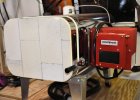
EvenHeat HT Oven_outside.jpg

EvenHeat HT Oven_inside.jpg

Patch Cord for HT Oven.jpg
 
Tony congratulations on the new equipment. It must be exciting. Have you ground or heat treated a blade yet?
 
I've ground a dozen pieces of steel into knife shaped objects. I've learned something with each one of them so far and they're coming out decent at this point. Mostly what I've learned is that grinding knives is a matter of fixing mistakes in the process. I mean we all know what a knife is suppose to look like. Its when we do something in our grind that a knife isn't suppose to look like that causes the problems. Only experience is going to be helpful here and I'm looking forward to grinding out my next few dozen. Haven't HT'd anything yet but I'm working with 1084 right now and I don't expect to encounter any problems, hopefully.
 
I probably don't have to tell a professor this, but for the benefit of those who may read this thread:

Get a log book and keep exact records.

Record the date and time.
Note the steel type, source, thickness, and any other particulars.
Note all temperatures, times, and rates.
Record the quenchant type and temperature, as well as all quenching and tempering details.
If you test the blade after HT, note all test results.
Note how the blade cuts and performs after finishing the knife. After a bit of use/test cutting, examine the edge under a loupe and see if there is any minute rolling or chipping.


Adjust future HT regimes based on this info.

Some really analytical folks also note:
The ambient temperature and weather, batch or invoice numbers for the steel, humidity, whether they got laid last night ( mood), and anything that can affect the HT, the steel, the equipment, or the people involved.
 
I've ground a dozen pieces of steel into knife shaped objects. I've learned something with each one of them so far and they're coming out decent at this point. Mostly what I've learned is that grinding knives is a matter of fixing mistakes in the process. I mean we all know what a knife is suppose to look like. Its when we do something in our grind that a knife isn't suppose to look like that causes the problems. Only experience is going to be helpful here and I'm looking forward to grinding out my next few dozen. Haven't HT'd anything yet but I'm working with 1084 right now and I don't expect to encounter any problems, hopefully.

congrats. first, do as Stacy suggests and keep notes. after a while, you will know the best procedures for you to use. second, once you temper a blade, you can't make it harder again easily. try some blades at 300F, and see how they work before you add a handle. if they seem too hard to sharpen or grind, it is easy to temper them again at say 350F. one of the joys of doing your own heat treat is that you can make your blades as hard or as soft as you want.
scott
 
Thanks for the advice Stacy and Scott. I do plan on keeping a journal of my work because it seems that as you get older, one of the first things to go is your short term memory. Not only that, but shortly thereafter, your short term memory starts to go. :D I've also realized that in order to record any meaningful data, I'm going to have to find myself a decent hardness tester. I've been keeping my eye on c'list but man oh man these things are expensive even on the used market. I've got access to one at the school for right now, but after I retire next year I'm definitely going to need my own. If anyone has any recommendations along these lines, I'm all ears. Stacy, I think you left one thing off the list...the directional alignment of the oven. I assume that north-south is still the preference. :rolleyes:
 
Thanks for the advice Stacy and Scott. I do plan on keeping a journal of my work because it seems that as you get older, one of the first things to go is your short term memory. Not only that, but shortly thereafter, your short term memory starts to go. :D I've also realized that in order to record any meaningful data, I'm going to have to find myself a decent hardness tester. I've been keeping my eye on c'list but man oh man these things are expensive even on the used market. I've got access to one at the school for right now, but after I retire next year I'm definitely going to need my own. If anyone has any recommendations along these lines, I'm all ears. Stacy, I think you left one thing off the list...the directional alignment of the oven. I assume that north-south is still the preference. :rolleyes:

on hardness testers, see if there is a small machine shop in your area and maybe you can make a deal with them. most of the time, hardness testers just sit and it only takes a few minutes to do a 10 point test. directional alignment of N-S is ok except during new moon when it should face damascus.
scott
 
That's great Tony. I know exactly what you mean about fixing mistakes. I chased a few too far and wound up with some oddly shaped KSO's.

Stacy as one who will benefit from your advice on a HT log book, thank you for the suggestion.
 
on hardness testers, see if there is a small machine shop in your area and maybe you can make a deal with them. most of the time, hardness testers just sit and it only takes a few minutes to do a 10 point test. directional alignment of N-S is ok except during new moon when it should face damascus.
scott

Oh that's just great. I not only have to study metallurgy, leathercraft, woodworking, and grinding, now I have to break out geography and astronomy books! And all I wanted to do is make knives. :p My knife shop is in the middle of a jungle near Hawthorne, FL. The nearest machine shop is probably at least 20 miles from here, although this may still be a good idea for some folks. For me, I personally enjoy acquiring tools that sit around unused most of the time. LOL It's one of my main inspirations for taking on new projects. I get excited when something comes up on the honeydo list which requires a trip to the big box hardware store in search of just the right stuff. I'll likely eventually buy a hardness tester. I guess I'm just the kind of person that when there's something I want to do, I want to do it now, and I want the tools to do it now. When its not being used I can still look at it, light up a stogie, and think "wow...this is just cool". I find myself doing that a lot lately. ;)
 
In the engineering field, when something comes out oddly it becomes a special feature. On my very first grind, I decided that I'd give a shot at grinding a swedge. I took a perfectly good KSO and turned it into...well....I'm still not sure what to call this feature. Starting with the second grind, I decided to adhere to the KISS principle. So far, this has served me well, and every grind since then, I've learned something new with each. A process that I anticipate will continue for many more knives to come. I get the feeling though that much the same as with life, you never really get to spike the ball in the endzone. :-)
 
Back
Top