- Joined
- May 14, 2013
- Messages
- 22

The BladeForums.com 2024 Traditional Knife is available! Price is $250 ea (shipped within CONUS).
Order here: https://www.bladeforums.com/help/2024-traditional/

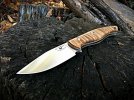
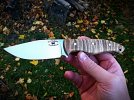
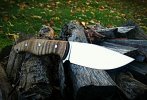
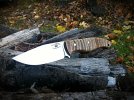
What type of grind, steel and how was it heat treated? Looks very nice.
What type of grind, steel and how was it heat treated? Looks very nice.

It's 1095 full flat grind. Did the heat treat myself. Brought it to non-magnetic and let soak for about 5 minutes and quenched in motor oil. Tempered at 385 for 2 hrs. I'm still experimenting with different heat treatments. From the research I've done on here, there's plenty of theories on treating 1095, so I'm just goin down the list


With a MAPP gas small forge, you will be better off with 1084. It will get nearly the same hardness as 1095, and the HT is super simple. Once it is at 1450-1475F...quench it....no hold needed. Then temper at 400F.
1084 and 1095 are just about the same steel...with the 1095 having just a tad more carbon. The 1084 blade may need re-sharpening slightly sooner than the 1095 blade, but I bet that in use no one could tell them apart.
One thing people don't always remember is that in all steel, only the first .84% of the carbon gets tied up in the iron matrix as steel. The rest just makes carbides. So, a properly heat treated 1084 blade will almost always be better than a so-so heat treated 1095 blade.


KT, very nice knife, and curly maple is a favorite. Your gonna love Aldo's 1084, guarantee it.
Stacy, thanks for the 1095 info

Agreed that it looks like a great knife!
Your attitude toward new information is really nice too, always great to see people that just soak up constructive info! You know they'll go far