
I am really liking the cork belts

AVigil

Adam Vigil working the grind
Platinum Member
Joined
Feb 17, 2009
Messages
7,310
I read S.R. Johnsons write up on using cork belts and watch him in his video use them so I thought to give them a try. I picked up a couple at TruGrit and broke them in. There is a specific procedure to breaking in a cork belt and it takes some time and effort to get it ready to use.

Grinding down to 220 grit and putting on a Cork Belt 400 grit really puts a nice smooth finish on the blade and any remaining stratches often can be removed with the cork belt at 400. It removes metal much slower and so getting up into the plunge to clean up and polish it works well and there is a less of a chance of screwing it up.

After the 400 Cork Belt I put on the 1000 cork belt and work over the blade. It nicely polishes the blade and brings it to a high luster. Once the handle is install and sanded I used the 400 Cork to gently work the G10 and clean up the finger groove and polish it nicely.

Here is a hunter I am working on that I used the cork belt on the blade and the handle. After using the cork a quick visit to the buffer to clean up some tight areas and remove some light scratches.

For what they cost they are a great deal

The photos were taken in the lousy light of the day...sorry about that. This is my humble attempt at a 4" hunter
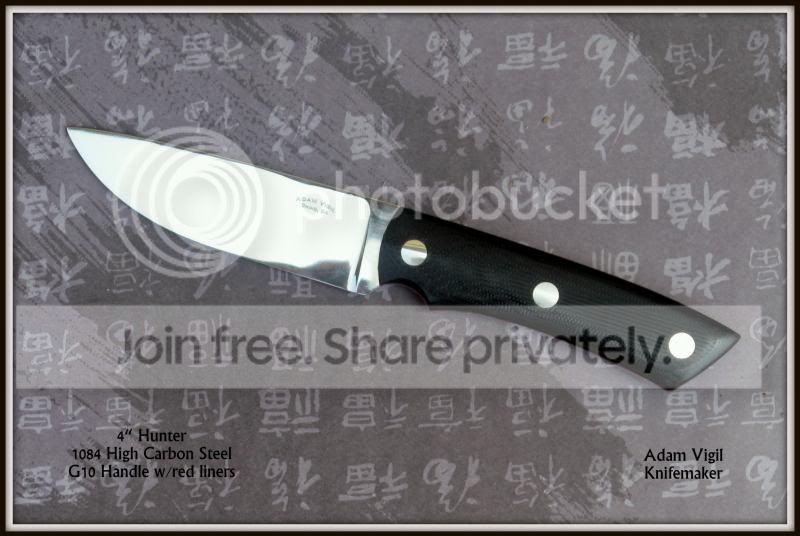
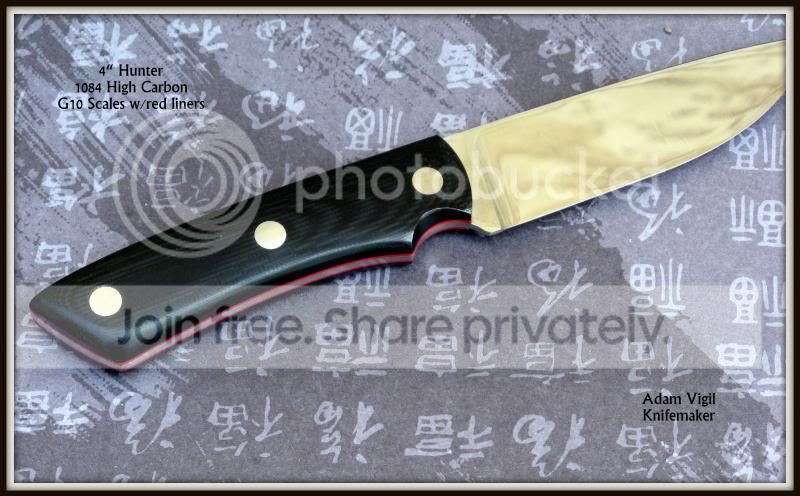

 
First off, very nice knife. I like the lines. Are the liners g10 or fiber?

Second thanks for the report in the cork belts. I've been thinking about them for some time now and your post just kinda pushed me over the edge.
 
Adam, would you have the link to Mr. Johnson's write up? Got one but never took the time to give it a good try.
Thanks for sharing.
 
KC,

Thanks... the red liners are fiber material.

Patrice,

Here is the write up http://www.trugrit.com/cork_belt_break_in.htm

What I did different and it is not as messy and dusty is I used a round bar stock to break in the belt. That way it did not knock off the tops the peaks and create a mess, but the round bar smashed the peaks down and smoothed out the belts. You need to run it for 10 minutes as explained in instructions.

It really can get you to a high polish 1000 grit finish pretty quickly and then you can do a hand sanded finish to 1500 in a much shorter time.
 
How would the 1000 grit cork belt finish differ from a 1000 grit belt finish?

The cork belt will last for many years. You apply compound on the cork belt and it will give it a mirror polish at 1000 grit.
 
You said it cuts pretty slow right? How much slower would a 400 grit cork be compared to other belts?
 
S many cork belt questions. Could be a good vid opportunity if someone has some time to burn.
 
I wonder why just using the cork belt for something wouldn't "break it in" as well.
It sounds like you're simply trying to wear it out, so it's ready for compound.
 
I wonder why just using the cork belt for something wouldn't "break it in" as well.
It sounds like you're simply trying to wear it out, so it's ready for compound.

Because 10 minutes of work will save you hours of frustration.

The cork belts look like they are 36 grit or worse. Smoothing them out gets you better performance when you go to make a knife.

Remember these belts last for years of steady use, you are not going to wear them out with the break in
 
I just used my 600 cork belt last week and couldn't get the mirror I wanted. I'm thinking I didn't break it in good enough although I did use a piece of scrap for 10 minutes. I should have used the work rest and the edge of the scrap rather than the face. But even then, I was able to go from 600 cork with green compound to 1500 hand sanding with no problem.

I now have 400 grit and 1000 grit on order
 
Jason when breaking in the belt get a steel pipe or round stock and use it on the contact wheel. It will smash down the high spots on the belt and you will end up with a shiny pipe :)
 
That's a good idea. Do you use the end of the pipe or a side? My method didn't seem aggressive enough although I suppose the end of a pipe might be too aggressive.
 
Really nice knife Adam :)

I started using the cork belts after reading Steve's posts several years back, and for hollow grinds, I think they're the bee's knees. I used them for quite a while on flat grinds too, but now I just use the flat platen for rough grinding and the 9" discs for finishing flat and/or convex grinds.

The break-in is very important. Do it just like Mr. Steve Johnson describes, and the belts will work just as he describes... Steve is a true Master in this craft... IMHO, when he shares something, it is WELL WORTH the time it takes to give it an honest try.


*side note* Even though I am primarily a forged knife guy, I think Steve's video on building a sub-hilt fighter is one of the best knife making DVD's you can buy! :thumbup: :cool:
 
Thanks Nick! Much appreciated.

I totally agree with you on S.R. Johnson and his vid is a best buy for sure.

Your input is always good to hear :)
 
Back
Top