

- Joined
- Dec 24, 2016
- Messages
- 3,382
I've been at this as a hobby for about 2 years now but with a limited amount of free time I've only been able to forge 15 knives. The majority of them have been 6"-8" hunter/camp knives. I wanted to do something larger this time so I sketched out a 16" chopper.
I started with some 1075 from Aldo. When I forged it to shape, I knew I was on the thin side, then rough ground it preheat treat. I thermal cycled it 3x then heated, quenched and tempered. I picked up a slight warp but was able to get it down next to nothing. After I did a post heat treat grind I really saw how thin it was. I was .09 at the spine with a full flat grind. I added some jimping and a finger choil thinking I would give myself a secondary handhold if I wanted to choke up on the blade. Well I hated the jimping so I ground it out, creating a thin section between it and the choil. I really did not like the blade at this point so I did the minimal finishing and put a garbage handle on it. I could have reprofiled and finished it as a BBQ slicer or something, but I decided to break it instead.
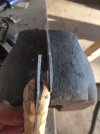
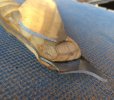
I put a quick toothy edge on it and started to swing. First I chopped 3 slats off of a pallet and chopped twice into the side of the pallet and hit a nail both times. Then I took 6 hard swings into the rim of a 30gal plastic drum. I chopped 6 pieces of 1" sch 40 pvc pipe, I chopped into the bottom of an empty coke can and sliced through a quart Gatorade bottle. The straw that broke the camels back was a 3/16" copper strand I've used as pin stock, it was on a solid table and I chopped it once but the second chop it went TING !
The blade finished at 16"OAL, 10" blade. 1 5/8" height, .09" at the spine. Just under 1" height between the choil and area where I ground the jimping out.
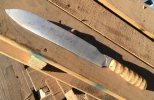
I started with some 1075 from Aldo. When I forged it to shape, I knew I was on the thin side, then rough ground it preheat treat. I thermal cycled it 3x then heated, quenched and tempered. I picked up a slight warp but was able to get it down next to nothing. After I did a post heat treat grind I really saw how thin it was. I was .09 at the spine with a full flat grind. I added some jimping and a finger choil thinking I would give myself a secondary handhold if I wanted to choke up on the blade. Well I hated the jimping so I ground it out, creating a thin section between it and the choil. I really did not like the blade at this point so I did the minimal finishing and put a garbage handle on it. I could have reprofiled and finished it as a BBQ slicer or something, but I decided to break it instead.
I put a quick toothy edge on it and started to swing. First I chopped 3 slats off of a pallet and chopped twice into the side of the pallet and hit a nail both times. Then I took 6 hard swings into the rim of a 30gal plastic drum. I chopped 6 pieces of 1" sch 40 pvc pipe, I chopped into the bottom of an empty coke can and sliced through a quart Gatorade bottle. The straw that broke the camels back was a 3/16" copper strand I've used as pin stock, it was on a solid table and I chopped it once but the second chop it went TING !
The blade finished at 16"OAL, 10" blade. 1 5/8" height, .09" at the spine. Just under 1" height between the choil and area where I ground the jimping out.


