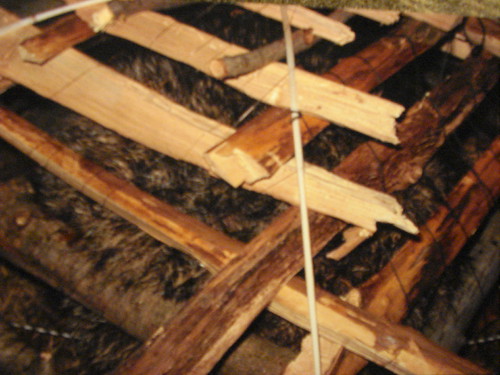
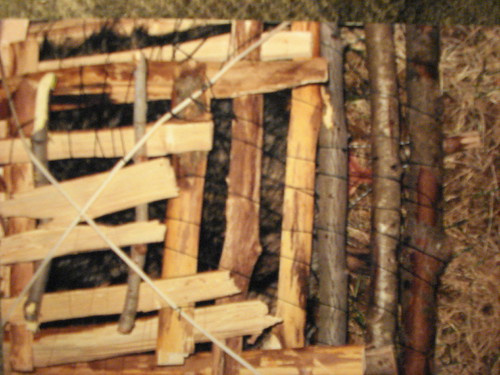
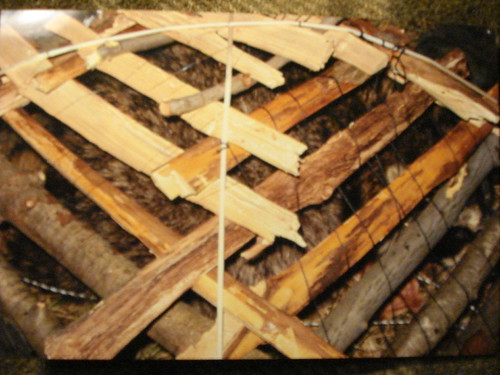
Thanks to Colhane, AKA 'Pict', I've known about the Arapuca Bird Trap for quite a while now.
A couple of years back I used the trigger of this trap under a plastic crate. I was trying to catch rabbits that were coming into a garden, but I gave up trying in a fairly short time because a danged hedgehog would go into the trap and set it off before the rabbits arrived.
Anyway, I thought it was time to make the full proper version of this very good device. I was impressed at how easy it was.
I set it in the garden to see what would happen. It got triggered a couple of times, but I think the small sparrows that were hanging about managed to get out through the gap between the rails. I will either have to wait for a bigger bird, or lace some netting over the cage if I want to make sure that a bird can trip the trigger. I am confident that it works properly.
In case some folks aren't familiar with this trap, I want to explain the trigger.
The trigger is constructed from four sticks. The top stick is forked. The fork is propped up under the middle of one side of the cage. The outside of the forked stick has a notch cut in it. The second stick is whittled to a chisel edge, and this edge sits in the notch on the forked stick. The forked stick lies at a slight angle under the cage, and the base of the second stick sits on the ground. The weight of the cage tries to make the forked stick rotate under the cage.... but it can't because two identical 'trip' sticks are jammed between the bottom of the forked stick and the two back corners of the cage. Bait is placed under the cage, at the back between the trip sticks. When a bird knocks one of the trip sticks out of position, the forked stick rotates under the cage allowing it to drop.
The machete shown is my new 16" Tramontina. It works really well. The little knife is a simple one I made myself from a sawmill bandsaw blade. The metal ring at the top of the handle was cut from a bit of chromed steel towel rail. The blade has a tapered tang which is glued into a hole bored in the handle (using epoxy 2-part mix). This short knife is very handy and versatile and seems to be pretty much ideally suited to whittling trap parts. I batoned it 'cross-grained' through some sticks today to cut them to length.


And here is the link to Colhane's video on this useful trap:
http://www.youtube.com/watch?v=9iR_3zWd0hA
A couple of years back I used the trigger of this trap under a plastic crate. I was trying to catch rabbits that were coming into a garden, but I gave up trying in a fairly short time because a danged hedgehog would go into the trap and set it off before the rabbits arrived.
Anyway, I thought it was time to make the full proper version of this very good device. I was impressed at how easy it was.
I set it in the garden to see what would happen. It got triggered a couple of times, but I think the small sparrows that were hanging about managed to get out through the gap between the rails. I will either have to wait for a bigger bird, or lace some netting over the cage if I want to make sure that a bird can trip the trigger. I am confident that it works properly.
In case some folks aren't familiar with this trap, I want to explain the trigger.
The trigger is constructed from four sticks. The top stick is forked. The fork is propped up under the middle of one side of the cage. The outside of the forked stick has a notch cut in it. The second stick is whittled to a chisel edge, and this edge sits in the notch on the forked stick. The forked stick lies at a slight angle under the cage, and the base of the second stick sits on the ground. The weight of the cage tries to make the forked stick rotate under the cage.... but it can't because two identical 'trip' sticks are jammed between the bottom of the forked stick and the two back corners of the cage. Bait is placed under the cage, at the back between the trip sticks. When a bird knocks one of the trip sticks out of position, the forked stick rotates under the cage allowing it to drop.
The machete shown is my new 16" Tramontina. It works really well. The little knife is a simple one I made myself from a sawmill bandsaw blade. The metal ring at the top of the handle was cut from a bit of chromed steel towel rail. The blade has a tapered tang which is glued into a hole bored in the handle (using epoxy 2-part mix). This short knife is very handy and versatile and seems to be pretty much ideally suited to whittling trap parts. I batoned it 'cross-grained' through some sticks today to cut them to length.
And here is the link to Colhane's video on this useful trap:
http://www.youtube.com/watch?v=9iR_3zWd0hA