jdk1
Gold Member
- Joined
- Apr 21, 2010
- Messages
- 2,058
I personally like the guard, especially when being used as a weapon as the CS model was designed as.... But it's still a flat ground tool. Traditional convex ground kukris are much more functional for what they were designed to do.
Orion, while I share your enthusiasm for traditional khukuri, it's all a matter of perspective and intended use. For chopping wood, I agree a hammered blade works better as it doesn't get stuck and seems to throw bigger chunks of wood. In my area chopping wood is not as important when in the woods. A blade which can perform machete work and still chop quite well is much more useful than a dedicated chopping blade. The CS Gurkha is wonderful in this regard, as is the ESEE Junglas. Either would also be a superb weapon as well. That said, I have plenty of traditional khukuri and love them. They have a feel which cannot be matched by a machine made blade and can perform wonders in use.
Damonw45, Khukuri don't have guards, but there's nothing that says they can't. It's not needed for field use, but CS designed that khuk for fighting it seems. It looks a little funny to me, so I prefer the original version, but that's just me.
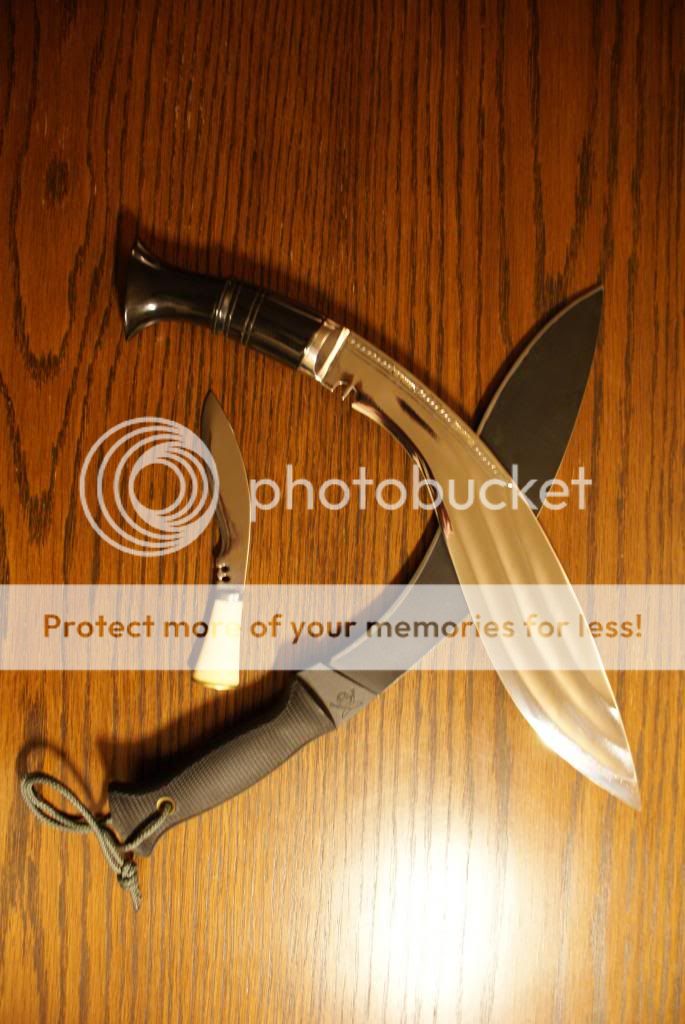
As for what makes khukuri special, there's a lot. The design and shapehas evolved over many hundreds of years, if not more. It's the most efficient big knife chopper I've seen. I'm not alone either. The shape lends itself to a lot of wood processing tasks. It's an incredible weapon. That's been proven time and again. It can also hurt you bad if you're not careful as it handles differently that most blades. The design builds a serious amount of momentum in use, much as an axe or hatchet. Just like those, the blade can easily find your leg as a convenient place to stop
 If you've never tried a khuk, you're missing out. I have some really good non-khuk blades, but they just don't feel as good in my hand as the forward curved leaf shape. Take care.
 but old style look better