I have some hawk questions

Joined
May 12, 2008
Messages
756
Im going to buy a cold steel hawk soon and i think im going to get a norse hawk and im wondering how to put the head on the handle the best way also i was wondering if you could give me some tips on convexing an axe with file. Im buying a nicholson for lowes Home depot or similar store and are there any file in particular that i should get. And what way do u treat a handle. This is how i would do it sand it and soak it in lin seed oil and then put way on it is that enough? and i see alot of guys burning there handles and i was wondering how to do that.
 
as far as the edge, having a perfect convex isnt all that important. a flat-ish edge put on with a file will cut just as well and it will be alot easier to put on. i would reccomend a single cut file for doing that. however, the steel they use on those (1025 i think) is really hard stuff. it there is any way you could get to a belt grinder, i would recomend doing that.

to fit the head, take off the head and then sand or use a rasp to shape it as best you can to the shape of the hole in the head. at that point, it should fit nice and snug.


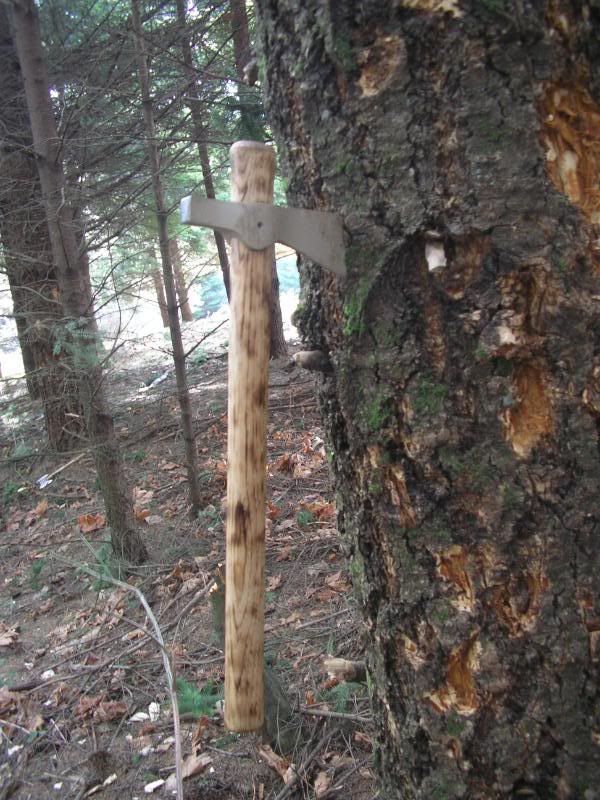
for the handle, you could sand it down, do a few coats of linseed or danish or tung oil then you could do an optional coating of beeswax to give it a nice grip. torching the handle also looks nice, to do that you just get a blow-torch and burn in the desired pattern, then sand a little, then do the oiling.

hope this is helpful.
 
Here's mine, I did just about exactly what Barber said. I laid back the bevel on the edge and thinned it some with a single cut file then used sandpaper and a mouse pad to convex. I am new to the convexing thing but it is sharp and will shave. I have chopped some and the edge seems to be holding well, even though I thinned it down it is still plenty thick compared to a knife. I torched the handle and did linseed/steel wool for several coats. The head is plenty tight and I didn't do anything to that. I am very pleased so far with this hawk and believe it is a lot of bang for the buck. My next project is to make a good sheath, I cobbled one up so I can carry it but want to get some leather and rivets to try to make a nice one. If you have any questions magnussen has been using this hawk for some time and has some good write ups on it and if there is anything I can answer I will do my best. Chris

Picture186.jpg
 
Here's mine, I did just about exactly what Barber said. I laid back the bevel on the edge and thinned it some with a single cut file then used sandpaper and a mouse pad to convex. I am new to the convexing thing but it is sharp and will shave. I have chopped some and the edge seems to be holding well, even though I thinned it down it is still plenty thick compared to a knife. I torched the handle and did linseed/steel wool for several coats. The head is plenty tight and I didn't do anything to that. I am very pleased so far with this hawk and believe it is a lot of bang for the buck. My next project is to make a good sheath, I cobbled one up so I can carry it but want to get some leather and rivets to try to make a nice one. If you have any questions magnussen has been using this hawk for some time and has some good write ups on it and if there is anything I can answer I will do my best. Chris

Picture186.jpg


nice pic and hawk is that a old schrade?
 
Yes it is, a 13ot Old Timer, me and that knife have a lot of history, can't seem to retire it. Chris
 
Just remember to loosen the set-screw before you go to remove the handle. Definitely do NOT thump on the head with a mallet while the handle rests on the floor, muttering "cheese and rice, this thing is on tight!" or you'll be rewarded with a nice deep gouge in the handle and will need to order a new one.

Hey, it's not my fault they hid the screw under that dumb sticker! :D :o :eek:

I have a trailhawk (just about perfect for me) and a rifleman's hawk (too heavy to carry around all day, but great to leave at camp/cabin for the heavier chopping) from Cold Steel. As Chris said, they're a lot of bang for the buck. And just plain cool!

One thing I should point out is that hawks are often not-so-good for splitting, because they bind up once you get to the eye. Bring or make a wedge.
 
Last edited:
I thinned out the edge on mine with a single cut file as everyone else did... I did not convex it.. On a long enough time line all hand sharpened blades end up convexng themselves as the angle is never exactly the same each time you sharpen it. I left the handle as is... a few nights by the camfire and the handle is beginning to take on a charectar of its own....
 
Riley, you really should oil that handle, it will last longer. Don't fret, it won't stop the hickory from developing a "patina" of sorts. A quart of danish oil or plain tung or linseed oil will last most of us years and years.
 
Riley, you really should oil that handle, it will last longer. Don't fret, it won't stop the hickory from developing a "patina" of sorts. A quart of danish oil or plain tung or linseed oil will last most of us years and years.

My grandfather told me that to make an axe handle almost unbreakable that you need to "temper" it with kerosene. He said to soak your handle for a few weeks totally immersed and it would come out very durable. I have a new handle on the way and a piece of PVC pipe and I am going to try it out, probably let it soak for a couple of weeks. My grandfather died in 1983 and my father still uses an axe that he handled so there must be something to it. Chris
 
That sounds interesting, be sure to let us know how it goes!

The various oils mainly protect the wood from absorbing or losing too much moisture, I don't think they make it much stronger. I could be wrong though.
 
the loss of moisture could concievably make the wood brittle, also the constant swelling and relaxing of wood in response to environmental conditions could potentially make it weaker..seems like protecting it a to prevent that might make it "stronger"
 
I lived in the high desert for almost 7 years and can tell you for sure that when a handle drys out it will start splintering and break. Replaced to many sledge, axe and shovel handles while I was there. Chris
 
seems like protecting it to prevent that might make it "stronger"

No, it just keeps it as strong as it was to begin with ;)

Chris is right, getting the wood too dry would be even worse than getting it wet... but both are bad. I looked for some info on treating hickory with kerosene but no luck yet.
 
I wasn't pickin on ya friend, just clarifyin' ;)

On another note, you could have the handle stabilized, I'm certain that would increase it's strength, but would also increase its weight by as much as 50% and more.
 
Im going to buy a cold steel hawk soon and i think im going to get a norse hawk and im wondering how to put the head on the handle the best way also i was wondering if you could give me some tips on convexing an axe with file. Im buying a nicholson for lowes Home depot or similar store and are there any file in particular that i should get. And what way do u treat a handle. This is how i would do it sand it and soak it in lin seed oil and then put way on it is that enough? and i see alot of guys burning there handles and i was wondering how to do that.

On my CS Trail Hawk, I sanded the haft and torched it alittle, then soked it in linseed oil and sanded it again. I de-burred the inside of the eye with a dremel to get the fit nice and tight on the haft, stripped and painted the head and then on to assembly.

For assembly I put the haft in the freezer overnight, the next day I heated up the head in the oven for about 20 min. Took the haft out of the freezer and slid the head on, I used a piece of 2x4 to hammer the end of the haft to seat the head. The heat on the head will expand the metal and the freezer will contract the haft, once both return to room temp you will have a nice tight fit.

Also check out this sub forum, pages of usefull tips and how to's.

http://www.bladeforums.com/forums/showthread.php?t=483042

dff8e5ff.jpg


Hope this helps.
 
On a similiar note, I knew a guy who treated hammer handles w/ boiled linseed oil. He would drill a long hole in the bottom end of the hammer, and a lanyard hole. Fill the long hole up w/ boiled linseed oil, and hang the hammer up by the lanyard hole. Every couple days, refill the linseed oil, until the wood quit soaking it up.

It has been a while, but I think he didn't have heads getting loose, and didn't break handles. The one he was using at the time was like 8 years old, which is like 350 people years for a contractors hammer.
 
Back
Top