Hi everyone,
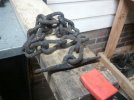
I got a little time in the shop today and while I was forging I wanted to mess with some "Wrought Iron" I got in a random box of junk at an estate sale. I say it in parentheses because a guy at the sale said it was WI. I have never worked with WI, so I have no idea. I am thinking this may be just plain iron, but I have never worked with that either. I cut off one link and forged it straight and flat, but forgot to try and quench it in water.
Here is what I know.
1. It is magnetic
2. It forges like copper or something. I have never forged steel this soft before. Heck, you can just about bend it with your hands.
3. The sparks take longer to go out than regular steel. You can still see them for a second after they hit the ground.
4. It sands super easy. It literally took about 3 or 4 minutes to get to 800 grit by hand from a 220 belt finish.
5. This chain was definitely made by hand, so I am assuming it's old.
Here are the pictures:


Now for comparison, I did a spark test with a 60 grit ceramic belt on 1084, mild steel flat bar, and this stuff.
1084

Mild steel flat bar

The Mystery

This is the mystery metal spark testing with a 220 grit belt. I didn't know if it would make a difference, so I will add this picture too.

I also sanded it to 800 grit and etched it in Ferric Chloride for about an hour.


Well, any ideas? I want to use some of it for san mai, but I want to find out what it is before I do.
Thanks,
-Adam
I got a little time in the shop today and while I was forging I wanted to mess with some "Wrought Iron" I got in a random box of junk at an estate sale. I say it in parentheses because a guy at the sale said it was WI. I have never worked with WI, so I have no idea. I am thinking this may be just plain iron, but I have never worked with that either. I cut off one link and forged it straight and flat, but forgot to try and quench it in water.
Here is what I know.
1. It is magnetic
2. It forges like copper or something. I have never forged steel this soft before. Heck, you can just about bend it with your hands.
3. The sparks take longer to go out than regular steel. You can still see them for a second after they hit the ground.
4. It sands super easy. It literally took about 3 or 4 minutes to get to 800 grit by hand from a 220 belt finish.
5. This chain was definitely made by hand, so I am assuming it's old.
Here are the pictures:
Now for comparison, I did a spark test with a 60 grit ceramic belt on 1084, mild steel flat bar, and this stuff.
1084
Mild steel flat bar
The Mystery
This is the mystery metal spark testing with a 220 grit belt. I didn't know if it would make a difference, so I will add this picture too.
I also sanded it to 800 grit and etched it in Ferric Chloride for about an hour.
Well, any ideas? I want to use some of it for san mai, but I want to find out what it is before I do.
Thanks,
-Adam