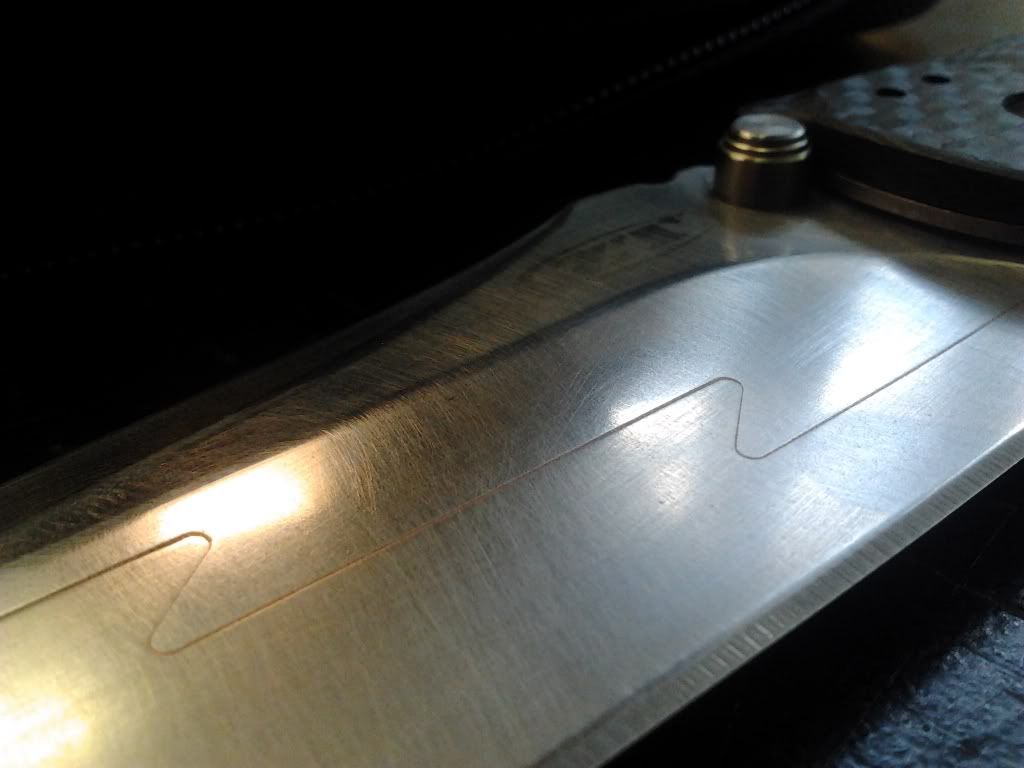
I need help with a polishing / controlled patina job!

The_Iron_Joe

Knifemaker, Jeweller. Custom Books Open!
Joined
May 3, 2012
Messages
1,091
I'm so very sick and tired of 14C28N blades from KAI rusting up on me. First my Skyline, then my Clash... and now my ZT 560CBCF's upper half. I removed the rust spots quickly after noticing, but I can't bring myself to carry the knife if it'll just rust up from some minor sweat or other moisture. Lubing it up every day isn't a very appealing option.

So I want to know the most effective method for creating a mirror polish-- while keeping the S110V portion of the blade unaffected. My second option would be to create a forced patina using fruit juices... ANYTHING to protect the blade from rust.

Can someone point me in the right direction? I want to carry this knife again.
 
I can't help on the rust but I can tell you I have forced a patina on a CB Rake with white vinegar. It didn't touch the rest of the blade just the D2 but you might try it. It took about an hour for me to get a good looking patina on D2. Hope this helps because I too have fought rust on a Sandvik blade.
 
I may have to try that, sounds close to what I'm looking for. How was the stamped lettering on the blade affected?
 
I don't think you can polish only a portion of the ZT, it requires a lot of sanding and a polishing wheel which aren't ideal for precise work. If you were to do a patina, I would put nail polish on spots where you don't want the patina and then submerge in whatever agent you want to try
 
I patina my knives by cutting hot beef, and also vinegar baths (30 min to 60 min wrapped in plastic wrap).

I then make slurry from 8000 grit stone, apply on rubber eraser, then gently wipe all of blade with stone saturated eraser and im assuming this evens the patina surface because it looks mirror smooth.


IMG_0414_zps4d6737a6.jpg

The back I tried a 'snakeskin' pattern for fun. Came out beautiful IMO.

IMG_1521_zps0fa54631.jpg
 
I don't think you can polish only a portion of the ZT, it requires a lot of sanding and a polishing wheel which aren't ideal for precise work. If you were to do a patina, I would put nail polish on spots where you don't want the patina and then submerge in whatever agent you want to try

The more I think about it, the more I come to believe that a patina would be the better option.
 
I patina my knives by cutting hot beef, and also vinegar baths (30 min to 60 min wrapped in plastic wrap).

I then make slurry from 8000 grit stone, apply on rubber eraser, then gently wipe all of blade with stone saturated eraser and im assuming this evens the patina surface because it looks mirror smooth.


The back I tried a 'snakeskin' pattern for fun. Came out beautiful IMO.

Those look pretty awesome! That's another point for patina. Although, I'm mainly concerned with the protection aspect lol.
 
What do you mean protection aspect?

Mine is food safe, patina was created specifically so that it doesnt leak any taste or color into acidic foods like onions.
 
What do you mean protection aspect?

Mine is food safe, patina was created specifically so that it doesnt leak any taste or color into acidic foods like onions.

I had just meant that I don't really care how good a patina will look on my 560 so long as it helps prevent rusting, but yours are very nice aesthetically as well.
 
If the 14C28N rusting is the primary issue, just sand the bead blast away, replacing it with a simple satin finish. Kershaw's long-standing problem with bead-blasted finishes rusting is notorious, on this steel and others. It's the particular finish that creates most of the problem, not the steel. Inducing a patina or polishing likely won't be necessary to fix that (unless you just want to polish the blade, for appearance's sake). Bead-blast finishes create pores in the surface of the steel, and that is what will trap & hold stuff that accelerates corrosion (moisture, salts, acids).

Being that 14C28N is stainless, it won't patina easily (if at all) using just fruit juices or vinegar. The 'black' iron oxide that makes 'patina' won't form on stainless steel anyway. Chromium oxide is what replaces it; this is what makes stainless steel 'stainless', and it's essentially a clear (invisible) layer. Harsher acids or other caustics (like ferric chloride) can alter the appearance of the steel by etching it, but still won't actually patina the blade in the same sense as with carbon steel. It also won't change anything in regard to corrosion protection on stainless steel, as compared to what a true patina can do on carbon steel.


David
 
Last edited:
If the 14C28N rusting is the primary issue, just sand the bead blast away, replacing it with a simple satin finish. Kershaw's long-standing problem with bead-blasted finishes rusting is notorious, on this steel and others. It's the particular finish that creates most of the problem, not the steel. Inducing a patina or polishing likely won't be necessary to fix that (unless you just want to polish the blade, for appearance's sake). Bead-blast finishes create pores in the surface of the steel, and that is what will trap & hold stuff that accelerates corrosion (moisture, salts, acids).

Being that 14C28N is stainless, it won't patina easily (if at all) using just fruit juices or vinegar. The 'black' iron oxide that makes 'patina' won't form on stainless steel anyway. Chromium oxide is what replaces it; this is what makes stainless steel 'stainless', and it's essentially a clear (invisible) layer. Harsher acids or other caustics (like ferric chloride) can alter the appearance of the steel by etching it, but still won't actually patina the blade in the same sense as with carbon steel. It also won't change anything in regard to corrosion protection on stainless steel, as compared to what a true patina can do on carbon steel.


David

Thank you for the excellent information, I had no idea patina's required that level of carbon content. Could you recommend a paper grit to start with?
 
If the 14C28N rusting is the primary issue, just sand the bead blast away, replacing it with a simple satin finish. Kershaw's long-standing problem with bead-blasted finishes rusting is notorious, on this steel and others. It's the particular finish that creates most of the problem, not the steel. Inducing a patina or polishing likely won't be necessary to fix that (unless you just want to polish the blade, for appearance's sake). Bead-blast finishes create pores in the surface of the steel, and that is what will trap & hold stuff that accelerates corrosion (moisture, salts, acids).

Being that 14C28N is stainless, it won't patina easily (if at all) using just fruit juices or vinegar. The 'black' iron oxide that makes 'patina' won't form on stainless steel anyway. Chromium oxide is what replaces it; this is what makes stainless steel 'stainless', and it's essentially a clear (invisible) layer. Harsher acids or other caustics (like ferric chloride) can alter the appearance of the steel by etching it, but still won't actually patina the blade in the same sense as with carbon steel. It also won't change anything in regard to corrosion protection on stainless steel, as compared to what a true patina can do on carbon steel.


David

This is of interest to me, as I have just ordered 3 of them. Please elaborate Dave. Do you sand the entire blade? I have 3 fixed blade skinners on the way. Should I remove the scales as well, and do the handle too? Thanks for the info, I really hope I didn't make a mistake here. Oh well, if I did, it cost me less than a Benji. I am sure I can do something with them.

I am thinking wet/dry 400/800 should do the trick. Correct me if I am wrong please. Thanks, Josh
 
Thank you for the excellent information, I had no idea patina's required that level of carbon content. Could you recommend a paper grit to start with?

This is of interest to me, as I have just ordered 3 of them. Please elaborate Dave. Do you sand the entire blade? I have 3 fixed blade skinners on the way. Should I remove the scales as well, and do the handle too? Thanks for the info, I really hope I didn't make a mistake here. Oh well, if I did, it cost me less than a Benji. I am sure I can do something with them.

I am thinking wet/dry 400/800 should do the trick. Correct me if I am wrong please. Thanks, Josh

That should do. Maybe even down to 320, but usually anything between 400-600 leaves a nice satin. Depending on the steel, some will start to polish at around 800 or higher. If just aiming for a basic satin finish, I'd start with 400 and see how that looks. On the composite blade, it'll work more aggressively (faster) on the 14c28n, with a deeper scratch pattern, and very likely much less so on the 110V (because of the extreme carbide content in that steel).

Sanding in one direction will make the scratch pattern more uniform. Using a block or rubber eraser with the paper wrapped around it also helps to evenly distribute pressure, which also helps make the result more uniform and clean-looking. Sanding wet can improve the working speed of the paper, and that seems to translate into better results as well (helps to keep the paper from clogging with metal swarf).

Personal preference (your choice), if you choose to remove handles and/or sand the whole blade. I'd avoid sanding too close to pivots on folding knives, as that can affect the operation of the pivot. In fact, it'd be a good idea to perhaps tape or otherwise protect the bearing surface near the pivot, so it doesn't get scratched.

I'd strongly suggest practicing the sanding on an expendable knife of similar steel, before jumping into doing this on a brand new knife. Most mid-grade stainless steels (420/440-series, etc.) would be comparable to the 14c28n, in terms of finished appearance.


David
 
That should do. Maybe even down to 320, but usually anything between 400-600 leaves a nice satin. Depending on the steel, some will start to polish at around 800 or higher. If just aiming for a basic satin finish, I'd start with 400 and see how that looks. On the composite blade, it'll work more aggressively (faster) on the 14c28n, with a deeper scratch pattern, and very likely much less so on the 110V (because of the extreme carbide content in that steel).

Sanding in one direction will make the scratch pattern more uniform. Using a block or rubber eraser with the paper wrapped around it also helps to evenly distribute pressure, which also helps make the result more uniform and clean-looking. Sanding wet can improve the working speed of the paper, and that seems to translate into better results as well (helps to keep the paper from clogging with metal swarf).

Personal preference (your choice), if you choose to remove handles and/or sand the whole blade. I'd avoid sanding too close to pivots on folding knives, as that can affect the operation of the pivot. In fact, it'd be a good idea to perhaps tape or otherwise protect the bearing surface near the pivot, so it doesn't get scratched.

I'd strongly suggest practicing the sanding on an expendable knife of similar steel, before jumping into doing this on a brand new knife. Most mid-grade stainless steels (420/440-series, etc.) would be comparable to the 14c28n, in terms of finished appearance.


David

Sounds good; looks like polishing is the best option after all. I think I'll tape over the S110V portion as well as the pivot, I've only got rust issues on the 14c28n portion. For practice, I've got my standard Skyline! Same steel.

I'll post some pics when I get the trial run done.
 
Well I just got my skinners in. They seem to have a satin finish, and don't seem to have any pits or anything we are talking about. Is it possible that they might have changed them? Or am I missing it?
 
Well I just got my skinners in. They seem to have a satin finish, and don't seem to have any pits or anything we are talking about. Is it possible that they might have changed them? Or am I missing it?

By 'satin' finish, I'm assuming you're seeing some hints of a linear grind pattern on the blade (sometimes called a 'brushed' satin finish)? If that's the case, then I'd think you have little to worry about with your blades. Bead-blast finish won't (or shouldn't) show 'pits' or pores, per se, when it's new, except under very high magnification (as with a microscope). By the naked eye, it usually takes on a sort of flat grey & non-reflective (not shiny) appearance.


David
 
Hmm, I noticed a few spots of rust on the 14C28N portions as well, which I believe means that the S110V steel is actually the more stain resistance part, despite the darker coloring. I'm kind of wondering if an acid etch would cause a reversal of the color, making the 14C28N part darker than the S110V. Though I'm not sure how experimental I want to get. The thumb studs aren't easily removable from what I can tell, so any attempts to scotchbrite the blade will definitely hit the studs as well, and I'm not sure what the consequences might be if iron oxide forms between the studs and the blade from an acid dip.

This is one reason why I like Spyderco knives when considering messing around with the blade.
 
Alright, after some quick work, here's the current result. I'll probably polish it up a bit more sometime in the next few days, although I'm satisfied with how it looks now, as this knife was always going to be a user for me. Maybe not the prettiest knife, but I vastly prefer this over rust.
2013-09-23083716_zpsccbd29a6.jpg
 
Back
Top