I think I've realized something about edge retention...

the steel's heat treatment, blade design and edge angle will also effect cutting performance. what knife were you using?

Whoops, my bad. Not S30V, but CPM3V. It's a Koster Bushmaster. This knife...
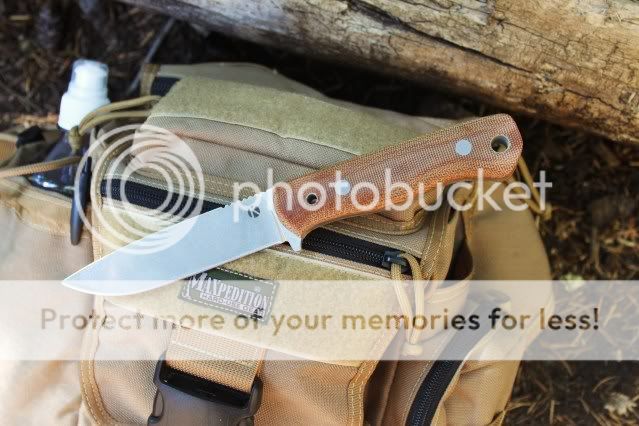
IMG_6519.jpg


Andy
 
Its fiber glass I'm surprised any knife held up.
 
Therefore, buck S30V and spyderco S30V are different because the steel's heat treatment?

Even Spyderco s30v at 58 and at 59.8 Rc perform differently.

rarreola, heat treating is like cooking food. two perdue chickens cooked by two different chef's will yield different results. each knife maker has their own goal for how they want their blades to perform, so they use their own "cooking" recipe.
 
With a few exceptions, hardness and toughness control edge holding more than wear resistance. Dulling is often from deformation/edge rolling, which is resisted by higher hardness. The other usual cause is chipping, either very small chips that make an edge feel rough, or catastrophic chips, which are obvious damage.

Speed of sharpening is controlled at least as much by geometry as by wear resistance. My M2 knife sharpens on a Sharpmaker pretty easily, while my 1095 Old Hickory had to go to the coarse waterstone for some edge thinning. Once it's thinned, I can probably do either in about the same time.
 
As you all know, there are countless factors involved in knife design and the successful application of a steel to a blade type is perhaps more of an art than a science. With this in mind, it is virtually impossible to level a blanket condemnation or a blanket praise to a particular type of steel. We can really only evaluate individual knives as they apply to the task at hand. Some designs and applications will do justice to S90V and others will not, whereas 1095 may be an ideal steel for a different knife design and application. A prime example is found in the different models of the Spyderco Manix 2. The CTS-XHP version uses a fully flat ground blade made from thinner stock than the hollow saber grind of the 154CM version. Which is 'better' is like asking 'Why is a duck', a completely nonsensical question without knowing the application and usage habits of the owner.

I have never met a steel that I didn't like, to coin a phrase. I have run upon poorly heat treated steel, steel that was a poor choice for the application, even steel that was clearly from a bad 'melt', but when done up well and applied properly, all steel can enjoy it's day in the sun.
 
I sharpened an AGR Acies ZDP189 Last night on my WEPS. Not only sharpened bit reprofiled the blade to17*. Sharpened it and stropped it to a scalpel edge. Was not difficult to do at all and edge holds very well.
 
I find VG10 (Spyderco, Moki) easy to sharpen. For me, it seems easier to sharpen than 154cm/ats34 (Benchmade, Gerber).
VG10 holds an edge pretty well.
I know that the composition should be similar for these steels, but they seem to react to stones differently.
 
for what it's worth:

i find sharpening up my laminated VG-10 fallkniven S1 to be a surprisingly swift and easy task.

certainly easier than sharpening up their 3G blades.
 
rarreola, heat treating is like cooking food. two perdue chickens cooked by two different chef's will yield different results. each knife maker has their own goal for how they want their blades to perform, so they use their own "cooking" recipe.

Fantastic analogy!

Heat treat/hardness is a big factor in edge performance.
 
Sharpening my knives is therapeutic for me. After a hard day of field use, they usually don't sit more than a day before they are shaving sharp again.
 
Back
Top
