
-
The BladeForums.com 2024 Traditional Knife is available! Price is $250 ea (shipped within CONUS).
Order here: https://www.bladeforums.com/help/2024-traditional/
You are using an out of date browser. It may not display this or other websites correctly.
You should upgrade or use an alternative browser.
You should upgrade or use an alternative browser.
I went to an auction and bought an old Barlow...
- Thread starter Codger_64
- Start date


Campbellclanman
Platinum Member
- Joined
- Mar 10, 2007
- Messages
- 16,309
I love that old Barlow, you can see how good it was before you even cleaned it up Codg-well done!
I love reading things like this -its what makes collecting knives fun!
I love reading things like this -its what makes collecting knives fun!

Codger_64
Moderator
- Joined
- Oct 8, 2004
- Messages
- 62,324
Nice, I love that stuff. Are you gonna use it or put it up?
I wish I knew enough about value to answer just that one question. Use the heck out of it, use it lovingly, or stow it away for now?
It resides on my desk for now. Dunno for sure. For now I am just enjoying fondling and looking at it. I do have favorite users that ride to work with me every day and multiple replacements for those same patterns if/when needed. So there is no real need to use it. Though it is in fully usable condition. I might just see if I can find it some pattern brothers to keep it company. I miss my prewar Barlows more than I thought I would. I am still amazed at the utility and value they packed into those knives at those low pricepoints. The Kwik-Kut Barlow sold for 23 cents in 1940 Sears catalog. The Fulton Barlow sold for 25 cents in 1941 and 29 cents in 1943.


- Joined
- Mar 21, 2005
- Messages
- 3,355
Great grab.

- Joined
- Nov 20, 2005
- Messages
- 19,385
Very cool. It's nice to know what you are looking at. I go to shows and see "old" Barlows and have no idea if it is something "good" or something that I should have no interest in.
- Joined
- Feb 1, 2007
- Messages
- 2,624
Loved finding those diamonds in the ruff. Great work on the clean up.

Codger_64
Moderator
- Joined
- Oct 8, 2004
- Messages
- 62,324
The penetrating oil I used is one of the two I use most in my work, PB Blaster. The other is liquid Wrench. I just work slowly and carefully with a wood or metal softer than the steel after I let it soak (Not immersed). Toothpicks, q-tips, bamboo k-bob skewers and a variety of plastic "probes". and soft cloth, turning it often so rust flakes don't scratch the knife. Less carefully, you could use superfine steel wool, but damage is a posibility. And finish off with a knife or gun oil.Codger whats your recommendation for rust removal on the bolsters and liners? Is it any different from the blades?
That's a great snag, Michael. There's still a few deals to be had out there, most of the time it takes a little gamble though.
Good eye!
I've been amazed lately at the deals I have found with little or no competition. I wish I had the knowledge and skill to do the voodoo that you do so well to those old worn TL-29s. I have the donor knives and materials, but not the know-how, shop and tools to do it right.
Last edited:
Codger_64
Moderator
- Joined
- Oct 8, 2004
- Messages
- 62,324
Someone gave an auction and again, no one came. So I am the proud(?) soon-owner of another cheap Barlow. I know that some of you looked at this one and passed. And it went begging through more than one relisting. Suffice it to say that the knife has "issues". Not major rust this time though. A probable reblading, then an abusive prior owner with a file or dremmel or bench grinder. A pity that, but I think it has potential to be a salvagable user.
And looking closely, I see bone covers and brass liners, both signs that at one point it was a higher pricepoint knife. A bit of research and discussion shows that the age is hard to determine. When did they use and quit using bone covers? The underline stamp on the blade is circa 1970's, but covers were nearly always synthetic by then, weren't they?
I think it will clean up nicely with some effort on my part. The blades will never be pristine and full again, but I can certainly reduce the gouges and scratches and straighten the edges. Making it more presentable if not more useful. Here are the auction pictures. The knife hasn't been received yet.


So critique and discuss. Did I just throw away another great $10 meal at McDonalds?
And looking closely, I see bone covers and brass liners, both signs that at one point it was a higher pricepoint knife. A bit of research and discussion shows that the age is hard to determine. When did they use and quit using bone covers? The underline stamp on the blade is circa 1970's, but covers were nearly always synthetic by then, weren't they?
I think it will clean up nicely with some effort on my part. The blades will never be pristine and full again, but I can certainly reduce the gouges and scratches and straighten the edges. Making it more presentable if not more useful. Here are the auction pictures. The knife hasn't been received yet.
So critique and discuss. Did I just throw away another great $10 meal at McDonalds?

- Joined
- Aug 24, 2010
- Messages
- 1,447
this knife

has this 1946-50 tang stamp with short underline. Note the long pull runs almost all the way into the tang.

Camillus tang stamps are listed in this thread
http://www.bladeforums.com/forums/showthread.php/497708-Camillus-Tang-stamps-and-dates
Codgers knife
has this 1960-76 tang stamp with long underline. Note the long pull does NOT run all the way into the tang.

This knife


Has the same 1960-76 tang stamp with long underline, and brass liners as Codgers, note the blade has 51 on the pile side. Note the long pull does NOT run all the way into the tang, similar to Codgers knife.
This knife has the same 1960-76 tang stamp with long underline as Codgers, with 11 on the pile side. Note the long pull runs almost all the way into the tang, different than Codgers and the 51 with synthetic scales.

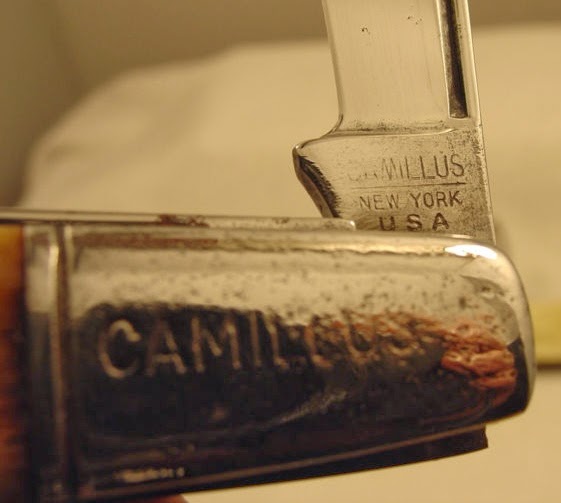

I will be curious to know if Codgers knife has an 11 on it also.
Does anyone know when Camillus began using 51 instead of 11?
Im also curious when the BARLOW bolster stamp began, my guess is 1956, not sure though. I believe the CAMILLUS bolster stamp started in 1946, replacing the Tip Top bolster...
has this 1946-50 tang stamp with short underline. Note the long pull runs almost all the way into the tang.
Camillus tang stamps are listed in this thread
http://www.bladeforums.com/forums/showthread.php/497708-Camillus-Tang-stamps-and-dates
Codgers knife
has this 1960-76 tang stamp with long underline. Note the long pull does NOT run all the way into the tang.
This knife
Has the same 1960-76 tang stamp with long underline, and brass liners as Codgers, note the blade has 51 on the pile side. Note the long pull does NOT run all the way into the tang, similar to Codgers knife.
This knife has the same 1960-76 tang stamp with long underline as Codgers, with 11 on the pile side. Note the long pull runs almost all the way into the tang, different than Codgers and the 51 with synthetic scales.
I will be curious to know if Codgers knife has an 11 on it also.
Does anyone know when Camillus began using 51 instead of 11?
Im also curious when the BARLOW bolster stamp began, my guess is 1956, not sure though. I believe the CAMILLUS bolster stamp started in 1946, replacing the Tip Top bolster...
Last edited: