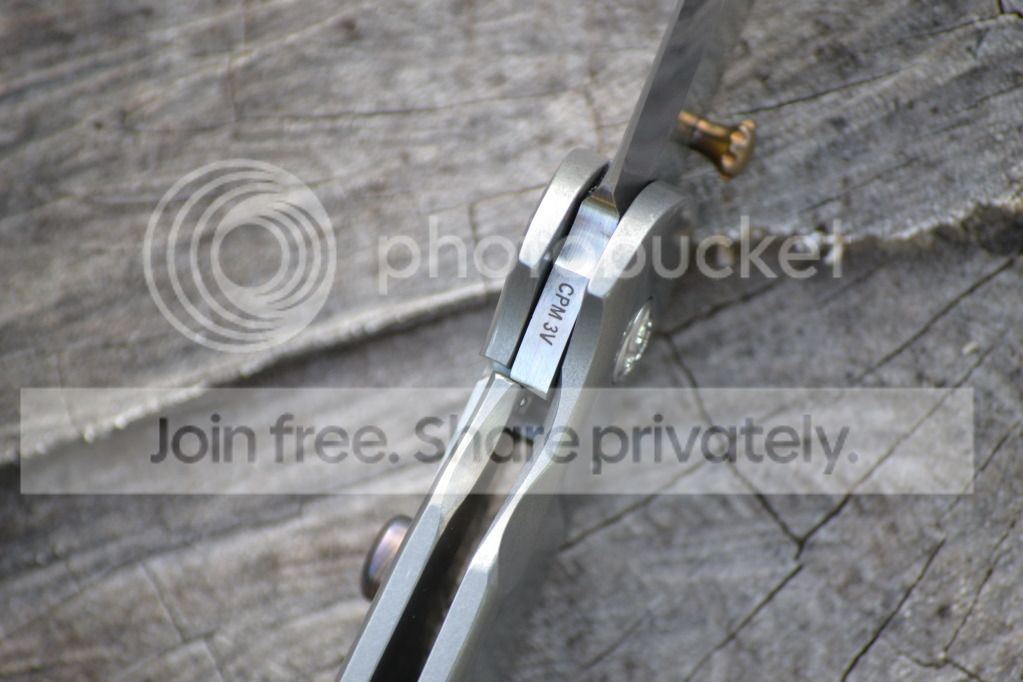
If CPM 3v is soooo tough....

Joined
Aug 21, 2011
Messages
146
just teasing :)

but seriously, I have a Fehrman Peacemaker and an ESEE 4, both around the same OAL and both 3/16'' thick. Can one calculate how much thinner the 3v blade could be while still being just as strong/impact/break resistant as the 1095 blade (heat treatment not taken into account)?

Thanks guys
 
Last edited:
Sure! Stick the ESEE into a wall and drop bricks or weights on it until it snaps. Then grind away steel from the Fehrman until it snaps under the same load. Then you'll know. :D

Oh... wait... you don't want to destroy your knives? You could extrapolate a ballpark figure based on published Charpy test results at similar hardnesses. Heat-treatment does have to be taken into account.
 
+1 to CPM 3V!!!

DSC_0805.jpg
 
it's all about the heat treat and blade design. I have had 3V that performed much worse than well HT'd 1095. ESEE is know for their Rowen HT. With 3V, you are at the mercy of the maker.
 
I have to ask... what 3V knife have you examined or tested that performed "much worse" than well-HT'ed 1095?

sorry, I won't drag anyones name out in public and honestly it was in the early days of 3V so I fully understand the issue. I have had 3V since that worked perfectly fine with thin edges, like my Koster 3v knife which is excellent. I really like 3V as I am a fan of chipper steels of which 3V is close to. I would not discard a simple carbon steel like 1095 or 1084. Properly done we all know that 3V, L6, S7 can perform much better in certain applications, but when I see what ESEE is doing with 1095 these days I wonder how much more is there a need for since it is usually a "want" to get more not a need. and I want more all the time, lol
 
Fair enough. I will tell you with absolute confidence that the major manu's using 1095 are not HT'ing it anywhere near its optimum hardness. There's a very simple reason for that, and it has nothing at all to do with performance in the field (despite reams of marketing to the contrary).

If you want more, much more, contact a custom maker who specializes in 3V.
 
Fair enough. I will tell you with absolute confidence that the major manu's using 1095 are not HT'ing it anywhere near its optimum hardness. There's a very simple reason for that, and it has nothing at all to do with performance in the field (despite reams of marketing to the contrary).

If you want more, much more, contact a custom maker who specializes in 3V.

agreed. The key word there highlighted. ;)
 
Fair enough. I will tell you with absolute confidence that the major manu's using 1095 are not HT'ing it anywhere near its optimum hardness.
Like maybe as many as 4 points below optimum hardness even for a "hard use" knife? :eek::D
 
what would you guys feel is the ideal hardness for 3V in a folder vs 3V in a large camp knife?

In a camp knife at 58 Rc it is about as tough as L6. In a folding knife at 62 Rc it would be about as tough as A2 at 58Rc, which is very tough for a folder, I would think, but not sure how high in Rc 3V can go. there is a drastic change in toughness on paper between the Rc points
 
I haven't sent a knife out at less than 60 in 4 years regardless of type.
 
In a camp knife at 58 Rc it is about as tough as L6. In a folding knife at 62 Rc it would be about as tough as A2 at 58Rc, which is very tough for a folder...

That will certainly work. I'm pretty sure you'd be just fine at 60Rc or probably even 62Rc in a big chopper, though. As you say, that compares favorably to much softer A2, and A2 is no slouch in the toughness department. Next time I send a batch of 3V out I'm gonna have a big blade run at 62 and beat the snot out of it. :)
 
i have run 3v at the higher end but on a chopper not yet at 62 (i think it should be just fine tho )
mine was 61 and i beat the hell out of it
 
I'm a sucker for 3V (ever since i won a Horton Necker). The thinnest stock i've got in my stash would be a Big Chris Bolo, my standard issue for jungle bum; at 4mm thick, my first thought wasn't convincing as i'm used to thicker spring steel BUT don't let it fool you.

I tend to want to cheat the geometry and balance a bit by getting thin stock with a bigger belly. That way you have a light blade with sheer penetration on medium of chop/cut ,albeit HT and grinding are vital. I'm currently testing the stock without any handle and it went through a rock solid, dried branch i had trouble with other chopper and it got me a good minute thinking.....with a big smile on my face.
 
I always try to run my 3V at 59-60 Rc, right in it's "sweet spot". I have never used it any harder, but have heard some negative results from higher heat treats. One fella I have talked to had a 3V folder that was tested to 62 Rc and he said he actually had much worse edge retention than 3V I heat treated at 60 Rc. Not real sure what that is all about, but I am anxious to hear some results from others at higher Rc's.
I really like 3V as an "all around" knife steel. It is my second favorite as far as cutting aggressiveness is concerned, right behind S90V. Holds a thin edge very well and can take a lot of abuse.
 
nevermind
it's all about the heat treat and blade design. I have had 3V that performed much worse than well HT'd 1095. ESEE is know for their Rowen HT. With 3V, you are at the mercy of the maker.
 
Yep. The HT not taken into account bit in the OP is...silly, unless that means "assume optimal HT on both sides." After all, the HT determines the quality of the blade, let alone whether it's a blade at all.

3V is considerably more expensive, in both materials cost, and in machining. So, while ESEE and Ka-bar do a great job with their 1095, and for that matter, I do really like 1095 because it's darn good for what it costs, that doesn't mean it's in the same category as 3V done well. It's just a lot more cost effective.

As for being at the mercy of the maker, I've gotten the impression that a good many makers that use 3V, also send their blades out to Peter's or Bos for heat treat, both of which are as well known for doing a good heat treat as Rowen is for 1095. I would certainly be more nervous about a 3V blade where the HT was done by the maker than I would be about a 1095 blade where the HT was done by the maker, just because the 3V is a more complicated steel, with a more complicated HT process. But I can't imagine there are that many makers who specialize in 3V who don't either have it professionally done, or else have put a LOT of time into testing it and refined their process. It would be foolish and expensive to specialize in 3V without getting the most out of the steel.

And then to turn around and say that "oh, we're leaving out makers who *specialize* in 3V," but then turn around and cite Rowen, who it can be fairly said, specializes in 1095... well, that's a bit hypocritical, is it not?

So...all things being equal, assuming ideal HT on both sides for the blades, if price is no object, 3V I think would clearly have to be a better choice. The thing is, 3V isn't cheap. An ESEE made from 3V would likely be VERY expensive, and most non-knife nuts already consider ESEE's to be expensive. Is it enough better than 1095 to merit the increase in cost? That's an entirely different question, and would depend on the user and the use.

 
Back
Top