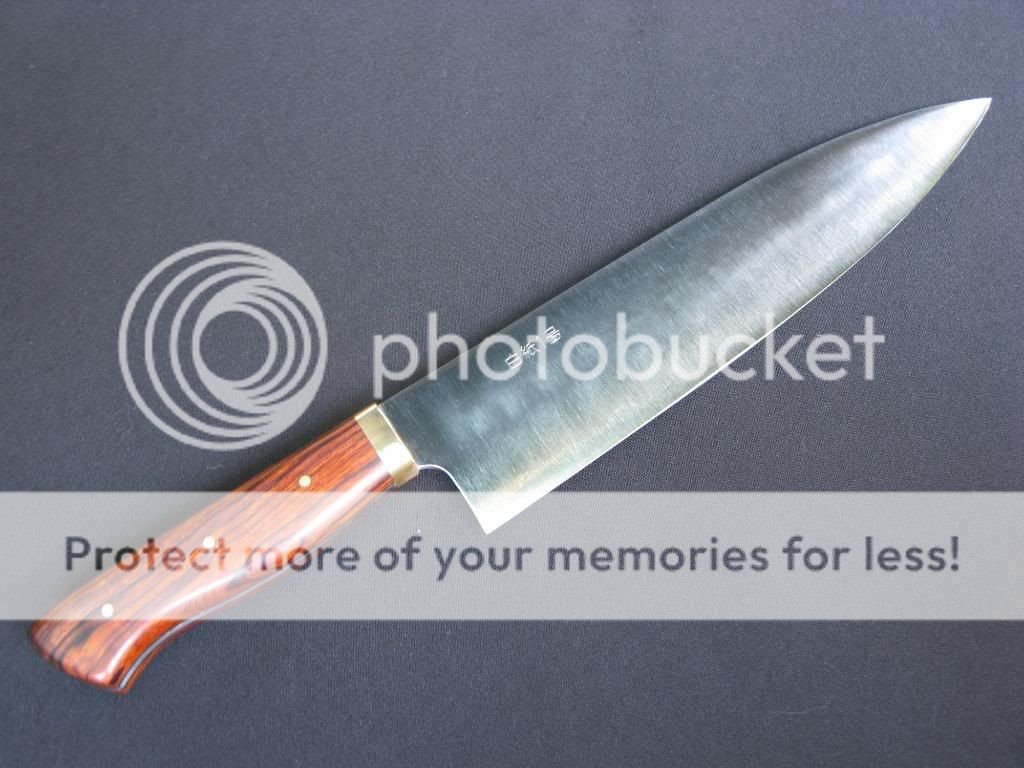
If you could only have 3 kitchen knives....what length would they be?

If you could only have 3 kitchen knives....what blade lengths?

  • 3" blade or shorter

    Votes: 1 100.0%
  • 3-4"

    Votes: 0 0.0%
  • 4-5"

    Votes: 0 0.0%
  • 5-6"

    Votes: 1 100.0%
  • 6-7"

    Votes: 0 0.0%
  • 7-8"

    Votes: 0 0.0%
  • 8-9"

    Votes: 1 100.0%
  • 9-10"

    Votes: 0 0.0%
  • 10" blade or larger

    Votes: 0 0.0%

  • Total voters
    1
The poll results were surprising.
The less than 3” getting the most votes?
Hmmm, not to many culinary types out there I guess.

If I were limited to only three kitchen knives I would have:

Chefs, 8-9"
Paring/Utility, 3-4"
Serrated Bread, 8" or longer

I have a large set of culinary knives made by Icel. These knives are made in Portugal and are easily as well made as any of the German brands.
All are forged, not stamped, and made of high carbon stainless.

I also have 4 specialty knives that are made by different manufacturers, since Icel doesn’t offer the design.

The 3 main knives I use are an 8” Chefs, 4” paring/utility, and a small 6” serrated for bagels/sausage.

My culinary set consists of:

Chef-8”
Serrated Bread- 8”
Serrated Bagel/Sausage-6” (Wusthof)
Boning-6”
Paring/Utility-4”
Skelton Cheese-6” (Schaaf-Goldhamster) Expensive, but the best cheese knife ever made
Curved Paring-2.5” (Wusthof)
Cleaver- 6.5”
Carving-8”
Salmon Slicer-12” (Wusthof)
Steak knives-4.5” (6ea)

And, of course, a block to store them in.

A few of thoughts on kitchen cutlery:
• I don’t have a Santoku because a Chefs does everything a Santoku does, without the drawbacks. And a cleaver does everything a Santoku does without the drawbacks. And a Utility does everything….you get the idea. There is nothing wrong with a Santoku. If you can only have one knife, it's a good all-arounder, but it is a comprimise.
• Don’t be fooled into anything bigger than an 8” Chef. They are plenty big enough to handle anything in the kitchen, but still maneuverable. Every good chef/’cook I know does not like 10” chefs. As for 12” chefs, they hate them, they are just too big and unwieldy. If you really need a big knife for processing meat, then get a big 12-14 Scimitar or something.
• I regret having an 8” Serrated Bread. It’s not long enough. If you ever get a dedicated Bread knife, get at least a 10”. Don’t believe me? Measure a nice round loaf from a specialty bakery sometime. You end up standing the loaf on its side for the initial cut with an 8”.
• Japanese knives are all the rage right now. Their steel and geometry is quite different from the European brands though. I’m not sure they are really a better idea or not. Time will tell.
• If you buy kitchen cutlery. Learn how to hold a knife! Believe it or not, there is actually a proper way to grasp a Chefs knife. Most people do it wrong. If you are a “knife guy”, and most of us are, you might as well do it right huh?
• Don’t use a glass or stone cutting board. Do I really have to explain this?

I make these suggestions to those who are new to kitchen knives. If you have a 10"-12" chefs already, and you like it, good for you! I'm not saying you are wrong. I would never suggest that size knife to a novice culinary knife buyer though. I've seen kitchen stores put the larger knives on sale to the ususpecting public simply because they can't move them otherwise.

If you cook at home do yourself a favor and get a couple of quality kitchen knives.

It is truly amazing how many guys on this forum have $300 knives that see no more hard use than envelope opening and cord cutting. They talk about how great XYZ steel is. They look down on $50 AUS-8 folders
Then they admit they use a cheap, POS Old Hickory in the kitchen, where a quality blade REALLY makes a difference.

Makes me think they are posers.
 
Last edited:
The 10" chef knife blade is recommended by graduates of Le Cordon Bleu and a favorite of the Japanese-trained chefs I know (yes, both of them! ;) ), so by all means, don't be fooled into getting one, get one because they make the job easier.

Chad Ward's An Edge In the Kitchen is a very great book for knifeknuts wanting to pick the right kitchen knives, right sharpening system, and right techniques for using both. Norman Weinstein's Mastering Knife Skills goes further in-depth on slicing, dicing, and fabricating, but isn't as geared towards knifeknuts.
 
thanks for all the votes so far....keep 'em coming!


This is a great discussion going....


The poll results were surprising.
The less than 3” getting the most votes?


I think what the vote results are showing is that regardless of what other knives people have....nearly everybody uses a 3" or smaller paring knife. *shrug*


Dan
 
3"-4" paring knife
6" utility / slicing knife
10-12" Chef's knife. An 8"-9" works just fine, but "bigger is better" ;)

Of course in real life most folks have many more than just three. :)
 
Hi Thom,
I have 3 Murry Carter kitchen knives, and Shun Pro knives. A nice combo set, as you know I like to cook, and you also know I love knives. I just bought a Nomad from New graham a few weeks ago. I was wondering if they would send bandaids like you had mention to me a few years ago. Well of course they did. I bought a Mini Sere from Bonds house of Cutlery two years ago in las vegas, after I won a few hundred at craps. I was testing a rectifier with Bruce B. (with Mango sitting with him, on Wednsday) and he mentioned Brian S. was going out there next week. Bruce and Kim are going out the following week. Well now I'm a little envious, and am planning to go out very soon as well. We went in April, so this will be the second time out this year. I would recommend you check out a Murry Carter kitchen knife. Arizona Custom knves, and Kellam Knives both sell his customs for under $100.
 
Then they admit they use a cheap, POS Old Hickory in the kitchen, where a quality blade REALLY makes a difference.

Makes me think they are posers.

What's wrong with Old Hickory kitchen knives? 1095 at low-mid 50 Rc isn't unreasonable for the pricepoint.

D
 
I own about 200 kitchen knives and I routinely lead teams of 15 to 25 "cooks" at the local soup kitchen. Here's my pick:

3" paring knife--for peeling apples, taking eyes out of potatoes opening packages etc. For most work that seriously makes use of the point this is the safest, easiest and most precise size.

4-5" small knife--handy little knife for small jobs and boning. I usually use this on a cutting board so it needs some blade width.

7-8" chefs knife--for serious production you need a long blade. 90% of the time extra length beyond 8" is more hassle than advantage. It is a real liability in the hands of an amateur. I have seen one go to the hospital using the point of a 10-inch chefs knife to open a package that would have been better opened with the point of a 3 or 4 inch blade. If I was stuck without a 10 inch blade I would feel the loss, but how often do I cut a watermelon? I probably use my 7 inch blades more than anything else at home. My volume of production is smaller there than in the soup kitchen. At the soup kitchen I use an 8 to 10 inch blade when we're chopping up food for over 500 people.

This is a set of blade lengths that I could live with and work at near peak productivity. It is also a collection that I would feel good about handing to a novice. I know that most housewives would overuse the paring knife, but that's the breaks. If I had to live with two knives I would give up the paring knife.
 
Agree with a lot of the posters here in that three quality knives is all you need.

1) A parer sized to be comfortable in the user's hand while food to be cut is cradled in the other, or finer cuts while item is secured on a board.

2) Mid-size utility for use on a board.

3) Chef's knife/ gyuto in 210-270cm.

3B) A longer serrated bread knife is a plus, but not critical.

Put ever thing else in a shoe box and give it to the in-laws. :D

Now, having tried a few knives a well as researched a bunch:

The old thicker, softer steel, and heavier German and French style knives are the 57' Chevy of knives.
Classic, stable, and heavy, but not much in the way of handling and performance.

Once you cut with good Japanese style blades that are thin and hardened to a high degree it is an amazing contrast .... :)

Think speed and ease of performance, Maserati perhaps.
Not necessarily that expensive though.

Great topic Dan! :thumbup:
 
I would recommend you check out a Murry Carter kitchen knife. Arizona Custom knves, and Kellam Knives both sell his customs for under $100.

Carter's in big demand for a great reason. I prefer more rustic looking knives and have these chef knives from Takeda and Moritaka:

caltak.jpg

Takeda 255mm x 56mm gyuto

newmor03.jpg

Moritaka 260mm x 60mm gyuto

Speaking of Carter, here's a knife made by jazz trumpeter who attended his knifemaking class. First knife ever:

IMG_0627.jpg

San mai construction, too!

Maybe you should invest your money at Carter's school instead playing the odds at Vegas?

Chef's knife/ gyuto in 210-270cm.

Dude! That's hyooj!

Once you cut with good Japanese style blades that are thin and hardened to a high degree it is an amazing contrast

It's the difference between shooting a water buffalo with the bullet of a high-powered rifle and trying to maul it with a digeridoo.

Stamped steel and lousy balance for starters....

Whether steel is stamped, drop-forged, hammer-forged, ground, and evey combination of those doesn't affect its performance. That's just marketing hype. A Wüsthoff chef knife and a Michael Rader chef knife are both forged and I'd sell a kidney for the Rader and use a kidney instead of a Wüsthoff.
 
Dude! That's hyooj!

That is what she said... :D

My bad, mm :o
It's the difference between shooting a water buffalo with the bullet of a high-powered rifle and trying to maul it with a digeridoo
My BIL is Australian, but is that the bamboo type tube you turn up and down to sound like rain?

IOW, blunt force trauma to the head of lettuce? :D

On your Takeda, what does he call that gyuto with the extra tall blade and knuckle clearance?

I am sure that bad boy is sharp but it appears a little... clumsy, no?


Thom, thank you!
 
That is what she said... :D

My bad, mm :o

This isn't the forum for discussing your bad mm. :p

My BIL is Australian, but is that the bamboo type tube you turn up and down to sound like rain?

IOW, blunt force trauma to the head of lettuce? :D

You're thinking about a rainstick. They're marketed as being South American. A didgeridoo is a stick that's been hollowed out by termites.

Here's a guy jamming out on one:

[youtube]BYGbH50kWEw[/youtube]

On your Takeda, what does he call that gyuto with the extra tall blade and knuckle clearance?

He calls it a gyuto. My Takeda gyuto was a standard one. The Moritaka was a special order inspired by the Takeda (only I wanted more knuckle clearance).

Here's a very bad picture of a standard Moritaka gyuto that used to grace this household pictured with the Takeda:

mori02.jpg


I am sure that bad boy is sharp but it appears a little... clumsy, no?


Thom, thank you!

ADD, you're welcome.

The Takeda is quite nimble, actually. Despite being my second widest blade, it's also the thinnest chef knife I've ever seen or used. Just oiled it and put it away to give the Moritaka a try - going from foil-thin and feather-light to normal weight and Suisin-thin is going to be awkward. If the idea of a very wide chef knife is appealing, but wrought-iron cladding isn't your bag, Ichimonji Chuki Corporation sells western-handled, wide-bladed chef knives using SK-4 steel:

2.jpg

http://www.ichimonji.co.jp/shopping/goods_detail.php?id=337
 
This isn't the forum for discussing your bad mm. :p


You're thinking about a rainstick. They're marketed as being South American. A didgeridoo is a stick that's been hollowed out by termites.

Here's a guy jamming out on one:

[youtube]BYGbH50kWEw[/youtube]


He calls it a gyuto. My Takeda gyuto was a standard one. The Moritaka was a special order inspired by the Takeda (only I wanted more knuckle clearance).

Here's a very bad picture of a standard Moritaka gyuto that used to grace this household pictured with the Takeda:

mori02.jpg


ADD, you're welcome.

The Takeda is quite nimble, actually. Despite being my second widest blade, it's also the thinnest chef knife I've ever seen or used. Just oiled it and put it away to give the Moritaka a try - going from foil-thin and feather-light to normal weight and Suisin-thin is going to be awkward. If the idea of a very wide chef knife is appealing, but wrought-iron cladding isn't your bag, Ichimonji Chuki Corporation sells western-handled, wide-bladed chef knives using SK-4 steel:

2.jpg

http://www.ichimonji.co.jp/shopping/goods_detail.php?id=337

Those are some nice kitchen knives. I just don't have enough room in my block for any more large knives. I guess I need a new block to accomadate more fine cutlery. When it comes to knives,the more the merrier, I always say.
 
great discussion...let's keep it going...:thumbup:


focus more on lengths/styles and less on brands/makers. ;)


Dan
 
Back
Top