if you use Cru Forge V.....

Joined
Dec 21, 2006
Messages
3,158
Finally got around to hardening this blade of Cru Forge V after my last attempt ended in disaster. The last attempt I had ground the edge way too thin, .015", before heat treat. After quenching, a file dug into the blade like it was mild steel, and I thought I didn't get it hot enough (first time using a kiln). I went back to my forge, re-tried the quench, same thing.....file bit right in. I had really never experienced decarb before, so I was at a loss as to what I did wrong. With the help of everyone on this forum I determined that the culprit was not my kiln, or my forge, or my calibrated Mark I eyeballs, but rather decarb. That knife was not going to be salvagable, so I made another.

This time around, I was more aware of what to expect, and left my edge around .035 or so. 1650F, cool in air. 1500F, cool in air. 1400F, cool in air. 1200 equalize, ramp to 1500 and hold for 10 minutes, quench (P50). I used a VERY THIN layer of satanite to help control some of the decarb. I checked with a file after quench and the file bit into the steel just like the last time (I was a little apprehensive, but expected this). Tempered 1.5 hours @ 350 just for stress relief, then proceeded to see just what I had. Using 80 grit paper (by hand...no grinder....no heat), I started to sand the blade, hoping that indeed there was a layer of decarb. There was indeed. Hard to say exactly how thick it was, but I would say close to .010" of decarb. While sanding I was starting to worry about having a bad batch of steel, but the more I sand, the harder it gets! You can tell when you hand sand hard steel, the feel (and look) changes. Paper wants to skate off of the blade, and it has more of shine, I suppose. Once I reached the hard layer, I put it back into the oven for another 1.5 hours @ 400F.

I wrote this in case someone down the line has the same issue. If you did everything right, don't be upset if your file test fails. You more than likely have a thick layer of decarb to get through before you reach the hardened steel. San Mai comes to mind! I REALLY hope this helps someone in the future, because I have gleened a treasure trove of info from this forum. Even if I don't end up posting a knife to sell.....the money for the membership is well worth it. Another "Thank you so much" to the Bladeforum mods, members, and posters.

I am new to hypereutectoids and don't have much experience heat treating them. I did do a blade of 52100, with basically the same heat treat as mentioned above, but didn't have the decarb problem. It was done in my forge, tho, and not the kiln. I am thoroughly impressed with the edge on that knife. For those of you who HT hypereutectoids in a kiln, do you have this much decarb to deal with, or is this something unique with CFV?
 
I have not used CFV,but when I H/T carbon steels I put a very light wash of satinite over the whole blade,Will reduce your decarb almost completely.

Stan
 
Can't wait to try it!
Do you know how to set a reducing atmosphere in your forge? I find it helps a lot with decarb, though I rarely HT in the forge anymore.
 
If you're doing your cycling in an elec. furnace you can wrap it in foil to reduce decarb.. Then remove the foil for the actual hardening process.
 
elementfe, my forge is a paint can/Mapp gas. First with just one torch, then added a second for a much better result. Not sure about reducing that. Darrin your help has been tremendous as well. That is a good idea. The thin layer of satanite did come off that first 1650 cycle.....and I sanded the scale in between each cycle thereafter. The edge really must be thicker than .035" After sanding it all off, this dude is ground nice and thin. Too thin for most knives, but I think this steel will perform well the way it is. Measurement to come tomorrow.
 
Stuart, you should invest in some of the liquid anti scale compound from Brownells.
 
I use an electric kiln for all of my heat treating. I put a couple of chunks of lump (hardwood) charcoal in the kiln just before the blades go in which creates a reducing atmosphere (carbon monoxide from incomplete combustion) in the somewhat sealed environment of the kiln which consumes all of the free oxygen so I get virtually decarb free heat treats without having to apply descaling compound. I do not heat treat steels that require subcritical ramping to bring elements into solution so I am preheating the kiln to my austentizing temp and then putting the blades in so I am not doing long exposures at high temps so your mileage may vary if you do that, but if you have a kiln try the charcoal trick. I came up with the idea when I was making charcoal for smelting and had some sitting around while I was heat treating a batch of blades

-Page
 
I use an electric kiln for all of my heat treating. I put a couple of chunks of lump (hardwood) charcoal in the kiln just before the blades go in which creates a reducing atmosphere (carbon monoxide from incomplete combustion) in the somewhat sealed environment of the kiln which consumes all of the free oxygen so I get virtually decarb free heat treats without having to apply descaling compound. I do not heat treat steels that require subcritical ramping to bring elements into solution so I am preheating the kiln to my austentizing temp and then putting the blades in so I am not doing long exposures at high temps so your mileage may vary if you do that, but if you have a kiln try the charcoal trick. I came up with the idea when I was making charcoal for smelting and had some sitting around while I was heat treating a batch of blades

-Page

Page, have you had to replace your kiln elements at all because of doing this? As I understand it a reducing atmosphere in most electric kilns destroys the protective oxide coating that forms on the elements, and causes them to burn out quickly... I understand there are some elements that are rated for a reducing atmosphere, but most aren't.

I'm curious if it's caused you problems, because I was looking at using CO2 as a cheap shielding gas for the kiln a while ago, but had to abandon it because of warnings about the elements burning out...
 
I have not had to replace my kiln elements yet. This is the first I have heard of this. I googled it and looks like it may be a serious problem. My kiln is a lab kiln with the chamber lined with a hard refractory, so the elements are not visible or exposed. if that one burns up it will be a nuisance to fix, but I have gotten 5 years doing this so far. I am in the process of building a larger kiln and am currently researching a suitable refractory to bed my elements in like the elements in the tube furnace I got from the lab I used to work in, as I don't like exposed elements for a variety of reasons, but I am not terribly concerned as I bought my elements for less than $10.00 each so if I blow a few it is NBD and the whole kiln is going to cost me less than $150 to build so now that I know I will make sure that I allow the elements to re-oxidize between use. I wouldn't dream of wasting money on one of the commercial kilns that they sell for knifemaking when they all seem to have major design flaws when compared to laboratory kilns, so I am doing my own take-off on the lab kilns I have used

-Page
 
Thanks for the suggestion on the charcoal. I may invest in some anti scale stuff. The Brownells catalog was one of my favorites as a kid. Aaron, the knife I am talking about is the one you and I discussed, BTW.
 
I have not had to replace my kiln elements yet. This is the first I have heard of this. I googled it and looks like it may be a serious problem. My kiln is a lab kiln with the chamber lined with a hard refractory, so the elements are not visible or exposed. if that one burns up it will be a nuisance to fix, but I have gotten 5 years doing this so far. I am in the process of building a larger kiln and am currently researching a suitable refractory to bed my elements in like the elements in the tube furnace I got from the lab I used to work in, as I don't like exposed elements for a variety of reasons, but I am not terribly concerned as I bought my elements for less than $10.00 each so if I blow a few it is NBD and the whole kiln is going to cost me less than $150 to build so now that I know I will make sure that I allow the elements to re-oxidize between use. I wouldn't dream of wasting money on one of the commercial kilns that they sell for knifemaking when they all seem to have major design flaws when compared to laboratory kilns, so I am doing my own take-off on the lab kilns I have used

-Page

Hey Page! Glad to hear you haven't had any issues!

I believe there are some 'fancy' types of elements that are rated for reducing atmospheres, perhaps your lab kiln has them installed? Very convenient if so! No more having to worry about foil wraps and such...

Thanks for the suggestion on the charcoal. I may invest in some anti scale stuff. The Brownells catalog was one of my favorites as a kid. Aaron, the knife I am talking about is the one you and I discussed, BTW.

Sweet! I'll look forward to seeing photos!
 
Aaron,
I will get you photos as soon as I can. I have a big day tomorrow. Customer coming by to buy a blade. I'll post pics of it as well. Thanks to all you guys!
 
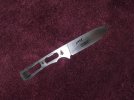
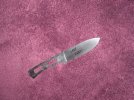
I thought I would post a pic of this knife. Finally getting around to making myself a hunting knife. Kudos to Aaron. Sorry for the picture quality, done in a hurry. In case you're wondering, the writing on the blade says "Last 220" to remind me which grit I used last. SAM_1175.jpgSAM_1182.jpg
 
Last edited:
Page, I would not recommend putting charcoal in the kiln if it has exposed elements. CO or CO2, doesn't matter because both will react with the metal in the hot elements. The atmosphere might be slightly reduced in the chamber if you keep the door tightly shut, but the gain on the blade will not equal the shortened element life.

A simple anti-oxidation coating will solve the problem on any carbon steel blade in HT, whether done in a forge or oven. A thin wash of Satanite, Turco, Brownell's PBC, ATP-34, etc., is all you need to keep the oxygen away from the steel.
 
Back
Top