I'm making my first knife. Am I doing it right?

Joined
Feb 22, 2009
Messages
160
Hello all.

I've decided to make my first knife out of an old file. I just wanted to make sure I have all the steps right so I don't forget anything as I go along. I will be butting a single bevel "Scandi" grind on the rather thick 3/16th inch knife. It's all I have, and I was planning on making a pretty hard use knife, so the thicker, the better. I was going to try to do it all with files, sandpaper and a wood stove, but I guess we'll see how that goes.

I will be updating, and asking lots of questions in this thread as I go along.

Here are the steps I'm going to be doing. Right now, as I type this, the file is in the wood stove out in the garage (on the hottest day of the summer, lol).


1. Find an old metal file.

2. Place the file in a wood stove. Get it to at least a cherry red color, and leave it in the wood stove until the file is cool to the touch.


REMOVING METAL

3. Grind off the teeth of the file.

4. Draw the rough shape of the blade on the file.

5. Cut off as much metal as I can with saws, drills, grinders, files, etc.

6. Smooth out the shape of your blade with finer, more accurate tools until I have a nice smooth blade blank.

7. Drill out the holes for handle pins and lanyard hole.

8. Scratch a line down the center of the knife edge to show where to line up the grinds on each side.

9. Start grinding the bevel of the blade with a file or grinder.

10. Use a jig of some sort and a file to sharpen the knife at a 22 degree angle.

11. Finish sharpening with a stone.


HEAT TREATING

12. Using a forge, heat the knife until it is non magnetic and then very quickly quench in a bucket of motor oil that is heated to about 120 degrees. Repeat 2 more times.

13. Clean off the blade with sandpaper.

14. Wrap the blade in aluminum foil, and place it in a tray of sand in a 400 degree fahrenheit oven for 2 hours. Turn off the oven and let it cool slowly.

15. Polish the blade to desired finish.


MAKING A MICARTA HANDLE

16. Cut strips of cotton (blue jeans, t-shirts etc) wider that the handle of the blade, and at least twice as long.

17. Lay them down one sheet at a time, coating each one with resin. Make the stack about 1.5 to 2 inches thick.

18. Wrap the stack in wax paper and press it using large clamps and 2 boards. Clamping as tight as possible. Allow to harden 24-48 hours.

19. Trace the handle shape on the slabs and sand them down, making sure the side that comes in contact with the steel is perfectly flat.

20. Drill out and fit the slabs to the knife using brass pins.

21. Disassemble the handle, apply a generous amount of epoxy to the pins, slabs, and steel. Clamp together over night.

22. Sand the handle down to its final shape and texture.

23. Sharpen the knife.

24. Enjoy!


Thanks for any help you can give me along the way.
 
Last edited:
1. Find an old metal file... Made by Nicholson or Simmonds

2. Place the file in a wood stove. Get it to at least a cherry red color, and leave it in the wood stove until the file is cool to the touch 3x each time shutting it down before it hits the last temp, cherry/dark cherry/black heat...(this is a hillbilly spheroidizing anneal)


REMOVING METAL

3. Grind off the teeth of the file.

4. Draw the rough shape of the blade on the file.

5. Cut off as much metal as I can with saws, drills, grinders, files, etc.

6. Smooth out the shape of your blade with finer, more accurate tools until I have a nice smooth blade blank.

7. Drill out the holes for handle pins and lanyard hole.

8. Scratch a line down the center of the knife edge to show where to line up the grinds on each side. (leave atleast .050" play room (.0625 is 1/16") for Quenching stresses)

9. Start grinding the bevel of the blade with a file or grinder.

10. Use a jig of some sort and a file to sharpen the knife at a 22 degree angle.

11. Finish sharpening with a stone. THESE 2 STEPS ARE THE LAST THING DONE AFTER THE HANDLE IS PUT ON!


HEAT TREATING

12. Using a forge, heat the knife until it is non magnetic and then very quickly quench in a bucket of motor oil that is heated to about 120 degrees. Repeat 2 more times. Quenching oil is the THEE most important part of the process nect to the steel itself... buy a gallon of McMaster Carr 11second quench oil for this. Your knife will thank you for it and love you more and will perform better than just dunking it in some old used motor oil...that's like buying the services of an old worn out syphlitic hooker for your first experiance... yea it'll work...maybe, but why would you want to! ( just saying k...)

13. Clean off the blade with sandpaper.

14. Wrap the blade in aluminum foil, and place it in a tray of sand in a 400 degree fahrenheit oven for 2 hours.

Turn off the oven and let it cool slowly.

15. Polish the blade to desired finish.


MAKING A MICARTA HANDLE

16. Cut strips of cotton (blue jeans, t-shirts etc) wider that the handle of the blade, and at least twice as long.

17. Lay them down one sheet at a time, coating each one with resin. Make the stack about 1.5 to 2 inches thick.

18. Wrap the stack in wax paper and press it using large clamps and 2 boards. Clamping as tight as possible. Allow to harden 24-48 hours.

19. Trace the handle shape on the slabs and sand them down, making sure the side that comes in contact with the steel is perfectly flat.

20. Drill out and fit the slabs to the knife using brass pins.

21. Disassemble the handle, apply a generous amount of epoxy to the pins, slabs, and steel. Clamp together over night.

22. Sand the handle down to its final shape and texture.

23. Sharpen the knife.

24. Enjoy!


Thanks for any help you can give me along the way.


There Fixed It For Ya . . . :thumbup:

Jason
 
On your HT. You only need one quench to harden. Bring the blade about two shades of red above non-magnetic. Try to hold it at that color a couple of minutes then quench in canola, mineral, or at least ATF oil, at 125° to 130°. Motor oil is not as good as any of those three. Canola or mineral is your best choice. You don't need foil to temper, but the dry sand is good. Temper at 425° to 450° for two, two hour heats. Let cool to room temp in between. Be sure your file is not just case hardened. Nicholsons, and Simmons are the only two that be trusted by name alone. At least by me, and I have made probably a hundred file knives that were all very good knives.
 
For your tempers, no need to let it cool slowly in the oven after baking at 400. Also, no real need for the sand or the foil (unless your oven has trouble holding temps...then the sand can help a bit). I just hang mine in free air from the kitchen oven rack and use a sheet of foil on the bottom rack of the PREHEATED oven to reflect the radiant heat. It's best to let your oven pre-heat for a good while to let it be fully heat soaked before popping the knife in. That way you avoid larger temperature swings. Use an oven thermometer to check the temp; don't just trust the oven reading. If you're using a toaster oven, rather than a tray of sand, use a refractory brick or something like that to make it more thermally stable and sheild the knife from radiant heat of the coils.

After a 2 hour temper at 400, keep the oven on, take the knife out, and let it cool in room air. After it's fully room temperature, pop it back in the oven for another 2 hours and then again, take it out and let it cool to room air.

--nathan
 
Last edited:
Jason, you're saying I need to let the fire cool, then build another one, but not quite as hot, let that cool, and then do it a third time, making sure it doesn't change color at all?
 
unrelated, but are you the same guy on diyaudio?

No. I'm the same guy on Headfi, watchuseek, EDCF, altgn.com. and a few others. I've never been to diyaudio. There are a lot of Spaceman Spiffs out there (hence the 23 after my name)
 
No need to let the fire cool, just remove the file from the fire and let it cool to black then reinsert to reheat. Do this 3 times to get the steel soft and the carbon spred out so it will harden properly when you get to that step.

On the tempers do your 450 2 hour soak remove the blade and let it cool to room temperature then reinsert it and llet it reheat to 450 for 2 more hours, then remove it and let it cool.
 
No need to let the fire cool, just remove the file from the fire and let it cool to black then reinsert to reheat. Do this 3 times to get the steel soft and the carbon spred out so it will harden properly when you get to that step.

So I can just let it cool at air temp?
 
yep sure can, but on the 3rd time leave it in, shovel ashes (NOT RED HOT COALS), over it and let alone to cool and let the fire die out... pick it up in the morning it'll be good to go, your drill bits will thank you :D

Jason
 
Ok, it's in there after taking it out, letting it cool, replacing, etc, etc. I burried it in as much ash as there was out there (not much) and moved the coals over to the other side of the stove.

There was however, a problem. The file has a nice bend in it now. Will I be able to flatten this out once it cools? I don't have an anvil.

Should I go do something to it now?
 
Also, What is case hardening and how do I know if my file has it?

About the sharpening before its hardened, with the scandi grind on such a thick piece of steel, the amount of steel that I would have to remove would be so much, that it seems like it would be easier to do all sharpening first, and then just touch it up when its all done.
 
Ok, it's in there after taking it out, letting it cool, replacing, etc, etc. I burried it in as much ash as there was out there (not much) and moved the coals over to the other side of the stove.

There was however, a problem. The file has a nice bend in it now. Will I be able to flatten this out once it cools? I don't have an anvil.

Should I go do something to it now?


Heat it up straighten it, replace in ashes...
 
Also, What is case hardening and how do I know if my file has it?

About the sharpening before its hardened, with the scandi grind on such a thick piece of steel, the amount of steel that I would have to remove would be so much, that it seems like it would be easier to do all sharpening first, and then just touch it up when its all done.

you need to leave some meat on the edge to avoid cracking during quench. .050" is considered minimum for 1095 and W series steels ( most generally the steel of choice for good files). I leave a 1/16" for the edge, becuase it's simple to measure and al little extra protection never hurt anyone... besides a 1/32 on each side goes quick putting the edge on with a bench grinder...

Jason
 
I forgot about it being brittle when you quench it. Thanks for the tip.

Also, No bench grinder for me ( even though I do have one) All files and sandpapaer. At least until I get frustrated.
 
Well, I gave up on the "no power tools" rule after about 20 minutes of trying to file of the teeth of my file. And since then it has been going very smoothly. Much more smoothly in fact than I ever thought it would.


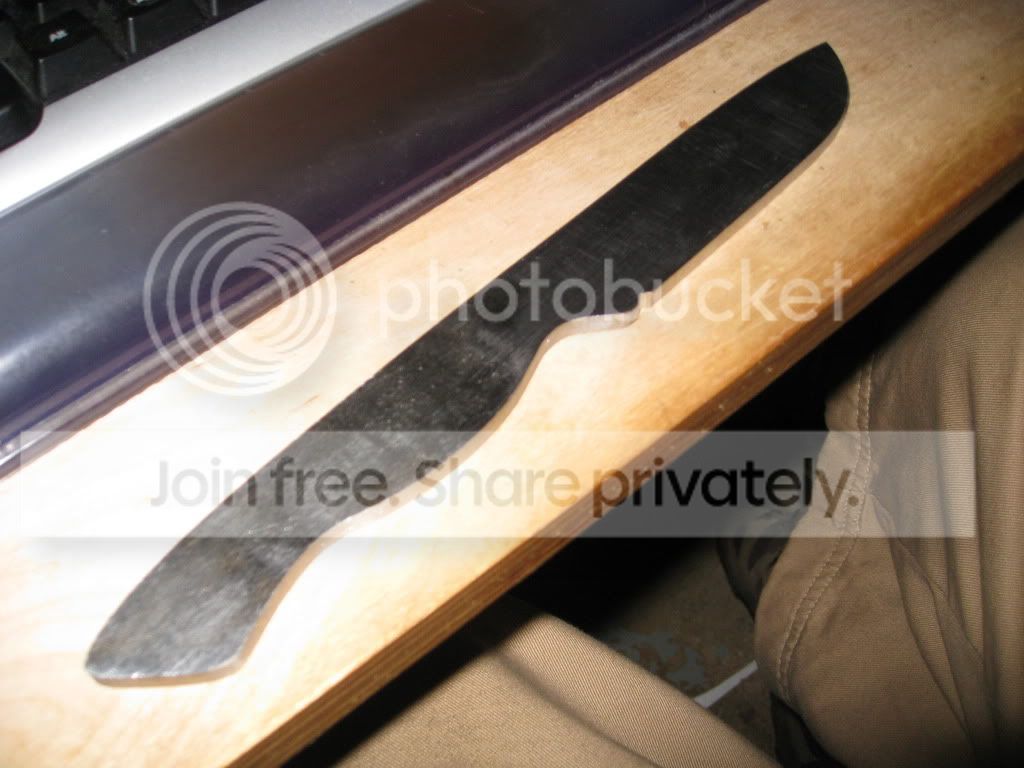
Here's what I'm up to.

IMG_9694.jpg


Now I've run into my first problem. Setting the bevel.

- Will a single bevel grind work on such a thick (3/16 inch or 5mm) blade?

- If so, how do I sharpen it at a consistent 22 degree angle?

- How do I keep the angle when going up the belly to the tip?

- If a single bevel won't work, what should I do differently?
 
2 more questions.

Anyone know how much resin I'll need to make a block of blue jean "micarta" that is about 12" x 2" x 3/4"? Aso, can I mix it all at once, or do I have to do it in stages?

second question. I'm not doing a scandi grind anymore, just a flat grind. How thin do I need to get the flat grind before I but the secondary (edge) grind on?
 
Back
Top