I'm Throwing Away My Jigs

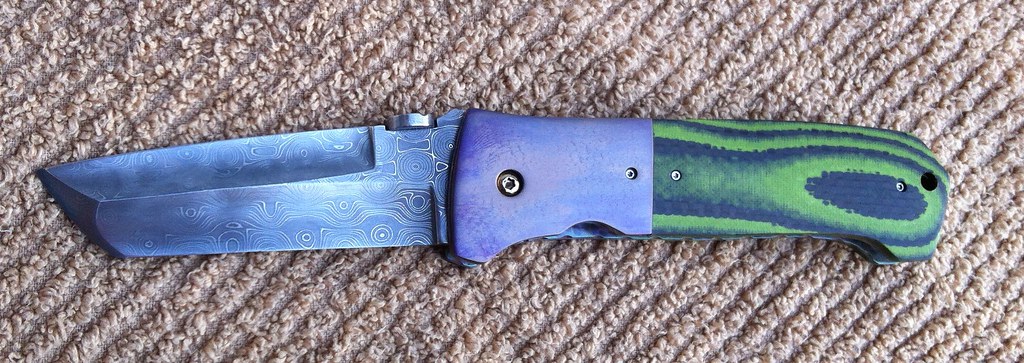
I free hand grind as well. A Fred Rowe bubble jig probably would have helped greatly with my tanto grinds but I'm pretty comfortable free handing those tips in now
8259068986_82531c65d5_b.jpg
 
I'm sort of glad Fred posted, as his jig is the type I was talking about.
A bubble jig does not restrict you, it enhances you. You still make the grind, the jig helps you keep the angle more consistent.

Fred sent me one of his jigs a long time ago. I used it and thought it was, OK, but still continued to do 99% of my grinding by eye. However, there are places where it really helps me.....like clips and specific angle tasks.

I have a customer who is obsessively determined that his fancy knife has an EXACT 17 degree edge. He evidently has asked several people to do it, and they all have had various reasons they can't/wouldn't do it. I will just stick Fred's jig on the blade, and make a perfect 17 degree edge.......no variance. I have other ways that I could make a rigid jig, and maybe get the same result....but it would be far easier to let my hand control the jig, than the jig control my hand.........and that is what I like about Fred's jig.
 
I agree Stacy (and with others) that a jig can be useful in a specific task or situation but for general grinding I wanted to be free from having to make a jig for each blade shape or make a jig that would fit all blade applications. Not only that but it saves me time because I do not have to worry about putting the knife on or off a jig and having to switch sides on the knife not to mention (my jig anyway) it is a pain to have to dunk a heavy steel jig and knife into water to cool it while grinding. Not using a jig will also allow me to make different adjustments on the knife while grinding. Thats what I liked about Fred's Bubble Jig; it will allow me to use (and develop) free-handed skills while allowing me to keep grind lines equal and not have a cumbersom jig to deal with in dunking in water and moving around the grinder. And by design should allow me to keep plunge lines straight. I'm not trying to "plug" any one product I just wanted to give an insight for those like me who are beginners in knife making and who are of the mindset that they have to compensate their confidence with a jig. If you need a jig I would not be against using one, I just don't want to use one as a cruthch if I don't have to. Thanks again for everyone's input and opinions on the subject. I value everyone's advice especially since you guys have way more experience than me. Thats the beauty of different opinions, if one way does not work for a certain person there are other adaptation (or a combination) to try.
 
Here's my issue:

I have a spinal nerve thing going on that greatly diminishes my ability to hold items in my left hand and keep a good tight grip. My left hand/arm also shakes a bit especially when trying to hold something steady, not so much when not in "use". I've tried free hand, quite a few times as I admire the versatility of this technique. I watch videos of Mr. Broadwell doing his amazing blades and can only dream of that ability.

I use a "sled" jig for all my grinding, including clips.


It makes blade grinding/knife making possible for me and I think I get pretty damn good results after practicing several hundred times. I'm able to produce flat grinds on all manor of blades, dramatic re-curves included. I just did two large re-curves, both with perfectly matched bevels. I would never be able to do that without the aid of my jig. I'm all for developing new/better/more versatile techniques, but so far I haven't found a method that works better for me.


http://postimage.org/

-Peter
 
Nice fixture Bigblue. Do you grind any thing bigger than what shows in the pic?
 
As Frank Sinatra said, I'm for anything that gets you through the night, be it prayer, tranquilizers, or a bottle of Jack Daniel's. Same goes for grinding - use whatever works for you, and don't be shy about trying a different way.
 
Before we start throwing tools in a pile and setting fire to them does it make seance to ask why? When I read this I think of the picture of the smith in Pakistan, holding his work in the forge fire with one foot while hammering the steel with his small hammer. This man would rush into the jig burning fire, trying to rescue something useful. Casting aside any tool is throwing away one more possibility, one more way to approach your work.


Jigs and fixtures do not limit what you can do at all; they add to your skill set. You will never hear this from a welder, carpenter, surveyor, machinist or any other tool centered job. I only hear this in the knifemakers world. Why is that?


We are not all the same, thank God, each of us is singular, we are not all alike with the same possibilities as Bigblue has pointed out.

This is not a plug for my invention; its a plug for working smarter. Don't limit yourself by saying no; do not constrain yourself in your rush to be creative.

Happy grinding, Fred


Good post, Fred:thumbup:
 
Nice fixture Bigblue. Do you grind any thing bigger than what shows in the pic?

Fred - That Khukri above^^ has an 11 1/2" blade. That's about the biggest I've done. However, I'm getting ready to grind a Chinese Hung Gar sword with a 34" blade. I'll need to do it in sections. It'll be quite a challenge.

-Peter
 
Before we start throwing tools in a pile and setting fire to them does it make seance to ask why? When I read this I think of the picture of the smith in Pakistan, holding his work in the forge fire with one foot while hammering the steel with his small hammer. This man would rush into the jig burning fire, trying to rescue something useful. Casting aside any tool is throwing away one more possibility, one more way to approach your work.


Jigs and fixtures do not limit what you can do at all; they add to your skill set. You will never hear this from a welder, carpenter, surveyor, machinist or any other tool centered job. I only hear this in the knifemakers world. Why is that?


We are not all the same, thank God, each of us is singular, we are not all alike with the same possibilities as Bigblue has pointed out.

This is not a plug for my invention; its a plug for working smarter. Don't limit yourself by saying no; do not constrain yourself in your rush to be creative.

Happy grinding, Fred

Good post, Fred:thumbup:

I agree, if you can find a way to do it better, do it. I think jigs are thought of as cheating or 'help', and you know how boys are at asking for help:D. Learning how to use a tool won't hurt. Just like the first time you stepped to the machine free hand, I bet it wasn't perfect. Neither will it be when you using a jig the first time.
 
I use a jig for bevel filing. If I have a choice between perfect results and slightly imperfect results, I'll always choose the way to get perfect results. If you think about it, a drill press is technically a jig; as is a knife vise.
 
I've never tried a jig, and feel pretty comfortable hand-grinding. But I'm always open to new things. At some point I'm planning on picking up one of Fred's jigs, and that sled one looks pretty neat as well. I make almost exclusively 22" OAL blades or longer these days, however. I assume the bubble jig will work fine no matter what the length, but it strikes me that longer ones would make it harder. I wonder if it would be possible to make a jig that's integrated into a tool-rest...
 
Fred - That Khukri above^^ has an 11 1/2" blade. That's about the biggest I've done. However, I'm getting ready to grind a Chinese Hung Gar sword with a 34" blade. I'll need to do it in sections. It'll be quite a challenge.

-Peter

That is a wicked grind; coming around those spirals will make you dizzy. . On the Hung Gar blade; just a little more planning is all. I really like oversized work rest. I've got one thats 24" wide.

I've never tried a jig, and feel pretty comfortable hand-grinding. But I'm always open to new things. At some point I'm planning on picking up one of Fred's jigs, and that sled one looks pretty neat as well. I make almost exclusively 22" OAL blades or longer these days, however. I assume the bubble jig will work fine no matter what the length, but it strikes me that longer ones would make it harder. I wonder if it would be possible to make a jig that's integrated into a tool-rest...

For really long grinds, 30", I set several bubbles along the length of the blade so I can keep line of site in front of me. This blade is 15" at the plunge. I save from center forward to the tip; for after I have the flats developed. Its easy working off an accurate bevel.
DSC01479.JPG
[/IMG]
 
You will never hear this from a welder, carpenter, surveyor, machinist or any other tool centered job. I only hear this in the knifemakers world. Why is that?
Happy grinding, Fred

Great question that I'd like to hear answers for.
When I started blacksmithing I kind of got religion about doing everything the "old fashioned" way. It was a great education in how metal moves and how to get along with it. The beginning of the end was when I read something one of the early 20th century's most influential blacksmiths wrote about being willing to break out the welding torch whenever it was the best way to do the job...then, I got it through my thick head that many of my customers loved my work but didn't necessarily go nuts about things done the traditional way.
It comes down to giving the consumer the best value for their money, which means concentrating on the things that they value most.
I freehand a lot of blades, but like a lot of things, I have to be more careful and deliberate to get clean results...I won't charge extra for that unless a customer wants freehand for some reason.
A jig makes the work go faster, and gives repeatable results in less time. For me.
Then there's the whole thing about just making what I want how I want...and charging what it's worth to me...that's my long range goal.
 
I use a jig for bevel filing. If I have a choice between perfect results and slightly imperfect results, I'll always choose the way to get perfect results. If you think about it, a drill press is technically a jig; as is a knife vise.

See, now that's getting to the crux of the discussion:thumbup: I was just discussing this with someone else here on the forum......what about a 2 x 72 grinder, the staple tool for that VAST majority of knife makers?? It keeps the abrasive media moving in a fixed position, usually adjustable to the particular task at hand. What about a spindle sander, where you can choose the proper diameter for the radius you're trying to finish?

Sure, knife makers use their hands to produce their craft. I have never really shaped a knife handle with a machine, I do that by hand. I use machines to get close to the finished shape, but I personally could never fully finish a knife handle using only machines, at least not the style of handles that are on my knives. But the bottom line is that knife makers also use tools.......LOTS of them. Maybe we need to focus a little bit less on the word "jig" and just call them tools of the trade. Just because some makers choose not to use them does not mean that they aren't valid tools of the trade. I can do lots with my hands and my eyes, but I'm not making knives as a hobby to relieve some stress after a long day at work, I'm trying to pay some bills here and I need to produce as much well made product as possible, so if there is a tool that can help me do it more quickly then I'll use it without shame.

Even though I feel that way I don't use too many jigs in my shop. Most of my work is done by eye and feel. I do use the bubble jig to set my bevels though. It makes my freehand grinding much smoother when I use the bubble jig to set the bevels at about 8 or 9 degrees before heat treat. Like Stacy said, you still need to use hand/eye coordination and keep things steady and even, but the jig is a tool to help you out, and when time is of the essence and every piece of steel counts then it's a good idea.

The quality of a knife is not diminished by the tools that were used to make it.

In the words of my buddy Fred....happy grinding! :D
 
I'm not anti jig; quite the opposite really.

I honestly don't care how someone goes about making a knife, as long as the end result is a quality blade.

If I had an extra $100K, I'd probably invest in a CNC machine and make a large percentage of my knives in that fashion.

I don't use jigs because I've never felt the need to. I like being able to pick up a random piece of steel wherever I am, and produce a variety of grind styles quickly and easily. If I were making 100 knives of the same design, I'd probably build a jig to speed things up.

YMMV, do whatever results in you producing the highest quality blade possible!
 
The quality of a knife is not diminished by the tools that were used to make it.
If you think about it, a drill press is technically a jig...

That's a really good way to look at this topic. :thumbup:

A big part of my appeal to clients is the handmade aspect. Every THK knife is ground, assembled and finished by yours truly. I grind my bevels freehand.

I don't currently use any fixtures/jigs for grinding... oh, wait... unless you count the disk-grinder/adjustable work-rest I use on every single knife to square up spines and set the basic chamfers on my handles... so actually, yeah, I do use "jigs". :o

Not one of my clients has ever asked me if I use a vise or press or work-rest or file-guide. They do not seem to care if I use a thread-chaser to layout jimping, or that I make a cardboard template before cutting leather for their sheaths, or that I often use a Lansky system to set my edges. They certainly don't give hoot that I buy my bolts/pins/tubes/epoxy/handle materials from other shops. They don't even care that I employ another company to do my heat-treating - in fact, that's often a selling point.

These topics will always be subject to controversy. I'm comfortable with the KMG guidelines.

Customers care mostly about overall quality and attention to detail. More often than not, only knifemakers argue about how it happens.
 
Last edited:
For really long grinds, 30", I set several bubbles along the length of the blade so I can keep line of site in front of me. This blade is 15" at the plunge. I save from center forward to the tip; for after I have the flats developed. Its easy working off an accurate bevel.

Well, I guess I'll be getting SEVERAL of your jigs :)

Would there be any advantage to freehanding it most of the way, and then using the jig to do a final cleanup? I'm having a little trouble visualizing how many extra steps in the process fitting the jig or jigs might add.
 
Back
Top