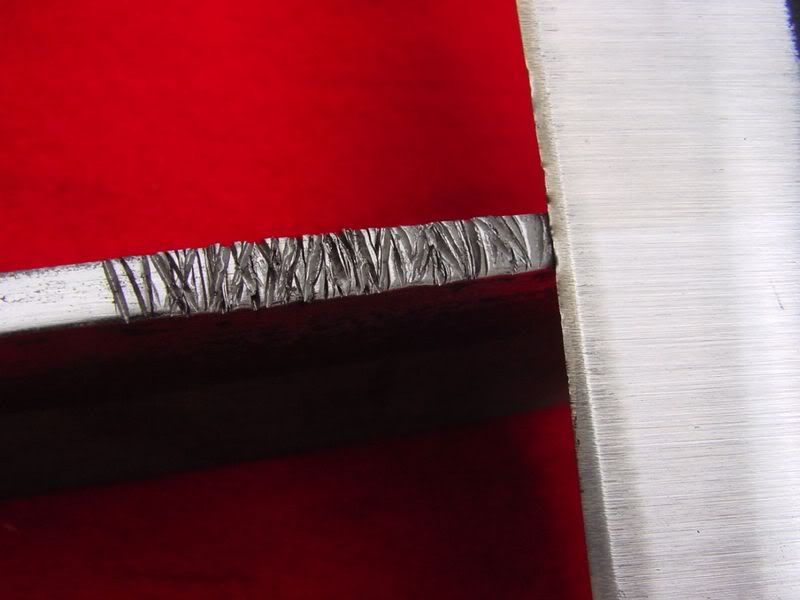
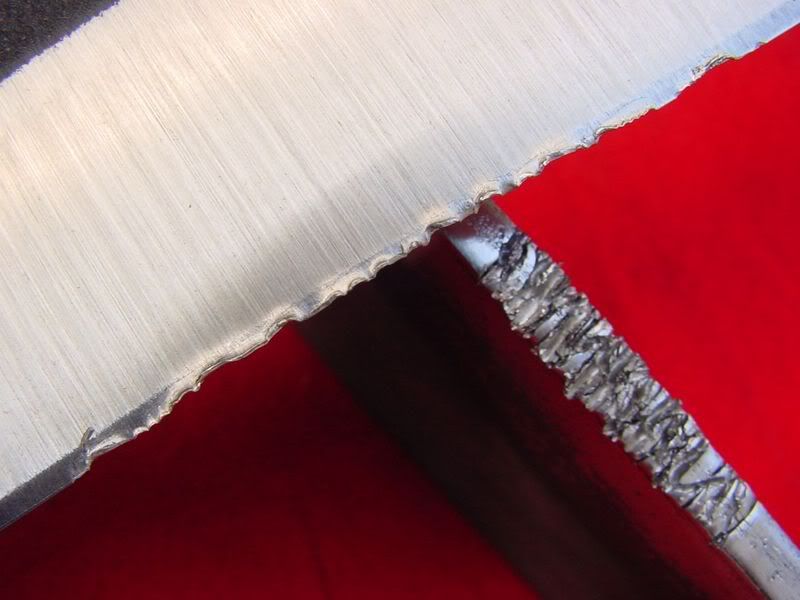
INFI and S7 versus my old bedframe

Better you than me!! Very interesting pictures - piqued my curiousity... but not enough to start chopping on steel w/ my CGFBM!!! :)
 
hell of a chopper they are, that's for sure! wouldn't it be cool if there were some battle mistress's made exactly half way in thickness between the cg and the le's and without corrugations :foot: ;)

Heavy Mistress sounds good (the knife I mean).
 
Great quote. You should add that to your signature line. Its the dang truth.

Thanks for the kind words, Anthony. You've written a ton of gems in recent threads which I hope to purloin soon.

Better you than me!! Very interesting pictures - piqued my curiousity... but not enough to start chopping on steel w/ my CGFBM!!!

Why not? Sharpens right out and you can have first-hand knowledge of what your knife does instead of BS tough-talk about what it might do. In the case of INFI, it does everything everyone says S30V and CPM3V are supposed to do, only it actually does it and it sharpens easier.

Heavy Mistress sounds good (the knife I mean).

Without the word 'fusion' in the title, I probably wouldn't have bought a Battle Mistress.
 
Thom: do you have thoughts on steeling your INFI before hitting the belt sander?
 
Having tried to steel lesser damage out of a blade before, I'd say when it's that far gone it's time to just grind it back down. I'd wager that once all the damage is sharpened out it'd fare better against that same bedframe. My infi SS4 and NO-E both had some edge weakness issues with the (thick) factory edge. A good sharpening to remove all the damage and they're performing much better with a much thinner edge.
 
Thom,

I could be completely wrong since I haven't tested this out myself, but I have been told by several people that bed frame rails are actually hardened steel. I don't know the composition, or hardness, but they do seem to be quite a bit tougher than the 1018 or similiar that you get at home depot.

Anybody got a rockwell tester and a bedframe handy lol.
 
Its just average angleline mate usually 50x50x3mm for bed frames like the one pictured . Definately not Hardened steel though , well not downunder anyway !
 
LOL!! Here comes the flood of that never happened I do it all the time posts! :eek:

I'm going to have to call B.S. on this! There is NO WAY THAT EVER HAPPENED because I do it all the time. Your FBM must not be made of INFI.

Whenever I chop bed frames (hardened or not), as soon as the INFI touches the bed frame the metal parts to make way for the INFI.
It is as if the bed frame knows what is about to hit it, and figures that the best way to avoid catastrophic damage is to sever the molecular bonds holding the metal together in the INFI's projected path . . .
It's essentially a parting of the Red Sea.

This happens whenever I chop things, no matter what they are made of.

So, send your FBM back b/c it isn't made of INFI.
 
Thom: do you have thoughts on steeling your INFI before hitting the belt sander?

I'm not that strong. For the accidental hitting of a rock once or twice (or a screw hiding in a rocking chair :mad: ), that'd save a lot of steel.

So how many (avg) whacks on the bedframe did u subject each knife to? :p

Just like the old tv show: eight is enough. They just weren't doing much and my ability to chop in the same place is lower than acceptable. On tree trunks, that's not a problem, but the softy soft steel of the bedframe - it judges. :o

Having tried to steel lesser damage out of a blade before, I'd say when it's that far gone it's time to just grind it back down. I'd wager that once all the damage is sharpened out it'd fare better against that same bedframe. My infi SS4 and NO-E both had some edge weakness issues with the (thick) factory edge. A good sharpening to remove all the damage and they're performing much better with a much thinner edge.

What yoda4561 said! :thumbup:

Now that is what I call useing your INFI!
1 of 12 no less?

Thanks, Mr. Steelnut. It'll be used on more outdoorsy targets, but I don't get out too often and have to cut what I can.

If you weren't testing the edges, why on earth would you do that to a $400 knife? Am I the only one who thinks this was a bit silly?

It's as silly as smacking a new ship with a champagne bottle - only I don't drink wine. The worst abuse knives can face is disuse and some knives seem too perfect (Muddy FBM comes to mind) to use, so a little violence gets that out of the way.

I have been told by several people that bed frame rails are actually hardened steel.

Not this one. Once you get the 90 degree bend eliminated, it bends and breaks by hand. The expose grain is so large that it's visible to the naked eye. :barf:

I think a nice Busse Cleaver would be really cool.

 
The title of this thread probably should've been "Thinner edge verses Thicker edge". . . . Here are some definitive pics of the EXACT same knife made out of SR-77 (It's a Scrap Yard Dog Father heat treated to 59.3 Rc) with 2 slightly different thicknesses behind the edge (The thicker one was .047" prior to sharpening and the thinner one was .030"). Both edges were sharpened to the exact same angle and the knife was set in a fixture on our automatic chopper in order to insure that they impacted the steel at the exact same angle and force. The ever so slightly thicker one faired MUCH better than did the same knife with the thinner geometry. I repeat for clarity purposes that we used the exact same blade for both tests so that there would be absolutely NO discrepancy in hardness or heat-treat. :eek:

The thinner geometry bit in nearly 50% deeper on the initial impacts BEFORE the edge gave up. The Thicker edge sustained far less damage but proved to be a much less efficient chopper on wood than did the thinner edge.

SR-77 is an impressive steel. . . Look closely at the thin edge and note how it dented and tore but never chipped! Very cool!!!

When these same tests are performed with INFI at these same geometries, you see nearly identical results. . . . . Most other steels suffer major fracturing and chipping with nearly irreparable damage to the edge.

Yours in nuclear clarity,

Jerry

Here's the damage to the thicker edge. . . Very impressive!!! (Pic below)


S-7ThickerEdge2.jpg


Here's the damage to the thinner edge . . . Ouch!. . .Does not look as impressive. . . but it is!!! (Pic below)

S-7Thinneredge.jpg


. . . and another shot of the thinner edge. . . Lots of good times ahead for the poor guy who has to resharpen this edge. . . (Pic below)

S-7ThinnerEdge2.jpg
 
Lots of good times ahead for the poor guy who has to resharpen this edge. . .

S-7ThinnerEdge2.jpg

Send it my way, boss, and I'll send it back with happy edge.

For my knives, neither edge did well. Got much more done with a hacksaw and bending.

Just to clarify, the knives were only hitting the edge of the frame, not each other. Both did great and prospered and suffered according to their geometries. The FBM's edge was thinner and better for actual work on this heaven below. The RD-9's edge was thicker to provide me with entertainment (years back, it and a Ratweiler at smacking galvanized fenceposts and the Ratweiler faired better for the same reasons Jerry mentioned). I am not saying knife a is better than knife b or vice versa. One was a custom made just for me (the extended front guard and serrated thumb ramp) and the other was made Muddy (presumably just for me) and they both rise and fall on their own merits as nearly-indestructible knives.
 
Back
Top