
-
The BladeForums.com 2024 Traditional Knife is available! Price is $250 ea (shipped within CONUS).
Order here: https://www.bladeforums.com/help/2024-traditional/
You are using an out of date browser. It may not display this or other websites correctly.
You should upgrade or use an alternative browser.
You should upgrade or use an alternative browser.
INFI folder?
- Thread starter Lycosa
- Start date

If you look closely at your radar screen, you'll see the Folder. Sasquatch is holding it as he rides the unicorn to Atlantis, where they live under an intelligent, honest government.
MAN, THAT'S FUNNY!

Last Visible Canary
actively parsing hurf durf
- Joined
- Nov 28, 2006
- Messages
- 4,577
HMMM.. Thanks for supplying a diagram of the future folder..
I'm still leaning toward the full frame lock, it seem to be a more solid design. I have no doubts that the Busse folder will be simply amazing just like the rest of their blades. Does anyone know what the advantages and disadvantages of full frame lock and axis lock folders??
the pros
frame lock
- lot of metal behind the lock, if done properly
- very strong, IF the angle and curvature of the lock portion of the frame is done properly
- one side does not require a full liner, so it can be a bit thinner then a liner lock knife, or a lock back (depends on design though)
axis type ock
- very strong, if the spring is strong enough
- the "axis" (tm) lock itself has 2 springs, one on each side, that act as a safety should one be damaged or fail.
- ambidextrous
- very easy to operate, and creates a "gravity" type knife when the lock is disengaged. wich is to say, when the lock bar is pulled back, the knife is free swinging and extremely fast to open (can be opened by gravity) - even without a thumbstud or flipper of any kind.
- jerries design uses one side of the scales as part of the locking mechanisms houseing, so it also does not require a liner for that side.
cons:
framelock:
- If the lock portions angle is done poorly, the lock will be unstable, potentially prone to low pressure disengagement, and may also be prone to "sticking" where it engages completely and requires a great deal of pressure to disengage.
- can be difficult to disengage if the lock portion isn't raised, lowered, or textured enough for the thumb to grip on
- not ambidextrous
- requires one of the scales to be the lock, wich can be aesthetically unplesent (if done wrong).
Axis type lock:
- if the springs are not strong enough, it can result in a weak lock up that can be prone to dissengaging.
- if the springs are made of a metal that is prone to corrosion, they can prematurely fail
-requires a spring to be present.
and I'm sure there are others that can be added to both... honestly - if either one of the types of locks are done correctly where the materials are chosen for strength, corrosion resistance, and wear resistance, and the designs are plotted out and created according to good mechanical common sense: they are both excellent locks.
I prefer the axis type lock because its easier to engage and disengage. every liner lock and frame lock I've ever used required some level of friction to occur between the pad of the thumb and the bar - a small complaint, until you have to open and close your knife for a few hours straight. I never found that to be the case with the axis type locks. I love the fact that you can open axis type lock knives so quickly, without having to push on the blade in any way. I've always found that I disliked flipper style knives because it felt like if my hands were greased, I'd be increasing the risk of it flying out of my hand by pushing on it in that manner. and thumb studs are the same situation as liner/frame locks, where friction on the thumb gets kind of old after a while. not so with the axis type locks. and they are very fast to open.
Jerry's design isn't an axis lock (wich is property of benchmade (i think)), it's a spring operated locking bar thats of a similar theory. the axis lock uses omega springs, wich is kind of like a watches spring, where its coiled in a circle like tape, rather then like a car's shocks.
this is the rest of the patent papers that have been presented on the forums:
http://www.google.com/patents?vid=U...printsec=abstract&zoom=4&dq=7,032,315#PPP1,M1
rather then being a round cylinder like benchmades, jerries patent shows a kind of platform for lock engagement, rather then something thats round.
I wouldn't want the busse folder to be a frame/liner lock honestly, nor would I want a lock back. I've used all three and have had the least problems with the axis type lock, and prefer it all the way around. I think its a more versatile design that is easier to use on a day to day basis.

Last Visible Canary
actively parsing hurf durf
- Joined
- Nov 28, 2006
- Messages
- 4,577
interesting, the patent shows top side lever action, as well as a side mounted lever action. so, there is the option available of either engaging and disengaging the lock from the top ricasso side of the spine, or from the sides (axis lock style)...
edit to add: thats the first time I really looked at that patent. those are some good looking designs, and I'm a bit more interested in seeing the folder come to fruition now
still, give it a few more years

edit to add: thats the first time I really looked at that patent. those are some good looking designs, and I'm a bit more interested in seeing the folder come to fruition now
still, give it a few more years

Uncle_Jarvis
BANNED
- Joined
- Jul 19, 2007
- Messages
- 3,709
L V C
Thanks! for the detailed and insightful comparison of the folders..
Can't wait for the BUSSE folder to be released!!:thumbup:
Thanks! for the detailed and insightful comparison of the folders..
Can't wait for the BUSSE folder to be released!!:thumbup:

- Joined
- Oct 31, 2003
- Messages
- 8,583
I think Boss Hog is thinking something along the lines of an FFBM folder.
Uncle_Jarvis
BANNED
- Joined
- Jul 19, 2007
- Messages
- 3,709
HAHA..
I don't know If I would want to carry around a 3 lb. folder LOL
What about a Meaner style folder. I think the meaner design would work well in the form of a folder!! Think about it !!!
I don't know If I would want to carry around a 3 lb. folder LOL
What about a Meaner style folder. I think the meaner design would work well in the form of a folder!! Think about it !!!
I think Boss Hog is thinking something along the lines of an FFBM folder.
- Joined
- Oct 31, 2003
- Messages
- 8,583
HAHA..
I don't know If I would want to carry around a 3 lb. folder LOL
What about a Meaner style folder. I think the meaner design would work well in the form of a folder!! Think about it !!!
That's more like it. :thumbup::thumbup:

- Joined
- Sep 2, 2006
- Messages
- 16,703
There IS a custom folder out there with an INFI Badger blade... Matt Cucchiara made it. It's freakin' sweet... Right, westllen??!!
]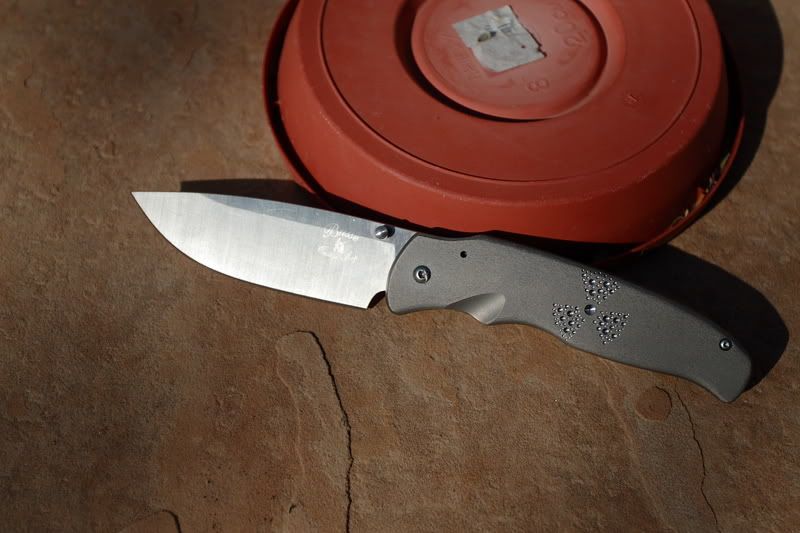
Hmm. Figures Jaxx would also know where this was ...
- Joined
- Sep 2, 2006
- Messages
- 16,703
thats a cool knife! one question, is it better that a sebenza?
I don't know. BUT ... Jules would!!


Unbreakable
Banned
- Joined
- Sep 21, 2002
- Messages
- 615
Why would anyone cut a perfectly good fixed blade down to make a folder. I mean folders are great... but a Badger Attack would have been better.

Bigfattyt
Gold Member
- Joined
- Jun 23, 2007
- Messages
- 19,272
Why would anyone cut a perfectly good fixed blade down to make a folder. I mean folders are great... but a Badger Attack would have been better.
I am sure it was some one who already had a ton of fixed blade infi. I mean, if you had a really beat up bagger attack, and plenty of spares why not? Just gives you one more thing that no one else has.
Last Visible Canary
actively parsing hurf durf
- Joined
- Nov 28, 2006
- Messages
- 4,577
Why would anyone cut a perfectly good fixed blade down to make a folder. I mean folders are great... but a Badger Attack would have been better.
sheeple. in certain area's a fixed blade is looked at as being equivalent to a gun thats openly carried.