Infi shines better in convex blade or v grind?

As far as the bevel goes, can one become sharper than the other? ya know, with out a full flat grind conversion type thing? thanks for the replies

 
I think it's a Your Mileage May Vary type of thing. I've been a chef my entire adult life, with lots of free-hand knife v-grind sharpening.

When I learned to convex the edge, the sharpness went WAY up! If I had picked up an Edgepro or similar, I probably would have experienced a similar revelation. Now I am stuck on convex, and I love the way it pushes material out of the way when cutting and chopping and whacking rope.
 
Starting to really appreciate a convex grind myself. Have reprofiled a few knives. How long does it typically take you to convert to a convex edge? I know there must be considerable variability. Any hints/clues/tips for your methods/equipment?

Thanks

Reprofiling a grind to convex? Takes a long time and some low grit belts on a sander. I spent 4 hours grinding my NMFBM to satin/full convex it. Convexing just the edge? I can reprofile the actual edge in probably 2 minutes with a lower grit belt and total sharpening time up to leather is probably under 20 minutes, stropping time not included. That's with a belt sander mind you, doing it by hand takes longer.
 
It took me about 4-5 hours to convex the grind of an early 80's saber-ground Camillus pilot survival knife this morning by hand. Just the saber-ground part.

...I was bored. A friend found it in a drawer and it was a little rusty, needed cleaned up. Next thing I knew, I had the grind polished up with 2000 grit. ><
 
Is saber grind with convex bevel as good as full convex? It sounds like its not, but what is the difference in performance? does the saber grind get stuck when you cut wood, or slow down slicing performance? thanks
 
Is saber grind with convex bevel as good as full convex? It sounds like its not, but what is the difference in performance? does the saber grind get stuck when you cut wood, or slow down slicing performance? thanks

It depends on what you are cutting.

For all out chopping, where you are taking deep bites out of the wood or material, you will notice more binding with a saber primary grind with a convex edge. If you took the same knife, and removed the shoulder on the saber grind, making it a full convex you would probably notice.

If you are just dicing green onions, not so much. Many people find they really prefer a saber grind for a lot of things. For me, given the same exact knife I would prefer the full convex, or flat primary grind to a convex edge (with a blended bevel, where it is tough to tell where the convex edge actually starts).

That said, I do love the look of a nice saber grind. Especially on SNFO, or MOJO, MOFO's I think it looks great.


My main reason for going convex edge on all my users is just how easy they are to keep nice and sharp. I grew up using a Lansky sharpening system. I could get hair popping sharp on all my knives. It just was a pain to set up, and use. It was also messy with the oil on the stones, and my wife hates the sound of sharpening. But with the convex edges, just a few minutes of quick stropping after use, and they are right back to hair popping sharp with no mess, or noise. I don't have to set up the clamp etc.

Basically just buy what you like.
 
I'm not much of a fan of saber grinds, yet I own several knives that have them, and it's not a dealbreaker. Given the choice on an otherwise identical pair of knives, I'm likely to choose the convex grind most of the time (unless that convex is one of those ones that's far too extreme and fat, like the killa zilla)


Saber grinds are worst on coated knives, IMHO, as the sharp transition not only binds when chopping and batoning (bummer), but it also wears the coating much quicker than the rest of the knife. Then you end up with something that looks like this:

If there is enough excess friction at that transition to wear the coating off like that without putting much more than a mark on the rest of the knife, think about how that extra friction is affecting the knife when you baton or chop. Plus it's kinda ugly :p

The flip side is that saber grinds are cheaper to machine than full convex, so they can produce lower cost knives. That swamp rat mini mojo was a heck of a value, and a beefy do-anything knife at a low cost. A convex grind would have just driven that cost up.

3709530415_313e837801.jpg
 
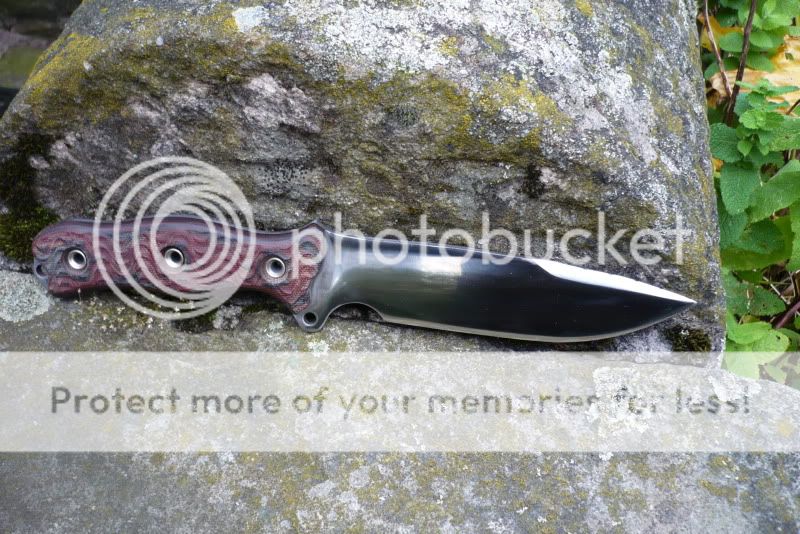
After experimenting with Infi for a few years now my sharpest edge comes from thinning down the flat grind on a knife and then taking a fairly high tapering convex edge like this ...

P1000827.jpg


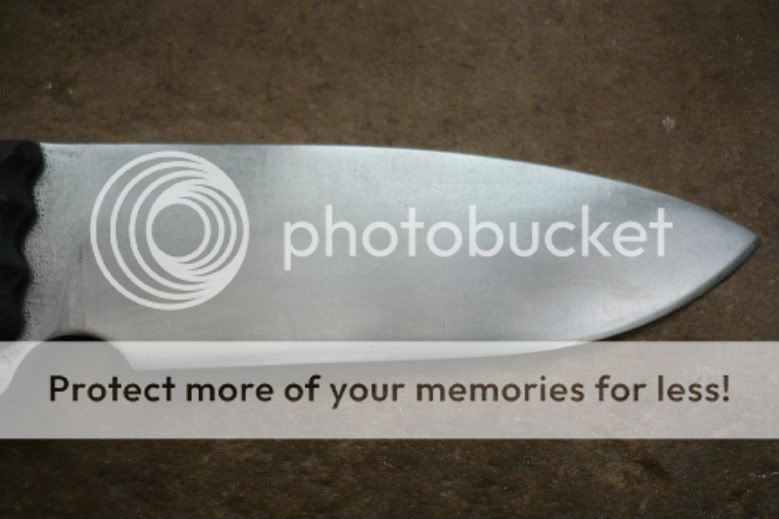
This is perhaps my sharpest Busse and I doubt any sabre grind blade would improve on it for slicing .... a thin fully convex Skinny Ash is close ....

100_0153.jpg


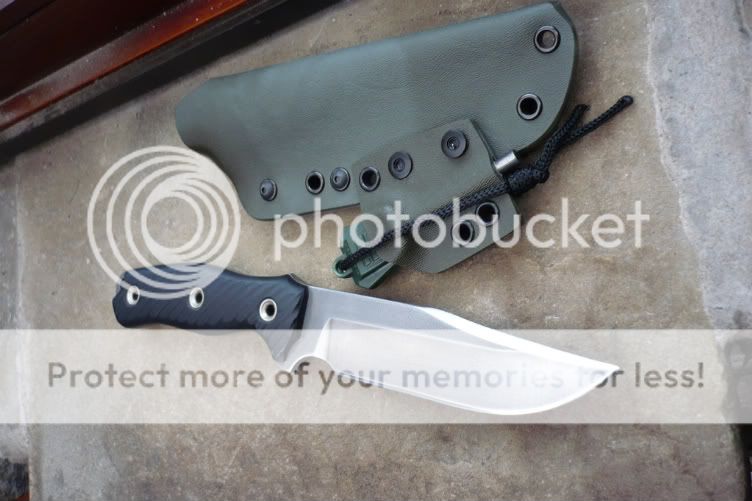
This one has a zero grind up until the belly where from the belly to the tip I kept more of a convexed edge which was not zero ground in order to keep strength in the tip and to prevent and element of "rounding" on the tip which can happen on zero knives near the tip and they start to look like a pizza cutter tip....

However on a sabre grind such as my RMD below the edge is more of a robust convexed edge which being SR101 or modified 52100 tool steel the higher carbon element in the blade enables IMO an edge which is equally as sharp as those above but not quite as thin or acute angle .... however the blade side profile is noticeable when cutting into a material deeper than the knife as the edge where the sabre grind meets the flat can be felt as a resistance point ... only slightly though ... and only on certain mediums ... if applying a lot of force into a cut it is virtually impossible to tell ....

100_0551.jpg


I would say of these three the top grind and edge on the SJTAC is probably the best for slicing ....

Ultimately all grinds can be razor sharp and perform well when they are like this .... it is really an infintessimal difference in real life use .... sharpness and edge profile mean more than the grind ....
 
Last edited:
ok, i think i am beginning to understand now. The top pic, is that full convex?
Oh, and WHY do SOME people LIKE saber grinds?
 
The top pic is a flat V grind but the edge is a curved convex appleseed shape ....

Well I like all grinds .... you won't get a better handling knife than a RMD for it's balance and size .... the sabre grind offers the oppertunity to keep a blade heavier for it's length and that is no bad thing in some circumstances .... for instance in the RMD if you want a tough but small 5 inch blade for all round use where the knife balances on the forefinger when gripped .... you have all of that BECAUSE of the sabre grind.

If it were flat ground or fully convexed there would be more weight in the handle than blade and the balance would shift further back in the handle ....

If you went with a flat grind but tapered the tang then you could retain the balance for the size of knife ...

Ditto for a fully convexed blade ... it would be slightly heavier than a flat grind but to balance it like the RMD you would still want to taper the tang ...

The RMD balances well with a straight tang ... no taper ... but needs the sabre ground to do so.

I think balance is the key to finding a knife feel great in the hand .... if the edge is razor sharp I don't think many would worry about the grind.

As an alternative example .... I prefer the DFLE to the DFCG because of balance and feel .... not because of grind .... but the sabre grind on the DFCG makes it a bit too blade heavy for me .... the DFLE being flat ground is a much more livlier and balanced knife IMO and of many others. It is the balance and feel though that we notice .... not the grind ....
 
Last edited:
Back
Top