
Inspiration or Copying?

Joined
Jul 7, 2012
Messages
1,896
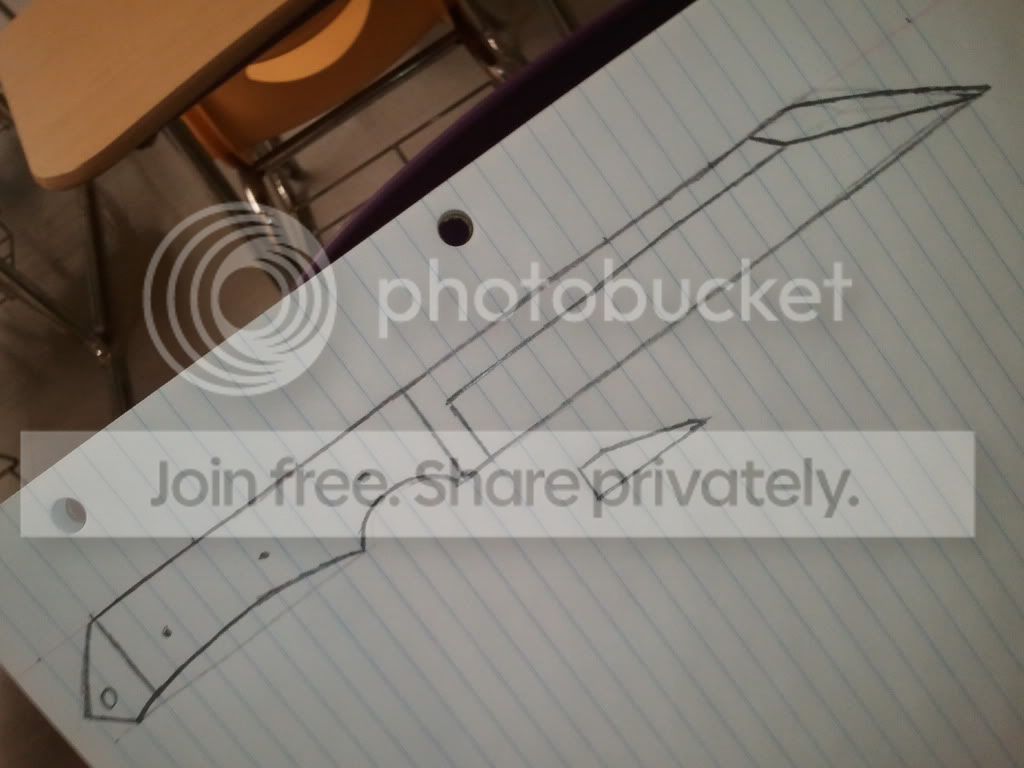
Alright, I have been wanting to make a reverse tanto knife for some time now, and have finally come into the materials I need. While brainstorming and making quick sketches I came up with the design below. I realized though that this knife is really close to the SOG Swedge II. I do go online looking for inspiration, so I know i've looked at the Swedge II before, but not while searching for inspiration, just during when shopping for a knife. My concern is the handle design, and not so much the blade. What is your opinion?

WP_001169_zps2258a09c.jpg
 
It's a common design. Why ? Because you are trying to design a knife in a rectangle. Every new maker usually does this, including myself.
As far as copying...no. But you are limiting yourself by confining your design in the box you created.
Think outside the box. Design the knife....then order the stock :D
It looks fine, good luck in your new addiction.
 
Even if you traced out the SOG, the final product probably wouldn't be an exact copy. I wouldn't sweat it. Good companies/makers encourage others to copy their work....like Bob Loveless did.

By the way, tryppyr is correct, that thing needs some curves! Squarish knives are square and boring!
 
This is why I make slipjoints. Every (you know what I mean, don't be technical) pattern has been done before. I'm not copying Erikson, Coats, Bose or others, I'm just making a barehead jack.

Also, +100 on the curves. Design the knife, then order the steel. Treat steel and belts like they're free. Trying to save space on a steel bar is a sure fire way of ending up with either a crappy design, too little steel for what you wanted to do, or both. Speaking from experience.
 
You need to go back and re-design the handle. It is not hand friendly.

If you are making a tanto, consider a simple cord wrap, or a more elaborate wrap in a pseudo-tsukamaki look. A Turk's head knot makes a good guard/stop.

Try re-drawing that knife with some sori (upward curve). It could be as little as 1/8" lower in the center compared to a line drawn from tip to but.

In my opinion, a reverse tanto has a very weak tip. A standard tanto grind is more useful and has a stronger tip......and looks better.

TIP:
When many/most new makers do a cord wrap, they just leave the handle the width of the blade and wrap it. That works, but makes the final handle a good 1/4" larger than the blade, which looks a bit off. By grinding the tang with a slight drop of 1/8" or so, you have a place to start the wrap and the final wrap will not extend greatly above the lines of the blade. You can also shape a small palm swell this way into the wrap by shaping the tang accordingly. File the shoulders of the drop with a round file so the cord lays perfectly. A similar place at the end of the tang is good to stop the wrap if you aren't doing a wrapped eye end. The final effect is a very smooth looking knife with no sudden projections in the lines.
 
You gotta work with what your got.

Very true, but then change your design or buy different steel. Designing a knife to fit the steel with no regard to basic design principles is folly. I'm not saying that's what you are doing, just putting it put there as a nugget to chew on mentally.


Stacy, I hadn't thought about notching the tang down an 1/8" to smooth out the lines on a cord wrap. I have been wanting to do a cord wrap. Now I will try this!
 
I agree with Stacey... the handle design with the superfluous pointy notch looks like it would be challenging to use ... especially considering the way that flat curveless blade will force the user to move the blade in order to accomplish anything.

The usual advice on handle shaping is to take some soft material (clay, play-doh, or the like) and put a bit on a wooden model of the knife. Shape it first, then grab it with medium pressure. Look for how the hand pressure deforms the original shape. Where it is deformed you have the pressure points that will bear on your hand. Where the material gets thicker, you have a curve in the hand that your handle is leaving empty. In any case, you should notice that the hand has very few flat areas, and a lot of curves.

It's not all about what looks good on paper. It's also about what works with your (or the customer's) hand.

- Greg
 
Back
Top