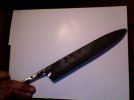
First,when filing the tang prior to HT,make sure the tang is a taper from the ricasso.Sand and finish the blade completely after HT all but the final sharpening. Tape the blade up to about 1/2" from the tang.
Now with the wood block for the bolster, Drill two small holes to start the opening.Using a jewelers saw or a coping saw (use a fine blade - #0 to #00), cut between the holes to make an opening . File with a needle file to get a perfect slip on fit. Use a block that has smooth parallel sides the desired thickness of the bolster ( about 3/4" to 1" looks good), but larger than the finished handle size (it will be trimmed later). After the bolster is fitted then you need to drill out (and burn in if you want) the main handle block. Slip the bolster block on the tang and seat it down snug. Test fit the handle block against the bolster. Sand and fit the two until they sit flush together. Put some 5 minute epoxy (just a little bit) on the end of the handle block and slip it
up tight against the bolster, checking the alignment. Hold in the hands and maintain a flush fit for about three minutes, or until the epoxy sets up firm. Carefully push the handle assembly off the tang by pressing backward on the bolster block. It should slip off fairly easily. Waxing the tang prior to the glue-up helps a lot. Carefully pre shape the handle as desired, trimming the bolster to the handle. Sand and polish the bolster front before final assembly. Mix some slow cure epoxy (one hour minimum,24 hour is better), dye it to match the bolster wood, if you wish (I always do), and warm it to about 100F. It will pour quite fluid at that temp. Using a plastic medicine cup, pour epoxy down the tang slot slowly and in a thin stream. It takes some practice, but this can be done in less than a minute with patience. Warm the tang to about 100F, and slide the tang slowly into the bolster slot. As it displaces the epoxy it will push out the extra. Go slow, you have plenty of time (another advantage of the slow cure epoxy), pushing the blade in until seated fully. Wipe away the excess epoxy with a paper towel, and then clean off the remnants with a paper towel and acetone. Once all looks good, set the handle in a vise or clamp ,with the blade upright, check on the seating again and let it sit. As the epoxy comes up to a set (gets firm) wipe off any additional squeeze out with acetone again. Let cure completely and shape/sand/finish the handle. The results are worth the slight effort.
Tip:
When doing hidden tang construction of any type, use slightly oversize handle blocks. Any misalignment of the handle to the blade (a common problem when the hole is not drilled straight) will be taken care of as you trim the excess off the block. This allows the blade and the handle to always be in perfect alignment on both axis. I usually start with 1.25X1.5" blocks to get a .75X1" handle. Sneak up on the final shape and quit when you are there. You can always go back and sand a little more off, but you can't add some back on.
Stacy