interesting stuff with thin geometry

Joined
Dec 21, 2006
Messages
3,158
This was cool to me....but it just shows what we all know. I made this petty knife out of 1.6mm O7. I had only run a temper of 360F. I wanted a nice super thin blade and edge to cut like a laser through food, and I had sanded the bevels down to a zero edge (not intending to leave it like that...just to get the geometry thin). The total angle there is 3 degrees. Yep....three. A little too.....um.......thin? You should have seen the way the edge was behaving while I ran my fingernail along it......like a bunch of micro serrations that would chip right off!!! Oh crap!!!! I put her back into the oven, this time at the proper 400F...and the colors came out perfect. Now that 3 degree edge flexes against my fingernail. Much better. I'll do the final polish up to 800 grit, sand the edge back down just a tad to where there's more steel to put an edge on! This thing should be the ultimate slicing machine! Very different from white steel that is fine grained....O7 (earily similar to Blue Steel) has huge vanadium and tungsten carbides to keep a good edge going. Probably won't get as sharp as white steel, but the kirenaga should be better. Pics to come when knife is done. Just had to share that experience with ya!
 
Sounds awesome , looking forward to pic
 
Roman Landes passed around one of his super-duper kitchen knives. The blade was very thin and the edge was even thinner. It would flex a lot upon a little side pressure on the fingernail. It was tempered perfectly and just flexed right back. IIRC, the edge was sharpened at 7-10 degrees.


As you have proved to yourself, changing the parameters to get something like a harder edge is not a good replacement for properly balanced parameters that give a fully functional edge with a balance between hardness and toughness.
 
Roman Landes passed around one of his super-duper kitchen knives. The blade was very thin and the edge was even thinner. It would flex a lot upon a little side pressure on the fingernail. It was tempered perfectly and just flexed right back. IIRC, the edge was sharpened at 7-10 degrees.


As you have proved to yourself, changing the parameters to get something like a harder edge is not a good replacement for properly balanced parameters that give a fully functional edge with a balance between hardness and toughness.

You said it!!! Exactly what I was thinking. "I'll make this thing perform better by leaving it really hard." WRONG ANSWER!!! There needs to be that balance!!!!
 
Most chef knives I see people make are too thick. That being said, they can be made too thin. If they are flexing too much (or really a perceptible amount) they can be difficult to use and inefficient. Also if they are completely flat ground on the side facing away from the cutter ,they usually have food release issues. Also starting that thin also kind of prevents much distal taper. I know this because I have made every one of those errors, a lot.

You are correct about finding the balance in heat treating but also in grind geometry, edge thickness, balance point and profile. In my opinion an excellent chef knife is the technically most difficult blade to make because the margin of error on all of those aspects is so small.
 
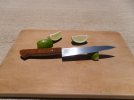
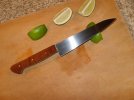
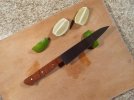
I finally got around to finishing this petty knife. As stated....it is wicked thin. 1/16" O7 tool steel. The edge was ~<.005" before sharpening! It feels like an oversized razor blade in the hands, as it is very very light. Mesquite wood handles with black/white liners. Can't wait to put it to use in the kitchen, but I'll have to make sure I have all my fingers when done using it! I wish I could do better close up photos...I don't think my camera allows for that. I wanted to show off how thin it was at the heel, but alas it only blurs at that close range. This is how all kitchen slicers should be made! Your thoughts are always welcome. Hope you like!

SAM_1314.jpgSAM_1320.jpgSAM_1323.jpg
 
Very nice looking geometry, break down a chicken with that will be a snap!
 
Back
Top