Interesting W-2 heat treating results

Joined
Feb 24, 2000
Messages
1,957
There was another post about heat treating W-2 so I decided to do some testing myself.
The W-2 is from Aldo. It came less than a month ago. It is 1/8" thick.

1. No normalizing, just took a piece of W-2 heated with a torch to above non magnetic, quenched in Parks 50. RC test, 65.

2. Heated to 1600 for 15 min. let cool in air for ten min. heated to 1450 for ten min. let cool for ten min. Heated to 1425 for ten min. Let cool, then heated to 1200 for a one hour soak. Then heated with a torch to above non magnetic, quenched in Parks 50. RC test, 40, RC test, 52

3. Heated to 1600 for 15 min. let air cool for ten. Heated to 1450 for ten min. let air cool for ten. Heated to 1425 for ten min. let cool. Heated with torch to past non-magnetic, quenched in Parks 50. RC test, 59, RC test, 58

I know this is just a one time test, but the W-2 got a lot harder without any normalizing.
 
Thanks for sharing the results. I think experiments are extremely valuable.
First, what were you expecting to see? Did the experiment confirm or refuted your assumptions? I would love to hear your thoughts.

Second, a posteriori, it makes sense to me. Smaller grains mean less hardenability, and W2 is expected to be on the limit for fast oils. So your "normalization" cicles would have reduced the grain size, reducing hardenability, and with oil as a quenchant, partial conversion and less hardness. Anyway, that would be my theory, but I'm interested in hearing the interpretation of others.
 
Strange. Normalization will grow the grain, and the two lower temp cycles create new smaller grains. This is odd. Something is up with this steel. It is responding very differently to the stuff I have (not Aldo's current batch, I have steel from the previous batch.)
 
Strange. Normalization will grow the grain, and the two lower temp cycles create new smaller grains. This is odd. Something is up with this steel. It is responding very differently to the stuff I have (not Aldo's current batch, I have steel from the previous batch.)
Normalization doesn't grow the grain if done right, it refines the grains (makes it smaller). Have also never heard of making 'new' smaller grains.

Smaller grain in W2 reduces hardenability.
 
Hmm that is interesting... I wonder if grain size also has a correlation with activity in a hamon. This might be something that has been done already, but I wonder about it'


Sent from my iPhone using Tapatalk
 
I really didn't have any expectations as far as results. I had heard that W-2 needs to be normalized in order to harden. I was surprised that the un-normalized piece hardened to a RC 65 and the normalized pieces had a smaller RC.
I realize this was just a one time test. I encourage other with Aldo's W-2 to make some tests and specifically try to harden a un-normalized piece.
 
If you have the ability to control the temperatures, why would you harden with a torch?
 
I also plan to use my Paragon oven to harden, but I used a torch because some knifemakers whose work is outstanding recommend using the forge or a torch to harden rather than the oven.
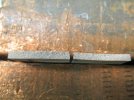
Here is a picture of the un normalized RC65 piece that I broke. Those with experience, what do you think?
 

Attachments

  • IMG_1744 (Small).JPG
    IMG_1744 (Small).JPG
    49.7 KB · Views: 62
Tom - thanks for sharing. Your 1,2,3 are very useful & time saving for others.

Let's save time:
  • It's Aldo W2 - ok, we trust Tom
  • Sufficient carbon in solution - if 1 is enough, 2 & 3 are given
  • Avoided pearlite nose - obviously 1 did. 2 & 3 have similar pre-harden microstructure set for fine grain but gap in rc
  • Most likely not duplex (mix of bainitic & mart) - because 1 & 3 indicated cooling were fast enough to avoid bainitic transformation
2 has lowest rc among three attemps, so we should focus on solving it. First step - understand the problem while keep in mind the list above. i.e. using higher aust temperature,faster quenchant, etc.. is more/less settle for a result less than seek/(your-optimal).

High RA% is my diagnosed. (Joking) one possible solution: Aldo recall & round up all of his too-optimized-W2, send to me -> THE best way to avoid class action bill:p

edit to add: Once normalized, optimizer alloy elements (low percentage however very effective for up to certain level of fine grain) are doing their job - pinning/nucleate grain. Coarse spheroidized cementite is more than just a big Fe3C - it's a snow ball gobbled up sand/alloy as well.

There was another post about heat treating W-2 so I decided to do some testing myself.
The W-2 is from Aldo. It came less than a month ago. It is 1/8" thick.

1. No normalizing, just took a piece of W-2 heated with a torch to above non magnetic, quenched in Parks 50. RC test, 65.

2. Heated to 1600 for 15 min. let cool in air for ten min. heated to 1450 for ten min. let cool for ten min. Heated to 1425 for ten min. Let cool, then heated to 1200 for a one hour soak. Then heated with a torch to above non magnetic, quenched in Parks 50. RC test, 40, RC test, 52

3. Heated to 1600 for 15 min. let air cool for ten. Heated to 1450 for ten min. let air cool for ten. Heated to 1425 for ten min. let cool. Heated with torch to past non-magnetic, quenched in Parks 50. RC test, 59, RC test, 58

I know this is just a one time test, but the W-2 got a lot harder without any normalizing.
 
Last edited:
Re: normalizing:

Industry specifies much higher heats for normalizing than many bladesmiths, 1600oF.-1700oF., and I always start out with a higher temperature to be certain that I put things into solution. At this first stage I am not so concerned about how fine the grain is but that they are all the same size, uneven grain size can be worse than larger grains, so using the high heat levels out the carbide/grain size and actually "normalizes" the inside of the steel. I then follow this heat with two or three more normalizings at subsequently lower heats to step down and refine the sizes of those constituents.

This was from Cashen.

I always understood that normalizing resulted in increased grain size by using heat high enough to break up the carbides and even out the grains. Normalizing is heating above ac3 for hypo euctoid steels, and above acm for hypereuctoid steels. The resulting structures are uniform with even carbide distribution. The reducing temp cycles allow new grains to form within the boundaries of the grains created when normalizing.

Verhoeven described it like this as well. Are we using different terms for the same thing? I know that Don knows his stuff inside and out, so I'm not challenging.
 
bluntcut, thanks for your reply. There is no question the W-2 came from Aldo, I just got it a short time ago.
I plan to do some more tests tonight. It's too hot during the day, and I need darkness to see the color in the steel. I also will do some tests in my Paragon and see if that is different than what I get with my torch.
 
Tom did you make sure to remove an appropriate amount of material to compensate for decarb with your second and third samples? Your soak times were long enough in my experience with W2 and similar steels to produce enough decarb to significantly throw off an RC tester. W2 forms a layer of decarb very quickly at those temps, and will usually show RCs in that range on the surface even if it's at max RC below.

I've never used Aldo's W2, but I've certainly never seen normalization affect Don's adversely. Your first test may simply have been fast enough to avoid any significant amount. I've seen enough decarb to affect RC test from freshly surface ground pieces just from austenizing with short soaks, I always grind away decarb after before testing, depending on time at temp it may show 2 points to 15 points typically.


Edit to add: I also don't soak for nearly as long when normalizing FYI. 5 minutes after temp stabilizes (rebounds and settles) seems enough, cool to black and back in IMO. If you want to test the question of decarb, duplicate the same test, but use a foil packet for the normalization/reducing cycles, they won't interfere with that, remove it for austenizing.
 
Warren, I don't follow industry metallurgy or know all the terms and such.

I just know what works for me and try to share that.

It's all good. :)
 
The sample pieces were coated with Brownells anti-scale coating, so I don't think there was much de-carb. I will grind off more of the surface on #2&3 and see if that makes a difference.
I just broke pieces #2&3 to see the grain. #1 has coarse grains, #2 has the finest grains #2 also was the hardest to break. #3 has grains finer than #1, but coarser than #2.
#1 with the coarse grains had a RC of 65, #2 with the finest grains had a RC of 40 and 52. #3 with grains between #1 and #2 had a RC of 58, 59.
 
Those of you who questioned if I had gotten all the de-carb off were right. I ground some more off #3 and got a RC of 62. I ground off some more and got a RC of 64.

With #2, I ground some off and got a RC 56. I ground some more off and got a RC 65.

So, decarb was the problem I was having. Thanks to all for your suggestions and advice. In the future I plan to follow the heat treat for #2 and be sure to get the decarb off. This is really a big relief.
 
Those of you who questioned if I had gotten all the de-carb off were right. I ground some more off #3 and got a RC of 62. I ground off some more and got a RC of 64.

With #2, I ground some off and got a RC 56. I ground some more off and got a RC 65.

So, decarb was the problem I was having. Thanks to all for your suggestions and advice. In the future I plan to follow the heat treat for #2 and be sure to get the decarb off. This is really a big relief.

I've had this experience with pretty deep decarb on W2. I rough grind to 120g, heat treat, and finish grind after heat treat.
 
I wonder if the decarb was there before heat treating? Using the anti scale and such.

I've never had any noticeable decarb with the W2 I have, except two flat bars (from a different batch) with .025-.030" decarb and it came from the mill that way.
 
Back
Top