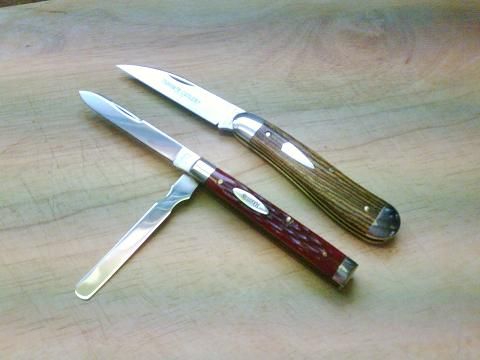
Is There a Doctor in the House?

The flat cap at the butt of the knife was what did the pill crushing. The spatula blade was used for mixing. Interestingly, if Levine is to be trusted (and he is), the spear blade was not intended for surgery, but for scooping and breaking up caked powders.

That's interesting.
 
The bottom line is that when the physician's knife came to be in the 1800's, it was designed to precisley cut pills in half or quartered, hence the very sharp blade, squared off butt cap for pulverizing pills into powder form, and a spatula which was originally intended for one to mix up a salve. That said, the design was adopted by and used by other professionals who found many other uses for it, limited only by one's imagination.
 
Last edited:
The bottom line is that when the physician's knife came to be in the 1800's, it was designed to precisley cut pills in half or quartered, hence the very sharp blade, squared off butt cap for pulverizing pills into powder form, and a spatula which was originally intended for one to mix up a salve. That said, the design was adopted by and used by other professionals who found many other uses for it, limited only by one's imagination.

Well, Levine says:

"The narrow spear blade was intended for scooping powders from vials, and for loosening powders if they got caked." Levine's Guide, 3rd Ed

with no mention of cutting pills. So, no offense intended, but, bottom line I gotta go with his take on what the spear blade was intended to be used for. :thumbup:

That said, it's a cool pattern in my opinion, and your new ones are particulary good looking. Congrats and enjoy!
 
Well, Levine might be one authority, but the hundreds of thousands of physicians who did cut pills so as to make an appropriate dose of those medications that are weight based, such as for infants and children would suggest many other uses. Do you find it odd that Levine makes no mention of those who use the spatula for reaming out their pipe bowls?;)
 
No, because his mentioned the tasks that the blades on the knife were designed for, and pill splitting and pipie cleaning are not among them. I'm sure one could use the spatula blade to pick one's nose, also...but that doesn't mean it was designed for it.
 
No, because his mentioned the tasks that the blades on the knife were designed for, and pill splitting and pipie cleaning are not among them. I'm sure one could use the spatula blade to pick one's nose, also...but that doesn't mean it was designed for it.

Perfectly understandable....your feelings, that is, about Levine. I used to feel the same way about the Encyclopedia Britannica when I was at Fordham Prep, believing everything in it was Gospel, until one of the Brothers pointed out the vast and wondrous truth that lay within the library at Fordham University, which I had privileges to. That said, I am sure that if the only reason a knife was included was to merely scoop up powdered/crushed medications, then I'm sure the designer's original intent was butchered, since a tiny scoop/spoon in place of the knife would have been most at home scooping/spooning up powders. Anyhoo, I took advantage of my Case Collector Club membership, and requested a history behind the design and intent of the physician's knife.;)
 
Perfectly understandable....your feelings, that is, about Levine.

Yes. Trusting what was written by one of the planet's foremost knife and knife history experts, who wrote "the book" about pocket knives, has never led me astray.
 
Why do you think case designed the doctor's pattern allnamvet? I've seen old ones made by other firms.

There is a variation of the dr pattern that has a small blade instead of a spatula. The small blade has a modified chisel grind perfect for splitting pills, but it also has the long thin blade. I split pills every day to save money on prescriptions and a short blade is easier than a long one.
 
Why do you think case designed the doctor's pattern allnamvet? I've seen old ones made by other firms.

There is a variation of the dr pattern that has a small blade instead of a spatula. The small blade has a modified chisel grind perfect for splitting pills, but it also has the long thin blade. I split pills every day to save money on prescriptions and a short blade is easier than a long one.

I'm not sure if it's a Case design, seeing as there were many other US brands that made a doctor's/physician knife, but I can see the need for such a knife for a doctor who made house calls, prepared elixirs, salves, or dispensed adult dosage pills to little tater tots who required smaller dosages.

Oh, and thank you for allowing me to respond to your post with my 1000th post.:)
 
A cheaper doc.

Buck%20Creek%20Doctors%20Knife%2003.jpg

Buck Creek

/ J
 
Back
Top