
Is there a fix for this?

weo

Joined
Sep 21, 2014
Messages
3,116
Hello all. I was trying to straighten a tang (after tempering this time) using Eduardo Berardo's technique and unfortunately it didn't work.

Is there any way to fix this (ie: hiring a skilled welder while wrapping the blade in a wet rag, re-heat treating, etc...)?
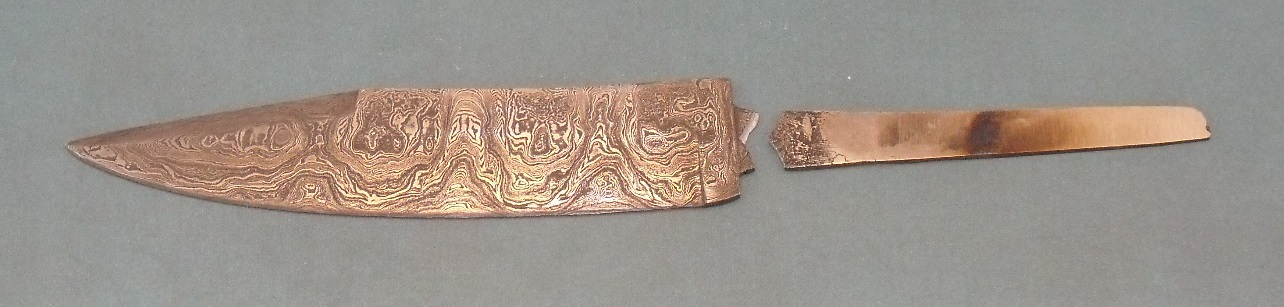
q4B65KE.jpg


Thank you
~billyO
 
I wouldn't trust any fix in that particular area in this case. Personally, that's what I would deem catastrophic failure and it would be time to start over at that point.

Bummer man. I feel for you.
 
Make a smaller blade from it? There is still plenty of material to forge a new tang out. Sure it wont have the same style ricasso/choil, but that's not the end of the world.
 
Braze the tang on, and move the rucasso forward a full inch as minimum. Do not sell it, and keep it as a user. You will need to thermal cycle the blade and re heat treat.
 
I would weld it. Most patternweld I make gets a welded tang.
 
Last edited:
Amazing what new MIG welding can do. Let a skilled MIG welder give it a go you might be surprised. Then test the hardness with a file. A good MIG welder could get this repaired and good to go. Check out Autobody shops.
 
Only thing I can see you doing is making a shorter knife. Turn the ricasso and plunge cut area of the blade into a new tang. The new tang does not need to be very long becaus you can then weld on a mild steel tang extention. I'm normally very anti welding on knife steel but let's not forget that one very famous knife maker known for Damascus welds tang extentions to his blades. The maker of whom I speak is Jim Hrisoulas, he says there is no point in wasting Damascus in the handle where no one will see It. The reasion you can do it where it broke is because that's the fulcrum point, the area that will take the most stress. But if you could get an inch or two and then weld on the rest I think you would be fine. But welding high carbon steel needs to be done right or the weld will crack.

I know I'm going to get blasted for this advice but I'm just telling you that it can be done with out sacrificing to much. I don't do it because honestly it does not take to much material to draw out a nice hidden tang. Don't worry about the plunge cut area. I would bring the tang past that and just get rid of it and bring the edge bevels all the way off the tang like a seax. Here is a picture of a seax I did to show you what I'm taking about. When done right it can look really good.
Photo%20Mar%2020%2C%2011%2016%2040%20PM.jpg


Photo%20Mar%2020%2C%2011%2019%2041%20PM.jpg


your tang ends up being this triangle shape, makes fitting guards a little more tricky but not impossible.
Photo%20Jun%2016%2C%2018%2038%2027.jpg
 
Thanks for the replies, everyone. I think I'll give it a go (maybe), I kinda like the pattern that came out. I'll post pics and an description of what I did when (if) it gets done.
 
Last edited:
If You have access to TIG welder try TIG-weld it with scrap of the damascus. Then redo HT. There will be visible difference but knife could be usable. Anyway, that is not for sell now.
 
I usually destroy a piece before putting it into the trash, but you could probably skip that step.

I wouldn't spend another minute on that.
 
Anyway, that is not for sell now.

At risk of being blocked because I don't have a knifemaker membership, rest assured, none of my knives are for sale, and only the best might turn into gifts for family/friends who understand where I am on this journey. (And I do recognize that the life span of these knives is most likely much longer than any of us....)
~billyO
 
I wouldn't trust any fix in that particular area in this case. Personally, that's what I would deem catastrophic failure and it would be time to start over at that point.

Bummer man. I feel for you.

I usually destroy a piece before putting it into the trash, but you could probably skip that step.

I wouldn't spend another minute on that.


I'm with these guys. There's no fixing a problem like that, certainly not in any way you could trust... that sucks! I feel for you man, but sometimes we lose 'em.
 
IMO it's steel. Not like your glueing the end grain of wood together. Properly welded, thermal cycled, HT, etc will be as strong as any other area.


Sent from my iPhone using Tapatalk
 
IMO it's steel. Not like your glueing the end grain of wood together. Properly welded, thermal cycled, HT, etc will be as strong as any other area.

I'm sorry, but I'm not sure that's accurate. There are many factors, but I think it boils down to a weld is cast material. It's moot in low carbon steels with higher ductility, but higher carbon martensitic steel is a different animal.

One sees welds in high hardness high carbon tool steels when repairing or building up stamping tools and plastic molds. While a very good weld may be close to the compressive yield strength of virgin metal, I don't think you'll see the toughness and crack resistance you'd want in a stressed location.

A forge weld, where the material is not taken to a liquid state, would be different. But I don't think that's what you're suggesting.
 
I'm sorry, but I'm not sure that's accurate. There are many factors, but I think it boils down to a weld is cast material. It's moot in low carbon steels with higher ductility, but higher carbon martensitic steel is a different animal.

One sees welds in high hardness high carbon tool steels when repairing or building up stamping tools and plastic molds. While a very good weld may be close to the compressive yield strength of virgin metal, I don't think you'll see the toughness and crack resistance you'd want in a stressed location.

A forge weld, where the material is not taken to a liquid state, would be different. But I don't think that's what you're suggesting.

Agreed. In tooling repair, the only time a welded repair is same/better performance than the original tool is when extra material is laid down that didn't exist in the original form, or in instances where yield strength is not a critical characteristic to the weld, such as hardfacing wear surfaces on more ductile structural material.

Even when welding ductile low carbon steels a flush full pen weld is weaker than the base material unless a filler of a higher yield strength than the base is used.
 
Thanks for the replies, all. Feel free to 'em coming. IMO this has been a good discussion and at least I'm learning something from each post.

Still thinking about doing it to give me more practice on fit and finish, and turning it into a wall hanger, but I am concerned about what may happen with it after I leave this world...
~billyO
 
I finished some knives I'll never let out of my hands for the same reason, to practice finishing and to test. Finish the knife, use it as a mule. Want to try sharpening in your grinder? Use the mule to practice. Convex edge? Try the mule. Etc. By time you're done and gone there won't be anything left of it for anyone to do anything but scrap.
 
You might try hard silver soldering to get it back together rather than having to get it done out of shop. This requires heat about 1450 degress.
Frank
 
I'm sorry, but I'm not sure that's accurate. There are many factors, but I think it boils down to a weld is cast material. It's moot in low carbon steels with higher ductility, but higher carbon martensitic steel is a different animal.

One sees welds in high hardness high carbon tool steels when repairing or building up stamping tools and plastic molds. While a very good weld may be close to the compressive yield strength of virgin metal, I don't think you'll see the toughness and crack resistance you'd want in a stressed location.

A forge weld, where the material is not taken to a liquid state, would be different. But I don't think that's what you're suggesting.

He can move stressed location forward if he grind some steel /say 5mm./ and if he make good fit bolster ,weld will bi inside bolster or behind them . When we try to test break blade in vise where they break ?
 
Back
Top