Is there a point to the point?

Mack

Expert Ultracrepidarian
Platinum Member
Joined
Aug 19, 2007
Messages
39,130
In looking at Chef's knives I notice that for most the blade is pointed. I understand this shape for a fillet knife but I'm not understanding its function in a cook's knife. I look at a Wharncliff blade and see that as an efficient cooks knife blade shape. Is it balance, weight?
What am I missing? What do Chefs use the point for?
 
Last edited:
I use the point to take the tough center (stem base) out of a tomato before slicing it.

DancesWithKnives
 
points can be useful for all sorts of things, piercing packaging, scoring things, finer detailed cutting
 
I use the point to take the tough center (stem base) out of a tomato before slicing it.

DancesWithKnives

I use the point for this as well. The point isn't needed persay, but knifes, IMHO, look better with a point than rounded. It can also make little things easier, which doesn't have to deal with cooking itself.
 
I use the point for this as well. The point isn't needed persay, but knifes, IMHO, look better with a point than rounded. It can also make little things easier, which doesn't have to deal with cooking itself.

Interesting. I was just discussing this with the boss and we both think the Wharncliff is best for us. We don't seem to use the point and she has a habit of sticking points into her fingers.
 
Why remove a potential function just because you might not need it? It's not hurting anything being there, and you may just find a situation that it really helps out on. If you are poking yourself with the tip of your knife during use, then you need to modify your technique, not the knife.
 
I've stemmed tomato with a suntoku (sp?) Japanese-style kitchen knife, which is a bit like a Wharny. I could do it with even a blunt Wharny by halving the tomato, then notching out the stem segments. It would just require a few more motions.

I'd just as soon keep the tip on my chef's knives.

DancesWithKnives
 
I'm hoping the some folks are not confusing a wharncliffe with a sheepsfoot blade. One of the main points,no pun intended, of a wharncliffe is very controlable point. A sheepsfoot on the other hand has an almost inperceptable point.

A popular blade shape used by Jens Anso on his model 67, Mike Obenauf on his model 3 or Todd Begg on the Glimpse, et al is the modified wharncliffe where the blade has a mostly flat edge leading to a very slightly upswept edge to the point.
 
Yes, I've seen a number of really pointy Wharns. I'm assuming protourist's references were to something with a blunter tip like the Suntoku or sheepsfoot.

DancesWithKnives
 
Excellent for removing avocado pits. Insert the point, twist, and pull. The main advantage of a French- or German-styled chef's knife is that a well designed one can do EVERYTHING. The whole point is versatility, and a point makes it more versatile. I find myself using the point on mine quite frequently for a variety of tasks.

P.S. Wharncliffe blades are always very pointed. That's the key difference between wharnies and sheepsfoot blades, which have a rounded tip.
 
Coring tomatoes/peppers, opening packages, poking vent holes in stuff. All of these tasks are easier with a pointy blade.

My utility blade has a very controllable point on a wharncliffe blade. I also prefer my chef blade to have a point. I'm even making a cleaver for a friend that has a clip-point. He likes having a precision point, even though he prefers a cleaver shape.

I consider a chef knife to be a multi-use blade shape. The more tasks it can perform easily, the better.

I have a hard time imagining that someone would poke themselves with a chef knife. I'd be much more worried about slicing myself with that razor-edge (a rare occurrence anyway).

Phillip
 
Actually I did mean a Wharncliffe. A small point is always desirable. I suppose what I am really meaning is the taper to a point. I looked at the Santoku style and that is more to my liking.
When I said she sticks herself, she has a bad habit, as many non-knife knuts do of not paying close attention and sticking herself when reaching for it. On her behalf I will say she has horrible vision and perhaps that is the problem. No depth perception.
Anyway, I appreciate the responses.
Thanks!
 
Actually I did mean a Wharncliffe. A small point is always desirable. I suppose what I am really meaning is the taper to a point. I looked at the Santoku style and that is more to my liking.

Do you mean the distal taper, or the profile? I admit that the point on a chef knife is pretty thin due to the distal taper. I don't like to use it to do things like opening cardboard packages because of it.

On my kitchen utility blades, I use a partial flat grind with no distal taper. This significantly reinforces the tip. Here's what I mean:

2825998780_a737794fee_o.jpg


The wharncliffe design is very easy to control and puts most of the pressure on the point when slicing. As a result, the tip will wear faster than the rest of the edge. I haven't decided if that's a good thing or not.

If I were to make myself a santoku-styled knife, I would probably give it a bit of a clip-point (as opposed to sheepsfoot). This would keep the balance similar, while providing a precision tip. This would reduce (but not eliminate) the amount of times I would have to pick up the paring knife.

Phillip
 
in my limited experiance of cooking I find it useful to have the tip for stuff like removing the center stalk from a pepper (which we then achieved to clean out and stuff IRRC), and also for opening the packaging on stuff like supermarket bought meat, in the polythene trays.
 
Do you mean the distal taper, or the profile? I admit that the point on a chef knife is pretty thin due to the distal taper. I don't like to use it to do things like opening cardboard packages because of it.

On my kitchen utility blades, I use a partial flat grind with no distal taper. This significantly reinforces the tip. Here's what I mean:

2825998780_a737794fee_o.jpg


The wharncliffe design is very easy to control and puts most of the pressure on the point when slicing. As a result, the tip will wear faster than the rest of the edge. I haven't decided if that's a good thing or not.

If I were to make myself a santoku-styled knife, I would probably give it a bit of a clip-point (as opposed to sheepsfoot). This would keep the balance similar, while providing a precision tip. This would reduce (but not eliminate) the amount of times I would have to pick up the paring knife.

Phillip
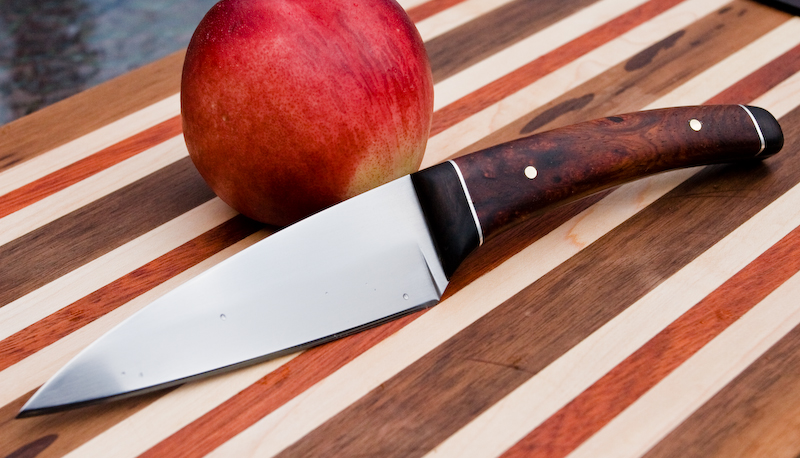
I love the knife pictured here. And I see the point.:foot::D
The chef's knives I was referring to for example the one I use now
754.jpg

Taper to a point both on top and along the edge.
To me the Wharncliffe seems a better design with it's flat cutting edge and the flowing taper on top.
 
Many folks like to be able to rock the knife on a slightly curved edge when mincing, etc. With a totally flat Wharny, you'd lose that option. However, I'll bet that totally flat edge would chop like crazy!

DancesWithKnives
 
I've never been hindered from the lack of a hugely pointy tip on my shun santoku. I can get anything in the kitchen done with it for the most part. The tip is enough to score meat effectively, open packages, etc. The more humped blade has its advantages in mincing and transferring foods into the pan.

To remove avocado pits, I use alton brown's method. Cut the circumference of the avocado, twist, take the piece with the pit and lightly chop the blade into the pit, then when the blade is stuck in the pit just turn the knife.
 
One great thing about the group we have here is that even when an idiot like me asks a question it gets answered. These answers give me a lot of other ways to look at what I want in a Chef's knife.:thumbup:
Thanks guys.
 
It all comes down to personal preference. I've learned a lot experimenting with different designs.

I have a hard time cutting with a perfectly flat blade. The blade must be perfectly flat against the board to finish the cut (especially with tough-skinned foods); either that, or you must slide the point though, with just the point contacting the board. On short blades, it's pretty easy to just keep the point down and slice, but it gets awkward as the blade gets longer. With this technique, the point wears quickly, but the rest of the blade stays very sharp.

The traditional chef knife has a belly and the blade is either rocked or sliced with. The belly of the blade is in contact with the board most of the time and sees the most wear. This wear is more distributed and, (for me), easier to sharpen out. Too much of a belly makes it awkward to put the tip in contact with the board.

There are also concerns not relating to cutting, such as scooping up food (as DWK mentioned).

I recommend sitting down with some paper and trying to design the perfect kitchen knife for you. You could even make some wooden mock-ups. It is an interesting mental exercise that forces you to analyze how you use a knife. I certainly didn't get it right on my first try, (the wharncliffe pictured earlier), but I learned a lot.

Phillip
 
Back
Top